At the inaugural design summit for OpenStack, an open source set of technologies for building clouds, Nebula’s chief architect Josh McKenty played a prominent role in leading the assembled folks. I caught Josh during a break and chatted with him about Nebula and NASA’s role in the newly announced OpenStack project. Here’s what he had to say:
Some of the topics Josh tackles:
What is Nebula (hint: NASA’s, primarily IaaS, cloud computing platform)
The history of Nebula and how it morphed from nasa.net.
Why NASA wants a cloud – and the importance of having an elastic set of resources.
NASA and Nebula’s use of open source and how it has evolved (they don’t simply fling tarballs over the wall anymore and they can use licenses other than the “NASA open source agreement”)
A match made in heaven: NASA has put together a strong compute platform and was looking to building a real object store, Rackspace had a strong object store and work looking for a new compute platform.
Today at E3, OnLive Inc is kicking off the roll out of its cloud gaming service. OnLive, whose motto is “Just Play,” leverages broadband and the cloud to deliver on-demand gaming titles directly to users’ PCs, Macs or even TVs.
Square Enix's Batman: Arkham Asylum -- one of the first batch of games available from OnLive
This new service could prove to be a real “game changer.” As Dell Data Center Solutions director Andy Rhodes, helping with the launch at E3 explains, “I see it as the start as of a move of processing power from consoles into data centers…from the center of the living room into the data center.”
Building the OnLive Cloud
So what’s behind this gaming cloud, Dell of course 🙂 (well, at least a good part of it). The Dell Data Center Solutions (DCS) group began working with OnLive a few years back to design and build custom-tailored systems for the OnLive platform.
The problem statement for the solution was to create an infrastructure that supported the streaming of HD-quality video game over the internet, drove down the total cost of ownership and allowed OnLive to scale quickly as the company grows. The DCS team worked directly with the folks from OnLive to architect an ultra-dense and uber-power efficient infrastructure solution designed around OnLive’s super secret hardware components and software. Thousand of these customized systems are now deployed at OnLive data centers around the country.
Plug and Play Racks
By leveraging the DCS supply chain and fulfillment chops, Dell is able to deliver pre-integrated fully racked solutions that can be hooked up and powered on within hours of arriving at an OnLive data center. Going forward Dell will continue to work with OnLive to create new infrastructure architectures for future generations of the service.
Game on! (and on, and on and on)
Electronic Arts' Mass Attack 2: available via OnLive
Who’s on First?
The initial batch of 23 titles available to OnLive subscribers include:
Over the past week I have presented Dell’s thoughts and capabilities around cloud computing to several different groups from the U.S. military. In preparation for these talks I did some research into what’s happening in the wild and wonderful world of federal cloud computing. Here are a couple things that I found particularly interesting:
Psych!
In the past I have used the General Services Administration’s cloud RFQ issued last July, as an example of how the government is boldly sallying forth into the cloud. Turns out that in February they withdrew the RFQ saying basically that too much had changed since the RFQ was issued and that they need to regroup and get a solid view of the customer and market landscape before writing a new one.
Speaking of snags, Apps.gov which was launched last September as “an online technology supermarket for federal agencies” has not been the success that Federal CIO Vivek Kundra had hoped for. According to the WSJ, “concerns about compliance with security requirements and terms of service have prompted many agencies to bypass Apps.gov.”
But wait, there’s more
The above being said, the US government has a ton of cloud projects its working on. To get smart on the littany of efforts, check out the State of Public Sector Cloud Computing report that Vivek Kundra issued last week.
Stay tuned for my next entry that will talk about how the Military is “forging” ahead.
When I was out in the Bay Area for our launch I stopped by data warehouse and analytics player Greenplum. Greenplum is one of the first three members in our Cloud Partner program (the other two are Canonical and Aster Data.) I sat down with Greenplum’s President and founder Scott Yara to talk about the company and where they’re going:
Some to the topics Scott tackles:
Whats happening in the world of data.
How Greenplum began with the open source PostgreSQL database platform and over the last 7-8 years have refactored it and built a massively parallel database kernel engine.
How it works: Greenplum takes the data and physically distributes it across all the Database segments and operates on the data in parallel. This parallel approach allows Greenplum to process data 10-100x faster than conventional databases.
Who is using it: Skype, Fox Interactive, NTT docomo, Deutsche Bank, retailers, large healthcare companies.
The enterprise data cloud initiative – Setting a new type of analytics infrastructure that takes advantage of virtualization and the latest in general purpose and multi-core systems and is centered around self-service principles.
While a lot of folks are excited about writing apps to the iPhone, the platform that Scott and crew gest really excited about writing to are 2 socket Nehalem servers with a bunch of disk drives behind them.
How someone would go about getting started with Greenplum.
Last month when I was out in the Bay Area for our launch, I stopped by the offices of salesforce.com. I visited with some folks that I used to work with in a past life and then grabbed some time with Salesforce’s VP of product marketing, Sean Whiteley.
Here is what Sean had to say:
Some of the topics Sean tackles.
The idea behind salesforce.com (SFDC): In 1999 founders Marc Benioff and Parker Harris looked at Amazon and wondered why businesses couldn’t manage and get insight into their customers with the same ease as they interact with their favorite website.
Given that SFDC is built on a model of “multitenancy” how do they address security concerns when they are brought up.
Force.com: what it is and how it came about. Also the advent of AppExchange, where you can shop for applications that let you extend the cloud applications that you use to run your business.
What salesforce.com and Dell are doing together to address small and medium businesses: providing a business in a box, helping organizations focus on their core business rather than IT.
Last but not least in our tour of the first flight of servers in Dell’s PowerEdge C line is the C2100. This was filmed last month at our launch right after we closed down our whisper suite. Click below and join solutions architect Rafael Zamora as he leads you through the thrills, chills and spills of this cool new machine.
Spoiler Alert! A few Highlights
This machine is a great high performance data analytics and cloud optimized storage server. It’s perfect for use in conjunction with software from our Cloud ISV partners Joyent, Aster Data, Canonical or Greenplum.
The entire front can be jam-packed with disk drives for mega storage. You can get up to 24TB by loading twelve 3.5inch 2TB drives.
While the C2100 has same system board as the C1100, it comes with twice the real estate in a 2U form factor.
There’s even a platform for two additional drives that you can use for a bunch of different purposes such as separating production and non-production traffic.
As part of the CIO series we are doing with Information Week, I did a webinar on Wednesday called The Journey to the Cloud. If you want to get a feel for some of the big issues and ideas addressed during the webinar, check out moderator Fred Paul’s entertaining blog entry. Here is the deck I used:
If you’re interested in listening to the webinar you can get access to it here (you will need to register). I spent about 20 minutes on the presentation and 30 minutes fielding questions from the audience. One question submitted that we didn’t have time to answer was why Fred Paul and I both have first names for last names. That will have to wait for another webinar.
Our first Cloud white paper is now available and I’m really happy with the way it turned out. Being relatively new to Dell I didn’t know if I would be “compelled” to mention product in it or not but I’m happy to say that the paper focuses solely on the trends behind, and characteristics, of cloud computing . I want to give a big shout out to Intel who helped to fund this and also didn’t insist that we mention their products. 🙂
This first paper is a short and basic introduction to cloud computing. We are working on a follow-up that will pick up where this leaves off and dives deeper. Stay tuned.
If you’re wondering about the funky game show-like setting, I shot this after hours on the day of our launch in the whisper suite. Your guide, as before, is the incomparable Dell Solutions Architect, Rafael Zamora.
A few highlights
The C1100 is a high memory, cluster optimized, compute node
Dont let its slim pizza box looks fool you, upfront you can pack either four 3.5 inch drives or ten 2.5 inch drives.
For high memory optimized compute you can get 18 DIMM sticks for 144GB of RAM.
Comes with your choice of either Intel’s Nehalem or Westmere processors.
Raf also gives a couple of examples of recent customers and how they’ve decide to configure their units.
I recorded this interview with David Lang earlier this year and have been meaning to post it for the longest time. David is Dell’s program manager for federal security which means he is charge of the team that supports the security requirements for all Dell’s businesses that faces the federal government. He’s based in DC but I was able to grab a bit of his time when he was out visiting Austin.
David’s interesting background: he spent many years as a special agent in the air force doing computer and espionage investigations and how this lead him to the cloud.
How David addresses questions around cloud security and what type of environments you find in federal space.
The balancing act between availability, security and cost and where Homeland Security would want to use the public cloud.
I was recently in Las Vegas for Dell’s annual kick off where the sales force learns all about the cool products we have on tap. Not only were there tons of presentation sessions, there was a full expo area with both Dell and partner booths.
In the Cloud Infrastructure Solutions booth I got to act as the official “ShamWow” guy, giving our pitch (over and over and over).
I must have done the spiel literally 50 times over the three days. But the crowds were great so I wasn’t complaining (much 🙂 ).
The Friday before last my boss Andy and I had a call with James Niccolai of IDG. We chatted about what we’ve been up to at Dell as well as teed up what we have in store for the near distant future.
To get the full scoop you should read the articles but here are some summary bits from the PCworld article:
The DCS [Data Center Solutions] unit was formed about three years ago to help Dell get more business from large Internet firms. Its engineers often spend several weeks on-site with those companies to design low-cost, low-power systems that meet the special requirements of their search, social networking and other Web applications.
That hands-on role means the DCS group designs servers only for large companies, such as Ask.com and Microsoft’s Azure division, which order tens of thousands of servers per year. But that’s about to change, Dell executives said in an interview.
Later this year Dell will turn some of those custom servers into standardized products and sell them to companies that order lower volumes of systems, including enterprises building “private cloud” environments in their data centers, and a second tier of smaller Internet companies.
“What we’ve found is, there are a whole bunch of other customers who want access to those designs but who are not buying in those types of quantities,” said Andy Rhodes, a director with Dell’s DCS group. “So the big thing we’re solving now, and we’ll talk more publically about over the next couple of months, is how to provide more of that capability to many, many more customers.”
Here is the second in my three part series on Virtualization and the cloud. Today’s entry focuses on the 800 pound gorilla in the virtualization space, VMware.
What VMware is seeing customers actually doing to take advantage of the cloud today both with regards to public and private clouds.
Some polling data he collected during his talk based on the ~300 folks who attended: 90-95% were virtualizing, 15% had an active private cloud project, 5-10% had a public cloud project. (This is pretty representative of what Dan’s generally seeing.)
The three phases of cloud:
Phase I: Standardizing and virtualizing an environment.
Phase II: Adopting private cloud from a management stand point: getting to self service and automation in terms of provisioning a new service/collapsing the time it takes to get a new image out to an end user or developer from weeks to minutes/ implementing charge back, dynamic capacity planning and management.
Phase III: Thinking about or planning how to leverage the public cloud in a fully compatible way.
A short history of VMware: how they’ve moved from desktop and server virtualization to VM management and optimization to enabling their platform for private clouds and public cloud providers.
Their “recent” acquisition of Spring Source and how it fits in.
Stay tuned next time for a summary of Gartner’s virtualization presentation from their data center conference.
Last month at the Interop/Web 2.0 I was able to drag Citrix’s Roger Klorese away from booth duty for an interview. Roger is a Sr. Director at Citrix who works on Xen server and the Essentials product family. Here is what he had to say:
Some of the topics Roger tackles
What Roger has been focusing on this year — Free Xen server. Launching the offering (there have been 200K downloads this year)and then bringing more features into it. What comes with it for free and what are add-ons that you get thru the Essentials family.
In the networking space Citrix announced a version of their netscaler app delivery server as a virtual appliance.
Managing “OPVs” (other people’s VM’s)
What Roger is most excited about:
Growing the datacenter into the cloud — Xen.org recently released the Xen cloud platform which is a full cloud distro, with a management stack based on open sourcing the Xen server stack.
Early next year they are releasing the Xen client type 1, a bare metal client hypervisor.
A couple of weeks ago I was in New York to visit customers and attend the co-located Interop and Web 2.0 events. One of the attendees/participants I got to know there was Joe Weinman, VP of ATT’s Business Solutions. Joe has been focusing a lot on the cloud lately so I thought I’d put down for posterity his thoughts and explanation of what ATT is up to in this space.
Some of the topics that Joe tackles:
ATT’s evolving strategy involves mix of managed endpoints and a variety of network services as well as a variety of services in the cloud.
ATT’s services range from infrastructure services like “Synaptic hosting,” storage as a service and compute as a service thru a variety of SaaS apps like unified comms and collaboration, SAP, Oracle ebiz suite, Seybold and JD Edwards.
They have a large platform as a service offering that is used by tens of thousands developers creating at mobile enterprise apps.
They target a wide variety of endpoints e.g. iphones,windows mobile devices, netbooks, black berries all the way thru tele-presence rooms.
How ATT delivers on both front end and back end architectures.
With today’s post, I’m right at the mid-point of my series of video interviews from Cloud Computing Expo. Today’s post offers a two-for-one special, Gluster CEO Hitesh Chellani along with Jack O’Brien who heads Gluster’s product management.
Some of the topics Hitesh and Jack tackle:
Gluster as a general-purpose open source cluster platform that runs on top of commodity hardware like Dell.
Their goal to transform the storage market the way Red Hat transformed the server market (Gluster employs a subscription model just like Red Hat).
What would you do after spending time at Lawrence Livermore National Labs putting together the second fastest super computer in the world? Hitesh thought he’d distill the experience and apply it to the storage space.
Some of the performance-driven verticals Gluster started out in.
The new hot area of virtual storage next to virtual servers.
Kicking off my series of videos from last week’s Cloud Expo in Santa Clara, here is a chat I had with Oren Teich, of Heroku. Heroku, if you’re not familiar is a 2-yr old Platform as-a-Service company targeting Ruby developers. Oren recently joined Heroku as their head of product management and had the following to say:
Some of the topics Oren tackles:
Where the name “Heroku” comes from and why they were going for a Japanese sounding name.
Why did they choose Ruby and why did they go with a cloud-based plaform?
How Heroku is similar/different from Google App Engine and Engine Yard.
The majority of the folks who have created the 39,000+ apps on the site are hobbists. That being said, the folks who pay their bills are those who are creating social media apps for platforms like Facebook, Twitter and the iPhone.
How Heroku makes their money: they charge as you scale and they charge for add-ons.
What they plan to concentrate on in the year ahead
Yesterday Gartner distinguished analyst Tom Bittman, who covers cloud computing and virtualization, posted some thoughts and observations from the Gartner Symposium in Orlando.
Private Cloud-o-maina
Based on Tom’s observations, private cloud (however defined) seems to have captured the hearts and minds of IT. Before he began his talk on virtualiztion he did a quick poll asking how many in the audience considered private cloud computing to be a core strategy of theirs. 75% raised their hands. While not overly scientific, that’s a pretty big number.
Little Miss Appropriation
The logical next question one may ask is what do people mean when they say “private cloud.” According to Tom the three most common ways private clouds are being (mis) described are:
IT defending its turf: Shared services that were being re-labelled as private clouds (but without a self-service interface, or much automation at all)
Vendors defending their products: Old products being re-labelled as private clouds in a box (I described most of these as “lipstick on a pig”)
Advanced server virtualization deployments: Although few have a true self-service interface, the intention is certainly there
So it looks like there is quite a bit of misappropriation of the term. However, as we previously learned, just because there is hype and misuse of terms, doesn’t mean there isn’t value in the concept of “private cloud.” The question is what is that value?
Tom sees private cloud’s value as a means to end and concludes his post by saying
The challenge with private cloud computing, of course, is to dispel the vendor hype and the IT protectionism that is hiding there, and to ensure the concept is being used in the right way – as a stepping-stone to public cloud… [italics mine]
(I’m not your) Stepping Stone
This is where I disagree. I believe that while private cloud can be a path to the public cloud, it can also be an end unto itself. Unfortunately (or fortunately) we will always have heterogeneous environments and in the future that will mean a mixture of traditional IT, virtualized resources, private clouds and public clouds. In some case workloads will migrate from virtualizaiton out to the public cloud but in other cases they will stop along the way and decide to stay.
IT will become more efficient and more agile as the cloud evolves but there will be no Big Switch (see above illustration), it (IT) will need to manage a portfolio of computing models.
Just a little while ago Steve Shankland posted an article from the front lines of the Gartner Symposium ITxpo in Orlando. The article is based on a presentation given today by Gartner addressing the top 10 trends that will be coming in IT in 2010.
And what found itself moving up two spaces from last year and claiming the top spot? Cloud computing.
Gartner’s cloud advice, notes Shankland, is
…companies should figure out what cloud services might give them value, how to write applications that run on cloud services, and whether they should build their own private clouds that use Internet-style networking technology within a company’s firewall.
(On a side note, it’s interesting to see that last year’s leader virtualization has been tri-sected into: Client Computing, Reshaping the Data Center and Virtualization for Availability)
Back on top
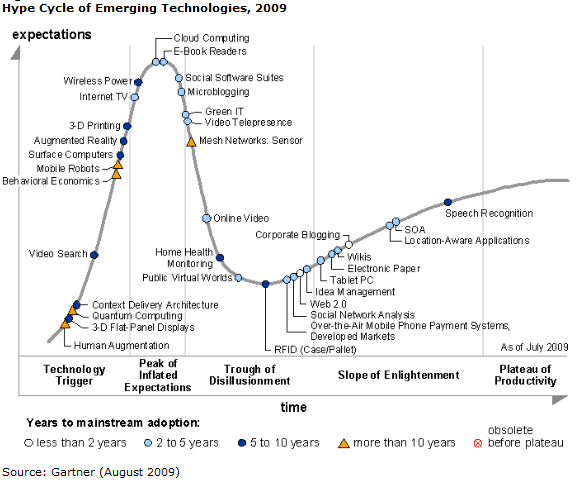
Being at the top of a Gartner chart is nothing new for Cloud Computing as you can see in this Hype Cycle from a couple of months ago:
So I guess the moral of this story is, just because something is over-hyped doesn’t mean its still not important. Ignore the cloud at your peril 🙂
Pau for now…
Endnote: A word from our sponsor
If you happen to be at the Gartner event and you want to see Dell’s take on the cloud, check out Tim Mattox’s presentation tomorrow at 3:30 – 4:30: Leveraging the Cloud to Reduce your IT costs.
Last Friday I got together with Michael Cote of Red Monk and John Willis of Canonical for a podcast. We met up at a nearby coffee shop and chatted about a whole bunch o’ stuff.
You can listen to the actual podcast on Cote’s blog.
Dell’s cloud building business, focused on a small group of hyper-scale customers (Azure and Facebook being a couple I can name), delivering a high volume of highly customized machines for these customers.
Some of the learnings we’ve gained with working with this group.
Our intent to take this effort to a much wider group of customers and offer complete cloud solutions made up of hardware, third party software, a reference architecture and services.


 Posted by Barton George






 Barton's Blog