The week before last Dell EMC held its first Dell EMC World here in Austin. The event was full of keynotes, breakouts and Dell EMC and partner booths. On the expo floor a stage was set up where partners and various Dell EMC employees, from Michael Dell on down, were interviewed as a part of Dell EMC World Live.
I was fortunate enough to participate in two of the live sessions, one about speeding up app development for the digital enterprise, and the one embedded below. The session below was entitled “Stop Hitting Yourself. Tips for Succeeding at Digital Transformation” and featured Richard Seroter and Michael Cote of Pivotal as well as myself.
Check it out
Some of the ground Cote, Richard and I cover
How Uber delivered a Digital-transformation wakeup call to ordinary enterprises
Evolving your business to being a software-enabled business
It’s not about software for software’s sake, it’s about developing a more intimate relationship with the customer
The last 20 years for IT has been about driving efficiencies rather than improving the customer relationship
Moving from silos to platforms
Often support will come from the CEO down and the developers up but it’s the those in the middle who have the toughest time
Extra-credit reading
Speeding Up App Development for the Digital Enterprise – A conversation – Barton’s Blog
Last week over 9,000 people attended the first Dell EMC world here in Austin. As you would expect there were keynotes, breakout sessions and an expo floor. On the floor itself, besides the various Dell EMC and partner booths, was an area set up for Dell EMC World Live.
Dell EMC World Live featured a full roster of live interviews on a variety of topics with everyone from Michael Dell on down. One of the two sessions I was fortunate enough to participate in was “Speeding Up Application Development for the Digital Enterprise.” My co-conspirator was Trey Layton, CTO and SVP, Converged Platform and Solutions Division in Dell EMC.
Take a listen
Some of the ground Trey and I cover
The challenges of moving to a cloud-native architecture and the need for software to become a core competency of today’s enterprises.
The use of company names as verbs e.g. “don’t get Uber-ed”
“Two pizza” teams vs. hundreds of developers
The “Square of Despair” — Complexity, Procurement, Legacy and Security
The need to abstract the complexity of the infrastructure away from developers so that they can focus on writing code
Today, on the 59th anniversary of the launch of the Sputnik satellite, the 6th generation XPS 13 developer edition makes its debut in both the US, Canada and Europe. This Kaby Lake-based system comes with Ubuntu 16.04LTS preloaded and features the InfinityEdge display.
A Quick Refresher
As you may remember, these systems began life four years ago as Project Sputnik, an open-ended exploratory project. From the very begining, the effort was designed to solicit and incorporate input from the developer community as to what they wanted in a laptop.
Courtesy of nasaimages
With the community’s input, Project Sputnik became an official product and continues to evolve. Recently, as the ultimate honor, Linus Torvalds selected the XPS 13 developer edition as his mobile laptop.
Additionally, as a happy by product of the program, an initial investment of $40,000 from an internal innovation fund has turned into in tens of millions of dollars in revenue, helping to keep the effort humming along 🙂
Thanks everyone for all your support!!
Specifications — Next gen XPS 13 developer edition
Here is what the 6th generation developer edition (9360) features:
7th generation Intel® Core™Processors
Ubuntu 16.04 LTS preloaded. Augmented with the necessary hardware drivers (drivers are upstreamed to allow a variety of distros to work)
Killer Wireless cards*
InfinityEdge™ display, FHD (1920×1080) and QHD+ (3200×1800) versions available
*Killer cards are a branding of Qualcomm Atheros. Their Linux drivers are open source and the firmware is now upstream.
US Configurations
As was the case last time, the US is offering four configs. This time around we are offering the following (including one in Rose Gold):
i5/8GB/128GB, FHD – $949.99
i5/8GB/256GB, FHD – $1,349.99
i7/8GB/256GB, QHD+ (touch) – Rose Gold – $1,599.99
i7/16GB/512GB, QHD+ (touch) – $1,799.99
You’ll find the XPS 13 developer edition collocated with Windows version on the following page. The easiest way to see the Ubuntu line up is to select “Ubuntu” in the “Operating System” pull-down menu on the far left.
The following configurations are available both online and offline in Europe. All of three of the XPS 13 developer edition configurations come with the Killer Wireless card and international keyboards can be selected.
i5/8GB/256GB, FHD
i7/8GB/256GB, QHD+ (touch)
i7/16GB/512GB, QHD+ (touch)
Where to order your system
As is the case in the United States, both versions of the XPS 13, Ubuntu and Windows, are featured on the same product page. Click on the country name below and it will take you to the XPS 13 landing page. Once on the page, you can get to the Ubuntu-based configs by scrolling right to the last three systems.
If you’re not familiar with it, Red Hat’s Ceph storage is a distributed object store and file system. To support its deployment on the Dell EMC PowerEdge R730XD, a team from Dell EMC recently put together a white paper that acts as a performance and sizing guide.
In the first video below, Amit Bhutani of Dell EMC’s Linux and open source group explains Ceph and takes us through the test environment that was used to create the deployment guide. Video number two stars Valerie Padilla from Dell EMC’s server solution CTO team. Valerie gives an a high level view of the white paper and the five categories of the results.
Earlier this summer I was out in Seattle for DockerCon. Among the people I interviewed was Taylor Brown of Microsoft. While Microsoft may not be the first company you think of when talking containers, they actually have a bunch going on. Taylor in fact leads the team focusing on the server container technology coming out of Windows e.g. Hyper-V containers and Windows server containers.
Taylor and I sat down and he took me through what his team has been up to and their goals for the future.
Take a listen
Some of the ground Taylor covers
Taylor and his team support customers running Windows on Azure, Amazon, Google and others.
The team has been working closely with Docker and the community contributing code to allow Docker to work with Windows
Windows Server 2016 will come with full container support
Following on Azure’s container services with Linux, they’re adding Windows support
Goals for the future: performance and scaling are a big focus; security around authentication and authorization; also thinking about Linux containers on Windows
Extra-credit reading
Docker’s Close Integration with Windows Server – Redmond magazine
Microsoft PowerShell Goes Open Source, Arrives On Linux, Mac – InformationWeek
VIDEO: Ubuntu comes to the Windows desktop — OpenStack summit – Barton’s Blog
Last but not least in my series of interviews from SpringOne Platform stars Brain Roche of EMC. Brian heads up engineering for EMC Dojo, headquartered in Cambridge Massachusetts. The dojo, which has been around for a year, teaches modern software development practices based on DevOps and focuses on Cloud Foundry.
Take a listen as Brian talks about the dojo, how it works and where it’s going.
Some of the ground Brian covers
Teaching pair programming, extreme programming and more with the goal of showing customers and partners how to rapidly deliver software in the modern world to better serve customers.
Qualifying as a Cloud Foundry dojo by contributing to a Cloud Foundry sanctioned open source project.
The dojo’s qualifying project is RackHD which acts as a cloud provider interface, providing and management and orchestration layer to run Cloud Foundry on bare metal.
The goals for the dojo going forward including expansion and evangelism.
A couple of months ago at the Cloud Foundry summit I tried to grab Sam Ramji, CEO of the Cloud Foundry Foundation, to do a short interview. Unfortunately the stars didn’t align and it didn’t happen. At SpringOne Platform however I had better luck.
Sam, who lead off the keynotes on day two, sat and talked to me about Cloud Foundry’s origins, what’s going on today and what its goals are for the future.
Take a listen
Some of the ground Sam covers:
Cloud Foundry began at VMware in 2009 and was open sourced back in 2011. The foundation itself was set up a year and half ago.
CloudFoundry.org wa established to increase the velocity of contributions (over the last year, over 2000 individuals outside of the core companies have contributed.)
While they want to grow the foundation, they need to be thoughtful on how they grow.
What drew Sam to the CEO opportunity and the role that APIs and Warner music played in his decision.
The foundation’s goals: 1) increase diversity of contributions, 2) increase the foundation’s population, predominantly via end users, 3) determine how best to build a framework that will allow to the effort to survive and thrive over the next 20 years.
Extra-credit reading
Talking Cloud Foundry Foundation – OpenStack summit Austin – Youtube
SpringOne: The Spring Platform, Where its Been and Where its Going – Barton’s Blog
SpringOne: Native Hybrid Cloud — The Pivotal Cloud Foundry Developer Platform in a Box – Barton’s Blog
SpringOne: When Web Companies grow up they turn into Java Shops –Barton’s Blog
Early this month, armed with my trusty Flipcam (and oldie but a goody), I attended SpringOne Platform hosted by by Pivotal.io. While there I was able to grab a few interviews with some of the movers and shakers. Given that the title of the event was “SpringOne,” I would have been remiss had I not grabbed one of the Spring community leaders. I was able to convince Spring Framework developer, Rossen Stoyanchev of Pivotal to chat with me.
Take a listen as Rossen talks about the history and evolution of the Spring Framework.
Some of the ground Rossen covers
Spring Framework’s birth 12 years ago and the role of Rod Johnson’s book
Providing tools that simplify and symbiotically work with Java Enterprise
Additional Spring Projects e.g. Web Frameworks, Spring Integration, Spring Batch
The debut of Spring Boot in 2012 and the quick follow up by Spring Cloud which extended programming to new models
Where Spring is headed: reactive programming and much more
Extra-credit reading
Expert One-on-One J2EE Design and Development – Rod Johnson
A few weeks ago at Pivotal’s SpringOne Platform event I met Drew Dimmick of EMC. Drew heads up product management for EMC’s Native Hybrid Cloud offering. Native Hybrid Cloud, or “NHC” is a complete shrink-wrapped Pivotal Cloud Foundry developer platform that can be set up in as little as two days.
I grabbed some time with Drew and had him take me through the offering at a high level.
Here is what Drew had to say:
Some of the ground Drew covers
How NHC cut set-up time from weeks to days and provides a single-vendor solution
Today’s stack is composed of: VxRack with Neutrino nodes + Pivotal Cloud Foundry with metering, monitoring billing etc, all siting on top of OpenStack
There are couple of other NHC flavors wating in the wings:
Pivotal Cloud Foundry + VMware’s VxRail solution sitting on top of vSphere (today half of all Pivotal Cloud Foundry implementations sit on top of vSphere)
Further out, a version featuring VMware’s Photon platform which customers could choose in place of OpenStack
Earlier this month I attended Pivotal’s SpringOne platform conference in Las Vegas. In case you’re not familiar with it, Spring is a Java Framework “that helps development teams everywhere build simple, portable, fast and flexible JVM-based systems and applications.”
For some of you out there you may be thinking Java is old school and not relevant in in today’s modern world of digital business. Au contraire mon frere. James Governor, the D’artagnan of the analyst world, countered this belief of irrelevance in his SpringOne talk entitled, “When Web Companies grow up, the become Java Shops.”
Take a listen as James backs up his claim. (For extra credit see the Redmonk Programming Language Rankings below that places Java in the top right corner second only to JavaScript. Click on the chart to enlarge the rankings).
Some of the ground James covers
Facebook as a big Java shop. Twitter as a member of the JCP (Java Community Process)
Seeing a lot of Java innovation even outside of Android
Big Data e.g. Hadoop written in Java/JVM
We will see cloud native Java in the next 3-5 years
In the last two weeks I’ve had the opportunity to participate in two podcasts. The first was the wild and wacky Lunduke & Whatnot (with Matt) show where System76 founder CEO, Carl Richell and I talked with our hosts about pre-loaded Linux laptops.
In the second, which was recorded last week at SpringOne platform, Michael Cote hosts me as we talk about the evolution of Free Software/Open Source as well as the history of Hawaii and it’s foods.
Check them both out below.
Some of the ground Lunduke, Matt, Carl and I cover:
[First I video bomb the intro by mistake]
How long System76 and Dell have been selling Linux preloaded on laptops
Mandriva as Lunduke’s favorite Linux distro
How System76 went from Carl’s basement to an office and a portfolio of 60 offerings
Why both companies went with Ubuntu first and why only Ubuntu
What are the biggest issues that System76 and Dell face when producing Linux laptops
Podcast #2
Open source and devs at Dell and the changing nature of OSS
The second podcast is audio only and, like the one above, is chock-a-block full of information and zaniness. Here’s how Cote describes the occurrence:
“I’ve had a theory that the hard-line philosophy of open source has softened in recent times. Rather than thinking closed source is to be avoided at all costs, I think most developer types are a lot more willing to accept closed source bits mixed in with open source bits. That is, open core has “won.” I discuss this topic with my long time pal, Barton George, while at SpringOne Platform, plus the work he’s doing in the developer and OSS worlds at Dell. We also talk about Hawaiian food.”
Back at the beginning of the summer I attended DockerCon out in Seattle. EMC was there in not one, but two booths. The first booth represented EMC {code} which I talked about in the previous post. The second one was hosted by EMC proper where, besides software, they showed their VxRack.
VxRack is EMC’s hyper-converged platform designed for the data center. The platform is EMC’s preferred platform for Native Hybrid Cloud, a turnkey Pivotal Cloud Foundry developer platform.
Mike Steinberg of EMC was manning the booth and gave me a guided tour of VxRack. Check it out:
When you hear “EMC” you most likely think storage, you most likely don’t think open source or devops. That’s where EMC {code} comes in.
Started nearly two years ago and championed by executive sponsor Josh Bernstein, this group of developers, evangelists and community activists is focused on enabling developers and on making EMC more relevant in the open source and devops communities.
For a high-level overview take a listen to Josh as he lays out the group’s goals and objectives.
RackHD and REX-Ray
As Josh mentions in the video above, two of EMC {code}’s key projects are RackHD and REX-Ray. RackHD provides hardware management and orchestration services while REX-Ray delivers a vendor agnostic storage orchestration engine. In the next video, shot at DockerCon, Josh does a double click and takes us through REX-Ray and RackHD.
But wait, there’s more
REX-Ray and RackHD are just two of the dozens of projects you can find on the EMC {code} page, including the unikernel project UniK as well as Polly which handles volume scheduling for container schedulers.
It’s all about the community
A huge part of EMC {code}’s efforts revolve around community development and developer support. This final video stars EMC {code} developer advocate and community manager, Jonas Rosland who talks about his roll and his perspective of EMC {code}.
To learn more about EMC {code} and to get involved, check out the links below.
Just when the tech world was starting to get their heads around containers, along come unikernels. Like containers, unikernels have been around in some form or another for quite awhile. Their resurgence has to do in large part to their container-like functionality. In a nutshell, unikernels combine an uber-stripped down version of an OS packaged with an individual app or service, providing a unit even smaller and more agile than a container.
Back in January Docker, seeing the strategic importance (threat?) of unikernels, acquired Unikernel Systems. Unikernel Systems, based in Cambridge in the UK, is made up of former developers of the Xen hypervisor project.
At OSCON I caught up with Richard Mortier formally of Unikernel systems and now a Docker employee, to learn about the wild and wacky world of unikernels.
Some of the ground Richard covers
What is a unikernel?
How is Docker positioning unikernels within its portfolio?
How unikernels augment, rather than replace containers
Unikernels: love em? hate em?
Unikernels are not without their vehement detractors. Roman Shaposhnik, in his post “In defense of unikernels” does a pretty good job of laying out the good and the bad. Roman’s conclusion:
….unikernels are not a panacea. Nothing is. But they are a very useful building block that doesn’t need any additional FUD. If you really want to fight something that is way overhyped you know where to find linux containers.
Extra-credit reading
Introducing Unik: Build and Run Unikernels with Ease – Linux.com
Docker bags unikernel gurus – now you can be just like Linus Torvalds – The Register
‘Unikernels will send us back to the DOS era’ – DTrace guru Bryan Cantrill speaks out – The Register
Docker kicks off the unikernel revolution – InfoWorld
Last week I attend DockerCon 2016 in Seattle. Besides spending time working the Dell booth, I grabbed a bunch of folks and did some short, guerrilla-style interviews. One of my victims was Kit Colbert who heads up VMware’s cloud native applications group.
With the onslaught of container-mania VMware, the 800-pound-VM gorilla, has had to take a hard look at the changing landscape and decide if/how they wanted to join the fray.
VMware’s response
VMware’s decision was to sally forth with not one but two entrants into the land of containers: Photon Platform and vSphere Integrated Containers. In the video below Kit gives an overview of Photon Platform and explains how it relates to vSphere Integrated Containers.
In the second video the product manager for VMware’s vSphere Integrated Containers, Karthik Narayan, provides a double-click on this vSphere-based offering.
Some of the ground Kit covers
Photon is targeted at those customers who are taking a greenfield approach and are looking for a platform optimized for cloud native applications. It GA’d this month and came with a version of Pivotal Cloud Foundry
Photon’s components: 1) the Photon controller which acts as a manger of all the hosts, 2) PhotonOS which is a container-optimized Linux distro and 3) Photon machine which is ESX and, going forward, will be optimized for cloud native applicaitons.
Native Hybrid Cloud: a tightly integrated stack from EMC composed of: Photon platform + EMC’s VxRack + Pivotal Cloud Foundry
Some of the ground Karthik covers
vSphere Integrated Containers are an extension of vSphere which natively integrates with Docker. It is targeted at enterprises who want to run containers alongside existing apps and workloads.
It is composed of vSphere + ESX hypervisor + vCenter +VSan + NSX etc.
It allows enterprises to take their existing environments, add vSphere Integrated Containers and in 20 minutes have an environment that will allow their developers to work with Docker while at the same time allowing Ops to use an environment they’re familiar with to manage these new workloads.
Extra-credit reading
VMware Hires Longtime Intel Linux Exec As Its First-Ever Chief Open Source Officer – CRN
Compare and Contrast: Photon Controller vs VIC (vSphere Integrated Containers) –CormacHogan.com
Today you would have to be under an IT rock if you haven’t at least heard of containers. Containers, which have recently been made easily usable by a wide audience, allow applications to flow in a uniform package from development, to test, to production. Containers also allow applications to be moved between public and private clouds as well as bare metal environments. All of this increases agility and reduces friction in the overall development to deployment cycle, increasing the speed that organizations can deliver services to customers.
The 800 pound gorilla in the space is Docker which makes the most widely used container format and is building out additional offerings in the greater container ecosystem.
DockerCon
Last week in Seattle Docker held DockerCon 2016, its fourth conference promoting the general container ecosystem. The event featured dozens of participating companies as well as a plethora of talks. There was a ton of energy and the event even included a “full on kitty laser death match” on the main stage:
I attended the show and while there I attended sessions, conducted a bunch of interviews (see below) and spent time working at the Dell booth supporting Dell’s presence.
Dell Booth
At our booth we showed off four major offerings/projects in the Docker and container space (here’s a video I did giving a brief overview what we were featuring).
We showed:
BlueData configuration guide: BlueData’s platform provides customers with Big Data as a service, giving them the ability to leverage one pool of storage across multiple versions and distributions of big data tools. The platform leverages Docker to deliver bare-metal performance with the flexibility of virtualization. The configuration guide details the configuration set-up for BlueData’s Big-Data-as-a-Service (BDaaS) platform on Dell’s PowerEdge Servers.
Developer laptops: In the booth we showed off our line of Ubuntu-based developer laptops (Project Sputnik). These Linux-based systems provide a native platform for Docker-based development and allows developers to push their container-based apps to the cloud. On the second day we gave away a “Sputnik” laptop (see below for the crowd on hand for the drawing).
Flocker plugin: This plugin allows ClusterHQ’s Flocker to integrate with the Dell Storage SC Series. This allows developer and operations teams to use existing storage to create portable container-level storage for Docker.
Docker Swarm plugin: This plugin, which is in the proof of concept phase, connects Docker Swarm with Dell’s next gen networking operating system, OS10. The plugin automates configuration of vlan & routers for Docker’s Macvlan/Ipvlan driver orchestrated using Docker Swarm.
All in all a great show, helping to raise Dell’s presence in the space and providing us with greater insight into customer needs and the ecosystem evolution.
Waiting in front of the Dell booth for the Sputnik drawing
Recently an announcement was made that took a lot of people by surprise. Canonical and Microsoft announced that Ubuntu was now able to run on the Windows desktop.
Dustin Kirkland was the main man on the Canonical side who drove this. I caught up with Dustin at the OpenStack summit to learn more about this seemingly strange move by Microsoft.
Take a listen
Some of the ground Dustin covers
Ubuntu and Azure and the Microsoft partnership
Microsoft approached Canonical about bringing Ubuntu to the Windows desktop (looking to attract developers using Linux)
The Microsoft kernel team has built the Windows subsystem for Linux – Translates Linux systems calls to Windows system calls – Canonical asked to deliver the userspace
When users type bash they end up in an environment which is essentially Ubuntu minus the kernel
What have been the reactions to this move from the various constituents
Yesterday here at the OpenStack summit here in Austin I caught a few of the sessions in the track that Canonical was hosting. One of the sessions dealt with Canonical’s LXD and where it fits into the whole virtualization/container space.
The talk was given by Dustin Kirkland and after he had finished, I grabbed him to explain the basics of LXD and the landscape it fits within.
Have a listen
Some of the ground Dustin covers:
What is LXD and how is it different from virtual machines and containers
How LXD acts like a hypervisor but is fundamentally a container
Application containers vs Machine containers
Applications containers like Docker host a single proccess on a filesystem
Machine containers from LXD boot a full OS on their filesystems
Yesterday the OpenStack summit kicked off here in Austin, TX. This week’s event is being attended by 7,500 individuals.
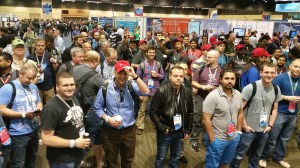
To give some perspective on the project’s growth, at the inaugural design summit back in 2010 there were 75 people in attendance. The purpose of this initial invite-only event was to “develop a roadmap for the first release, spec out the software and spend the last two days prototyping and hacking.”
Since that time the project has been spun out of Rackspace and has become an independent foundation and today “Hundreds of the world’s largest brands rely on OpenStack to run their businesses every day.”
Thoughts from day zero
To give you a feel for the project’s origins and what it’s aspirations were at that time, below is a set of interviews conducted at the event with some of the key players.
This first one, which does a good job of setting the stage, is an interview with the initial architect/project lead for OpenStack compute, Rick Clark.
The project has come quite a way since the initial meeting back in 2010 at the Omni hotel here in Austin. It will be interesting to see where it is six years from now.
A couple of weeks ago we announced the worldwide release of the Ubuntu-based mobile Precision mobile line as well and the US availability of the next gen XPS 13 developer edition.
Today I’m happy to announce that the Skylake-based XPS 13 developer edition is now available in Europe!
Background: As you may remember, as a part of Project Sputnik, these systems began as an open-ended exploratory project to identify what developers wanted in an ideal laptop. With the community’s input, Project Sputnik became an official product and continues to evolve.
Next gen XPS 13 developer edition specs
6thGeneration Intel® Core™Processors
Preloaded with Ubuntu 14.04 LTS
Augmented with the necessary hardware drivers, tools and utilities
InfinityEdge™ display, FHD and QHD+ versions available
Configurations
The following configurations will be available both online and offline in Europe. All of three of the XPS 13 developer edition configurations come with the Intel wireless card.
i5/8GB: 256GB, FHD, Intel 8260
i7/8GB: 256GB, QHD+T, Intel 8260
i7/16GB 512GB, QHD+T, Intel 8260
OTA (Over-The-Air) Fixes
There were several minor fixes that were not available in time for launch but have been made available as over the air updates so make sure to run all Ubuntu updates. (These fixes pertain to both the XPS 13 and Precisions.)
Where to order your system
The following, URLs will take you to the product pages for the developer edition in the various countries. The countries listed below will offer the XPS 13 online.
There is a second group of nations where the developer edition is available by contacting your local Dell representative. We will be adding that list, along with URLs, in the next couple of days. – Update: added April 8


 Posted by Barton George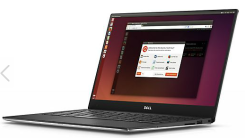


 in 2010 there were 75 people in attendance. The purpose of this initial invite-only event was to “develop a roadmap for the first release, spec out the software and spend the last two days prototyping and hacking.”
 Barton's Blog