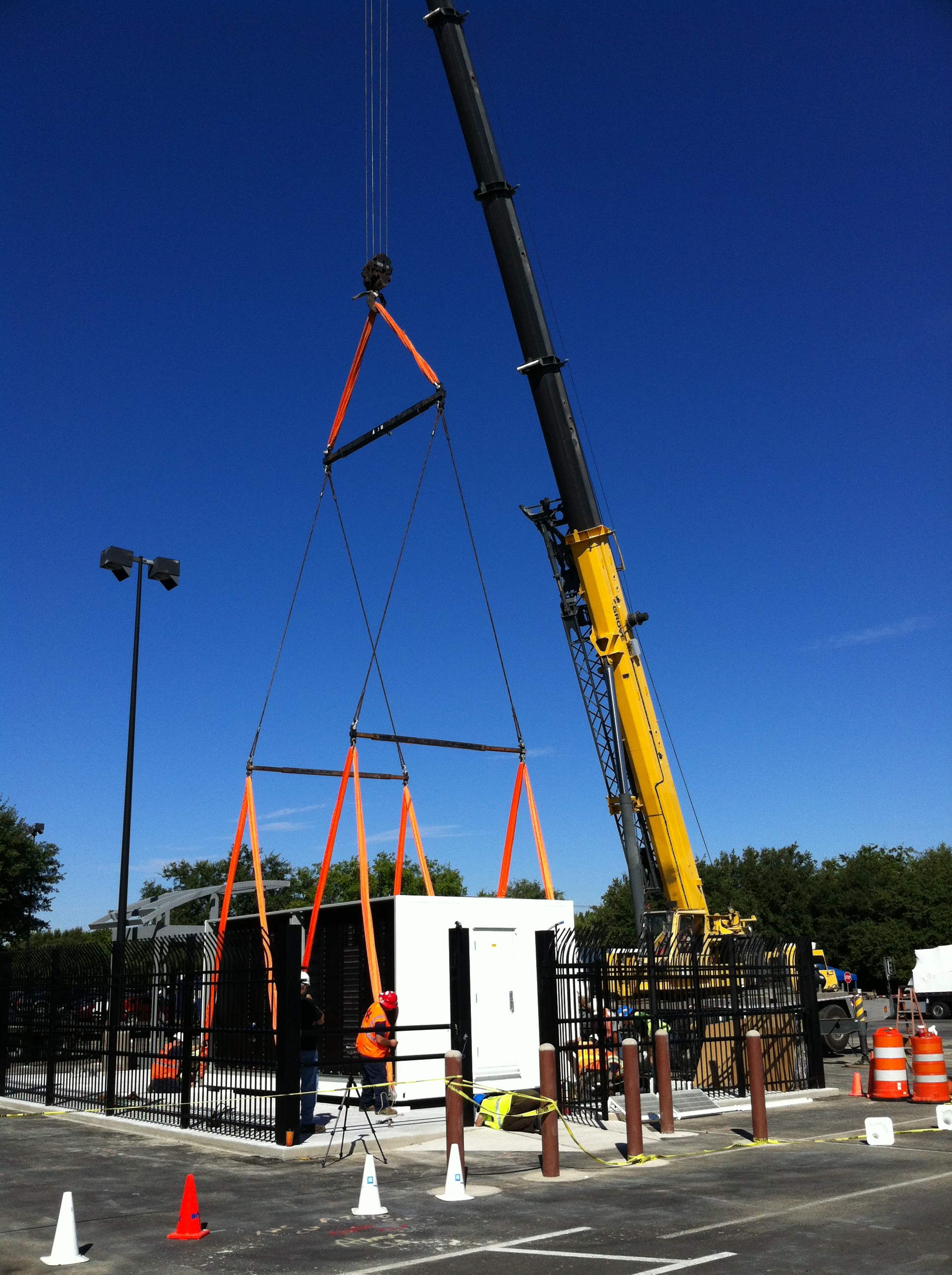
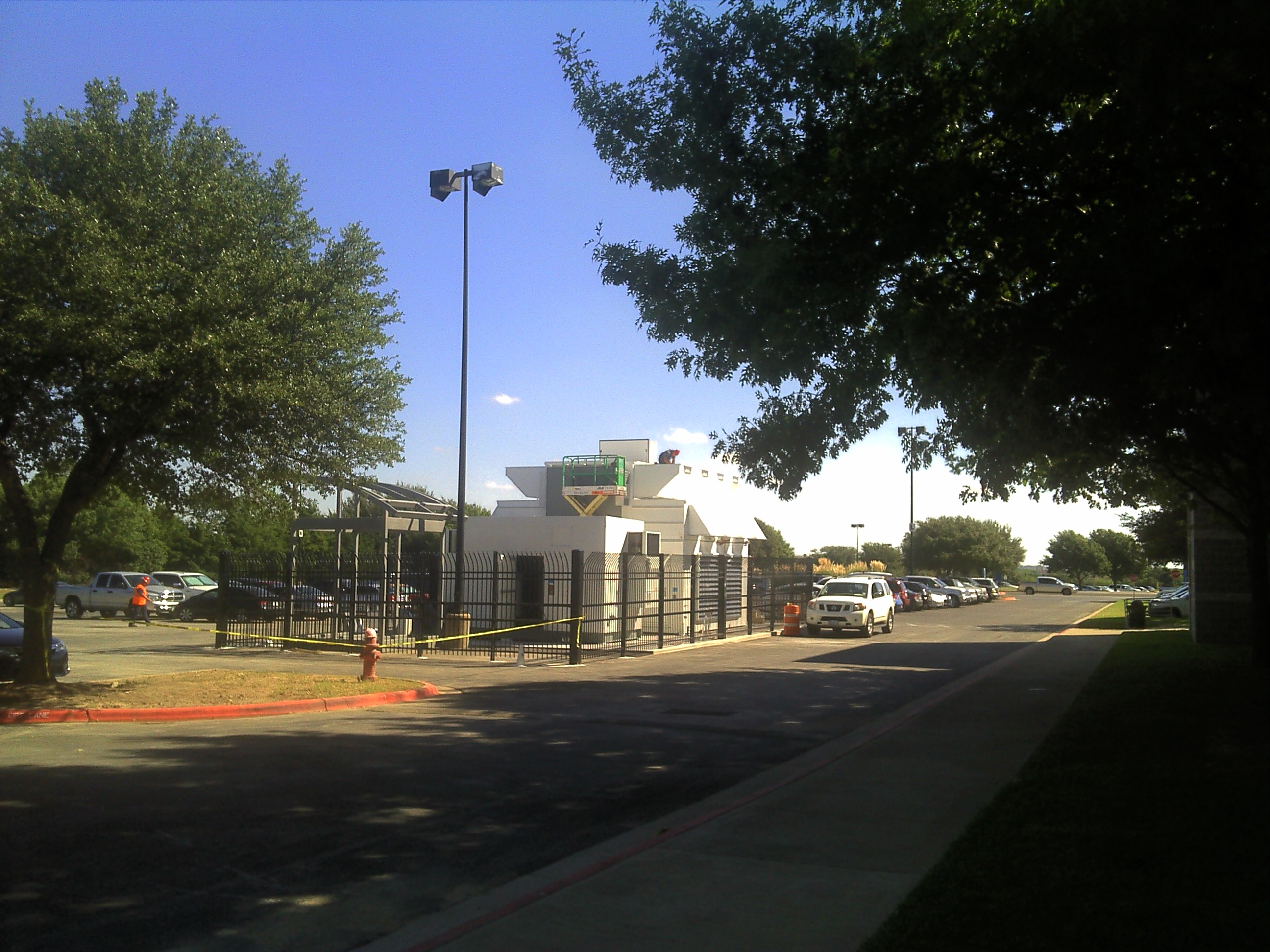
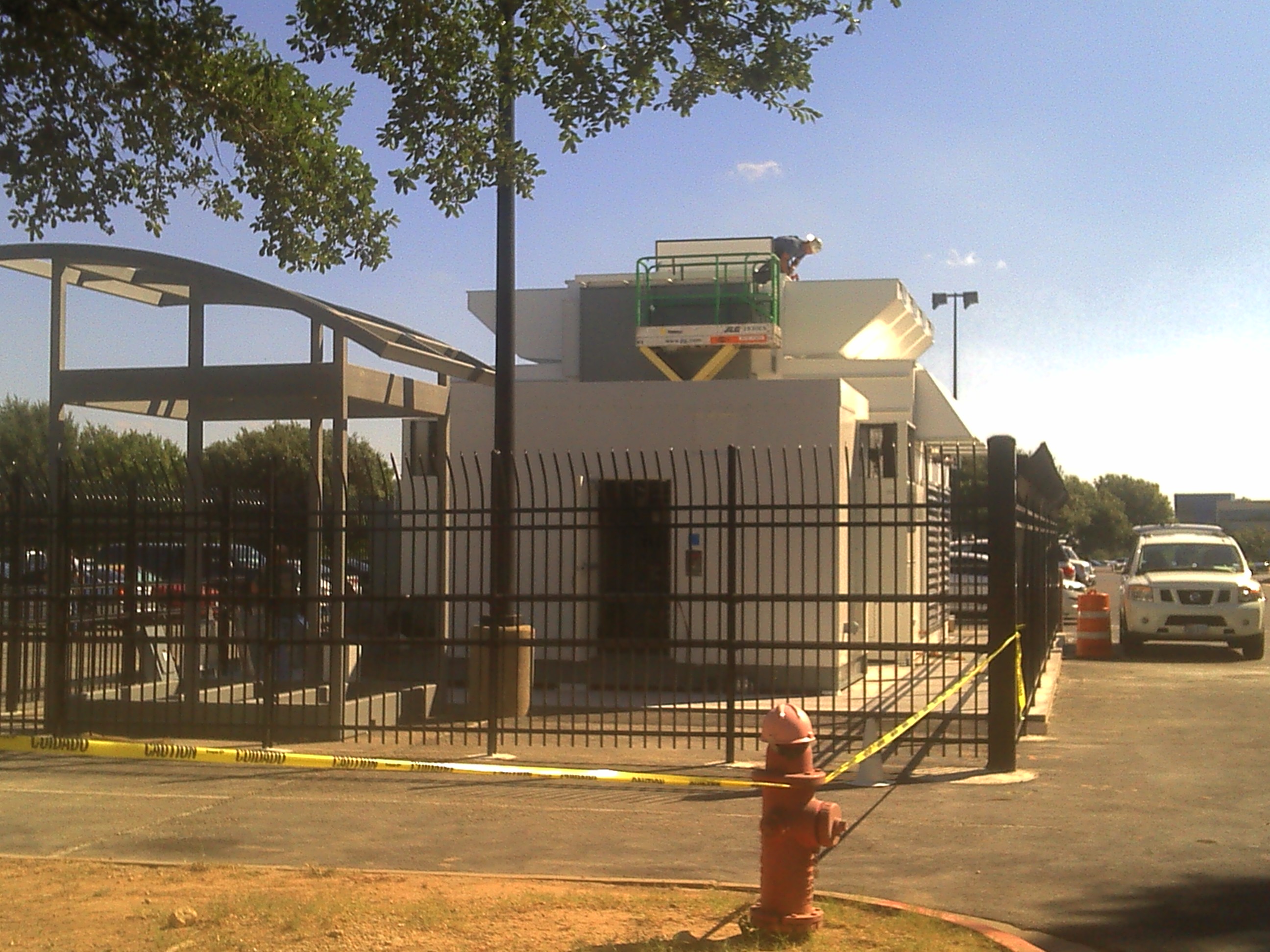
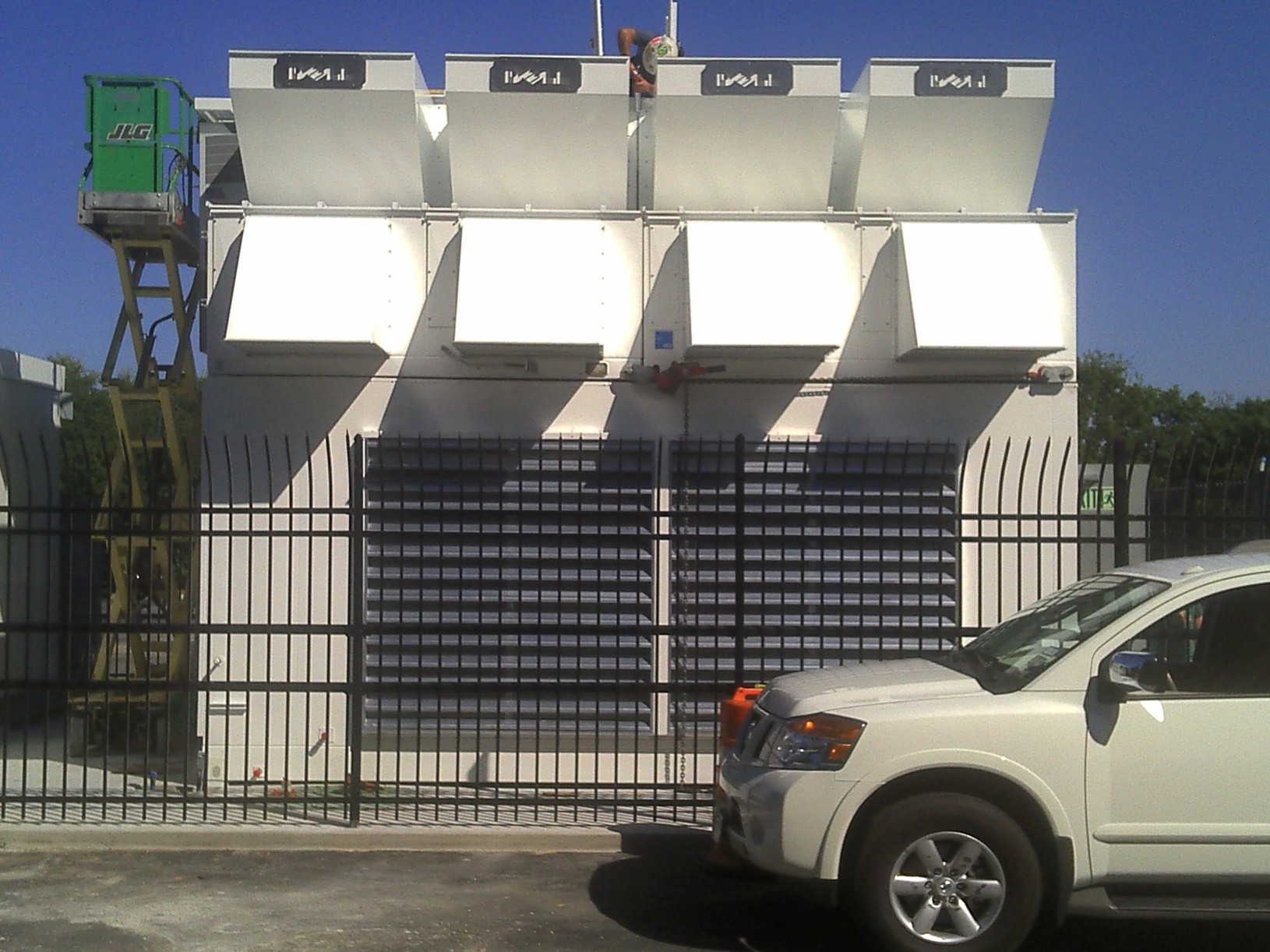
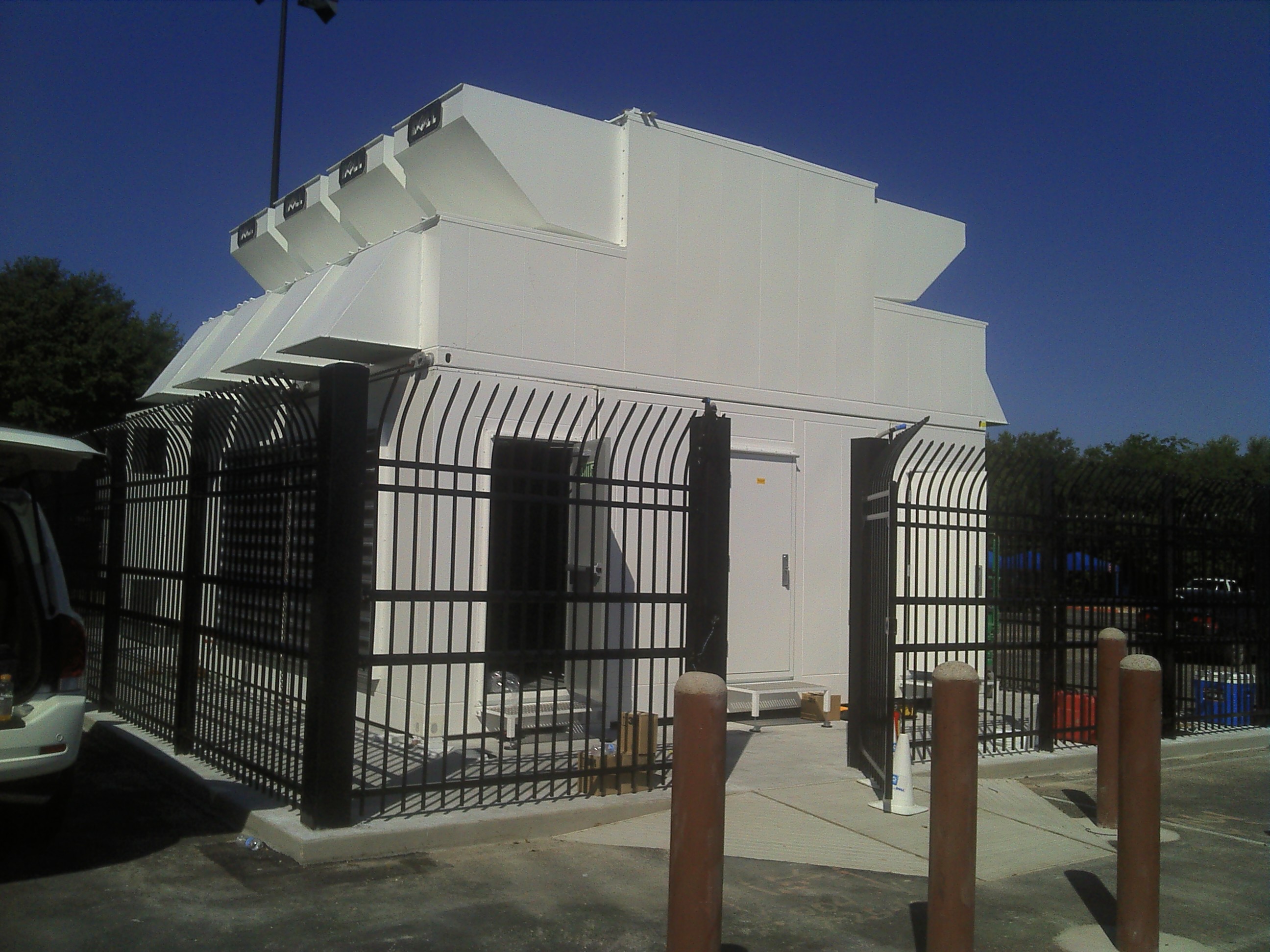
Why use valuable internal real estate when you can just set up a Modular Data Center (MDC) in your parking lot? The point wasn’t lost on the Dell Solution Center team who, with help from our partners Intel, is doing just that here in Round Rock.
The new MDC, which should be online in a few weeks, will host Dell’s OpenStack-Powered Cloud and Apache Hadoop solutions for customers to test drive and build POCs in Dell Solution Centers around the world.
Here’s the MDC being lowered into place yesterday.
Here are some pics I snapped this morning when I went down to get my coffee. (double click on them to see them full sized)
On the Thursday at OSCON, Ubuntu and Canonical founder Mark Shuttleworth gave a great keynote entitled, “Making Magic From Cloud To Client.” He did the entire keynote and live demo on a project Sputnik laptop (a Dell XPS13 running Ubuntu 12.04LTS)!
Here it is in its entirety:
Some of the ground Mark covers:
A fantastic demo on Juju and writing Juju charms showing how you can design a complex topology, deploy that in memory on your laptop and then map the whole shebang to the cloud.
How JuJu charms allow for “encapsulation and reuse”
The idea of crowdsourcing ops
A demo showing how, in realtime, you can map actual running infrastructure from one cloud to the next (in his demo he mapped it from EC2 to an HP cloud)
The idea behind Unity and the principle of having one UI that works across phones, tablets, desktops and even TVs.
Last Friday Cote and I took a break from the mad rush getting ready for today’s Sputnik announce and grabbed a conference room to record a short video. Below we discuss the project, how it came about, what its goals are and where it could go from here.
Earlier this month at DevOpsDays here in Austin the Dell Crowbar crew hosted a session and gave a demo. If you’re not familiar with it, Crowbar is an open source software framework written at Dell. I grabbed some time with Crowbar architect Rob Hirschfeld and got him to recap how far we’ve come in its less than a year and where he sees us going over the next year.
Last night we held our first SXSW meet up at Opal Divines. Opals is very close to the worldwide headquarters of Gazzang, which last week was named by GigaOm one of The 10 Austin startups you need to meet at SXSW 2012. Gazzang focuses on securing your data in the cloud via transparent data encryption.
Given the proximity and the promise of free beer, I was able to twist the arms of four members of their development team and get them to join us. Here is a quick video featuring Dustin Kirkland, Sergio Pena, Hector Acosta, and Eddie Garcia.
Yesterday morning, Laura Yecies, CEO of SugarSync stopped by for some meetings here at Dell. SugarSync, if you’re not familiar with it, provides instant and secure online file sync and backup for your PC, Mac, or mobile device. Before Laura’s first meeting we grabbed a cup of coffee and did a quick video. Here it is:
Some of the ground Laura covers
An intro to SugarSync: what it is and who it’s targeted at
0:43 — How do you get SugarSync and what’s their business model
1:32 — How Laura got involved with the company and how they’ve been doing
2:06 — How does SugarSync differ from something like Dropbox, how does it work and the power of cross-platform solutions
4:09 — What’s next for the company and the product
Dell corporate strategist by day, entrepreneur by night, Prabhakar Gopalan recently launched a SaaS offering called kanban2go that helps you manage and share your task list in the cloud. Prabhakar’s endeavor provides a quick overview of what it means to launch a cloud-based app today. Take a listen as he talks about the process and what he learned:
As I mentioned in my last entry, Mark Shuttleworth of Ubuntu fame stopped by Dell this morning on his way back from CES. Between meetings Mark and I did a couple of quick videos. Here is the second of the two. Whereas the first focused on the client, this one focuses on the Cloud and the back-end.
This afternoon Matt Ray, Technical Evangelist for Opscode, stopped by Dell’s Round Rock HQ to brief a gaggle of folks on what they are up to. Cote arranged the visit as well as one last month with Puppet labs, which I unfortunately wasn’t able to make.
After Matt, with some help from teammates on the phone, briefed the Dell gang I grabbed some time with him to get the 5 minute Reader’s Digest version. Here is the result.
Some of the ground Matt covers:
What are Opscode and Chef?
How did they come to be?
The hosted version of Chef (moving from EC2 to Rackspace)
As I mentioned in my previous entry, the code for the Hadoop barclamps is now available at our github repo.
To help you through the process, Crowbar lead architect Rob Hirschfeld has put together the two videos below. The first, Crowbar Build (on cloud server), shows you how to use a cloud server to create a Crowbar ISO using the standard build process. The second, Advanced Crowbar Build (local) shows how to build a Crowbar v1.2 ISO using advanced techniques on a local desktop using a virtual machine.
If you’re planning on attending the OpenStack Design summit and conference next week in Beantown you’ll have to check us out. I’m bummed that I will be missing the summit for the first time, I have a big internal presentation next week, but the rest of the Dell OpenStack crew will be there in force. Dell is a sponsor at the event and we will have a keynote, speaking sessions and demos.
What have we got in the works?
Besides checking out Crowbar and our Openstack solution which we launched back at OSCON we will have a whisper suite where we will be showing our latest and greatest stuff that is currently in the works. If you’d like to see what we have up our sleeve, email us at OpenStack@Dell.com and we can schedule a time slot for you to come and see for yourself.
Updated: For more details what we’ll be doing at the summit check out Rob’s blog
To close out my series of interviews from last week’s Structure conference in San Francisco, below is the chat I had with Data Center Knowledge‘s founder and editor, Rich Miller. Last week’s event was the 4th Structure conference that Rich attended and I got his thoughts on some of the hot topics.
Some of the ground Rich covers
How the discussion of cloud has evolved over the last four years
(1:21) Rich’s thoughts on OpenFlow and the networking space
(2:25) Reflections on the next-gen server/chip discussion and the companies on the panel: SeaMicro, Tilera, Calxeda and AMD
(4:25) Facebook’s OpenCompute project and the new openess in data center design
Last Thursday at Structure I ran into a couple of former Sun compadres who have started their own company in the cloud space: Cumulogic. Cumulogic is PaaS for developing Java applications and boasts the father of Java James Gosling and former Sun CIO Bill Vass as the leaders of its technical advisory board.
I got some time with Cumulogic’s CEO Rajesh Ramchandani and learned a bit about their new venture.
Some of the ground Rajesh covers:
Targeting enterprise Java PaaS for federated clouds
Announced the company in January and are conducting user betas now
Seeing early adopters in financial services and healthcare
Currently available as a public cloud via Amazon
Will have a release soon that will allow users to set up a private cloud within an enterprise on environments like vmware, cloud.com or eucalyptus.
As a run up to next months Structure conference, GigaOm has put together a list of the top 50 companies “that are influencing how the cloud and infrastructure evolves.” Those who made the list, entitled The Structure 50, are described as follows
These are the ones to watch — at least in 2011. You’ve heard of some – such as Amazon or Dell. Others – such as Nicira or Boundary – are probably not yet on your radar. But they should be. All of these companies, big or small, have people, technology or strategies that will help shape the way the cloud market is developing and where it will eventually end up.
Dell’s Bio
For each of the 50, GigaOm has put together a short “bio.” Here is the entry for Dell:
Founded
1984
Investors
Public Company
Structure50 Topic
Data Center
Description
Dell is among the world’s biggest server, storage and PC vendors, although the company has turned much of its focus to cloud computing software.
GigaOM’s Take
Dell has made heavy investments in cloud computing, ranging from dense, low-power servers for cloud data centers to software acquisitions and OEM deals that provide cutting-edge management capabilities. Going forward, Dell has plans to provide both Windows Azure- and OpenStack-based cloud services.
Looking forward to Structure 11
Members of the Dell cloud team, including myself, will be out in force at Structure 11. We will have a booth and Forrest Norrod, the GM of Dell’s Next Generation Computing Solutions division will be speaking on a panel. Forrest’s panel, entitled “The Economics of Open Everything,” will focus on OpenStack and Cloud Foundry as two specific initiatives built around open source.
If you find yourself at Structure swing by the booth or seek one of us out. Its a pretty intimate conference and we shouldn’t be too hard to find.
Today Dell is announcing that it is continuing to put its money where its mouth is when it comes to its transformation into a solutions provider, this time to the tune of $1 Billion. The goal of this investment, which is being made this year, is to provide customers with a complete set of resources and services to enable business agility, efficiencies and competitive advantage.
Specifically Dell is announcing:
Cloud Data Centers: The building of multiple cloud data centers around the world that will allow customers to take advantage of such offerings as Infrastructure as a Service, Desktop as a Service, Storage as a Service and IT outsourcing.
Global Solutions Centers: The creation of a network of global solutions centers to help customers architect, validate and build the efficient enterprise from the data center to the edge of the network.
New Solutions: New open, capable and affordable solutions for data management, client virtualization and data center virtualization:
Dell vStart: a single unit infrastructure solution that runs 100 to 200 vm’s and comes racked and cabled from the Dell factory.
Dell|Microsoft management and virtualization solutions partnership to deliver integrated management solutions made up of Dell’s Virtual Integrated System, our Advanced Infrastructure Manager and Microsoft’s System Center.
Dell Email and File Archive Solutions
Dell Desktop Virtualization Solutions
A little more detail:
Next generation cloud data centers
Over the next 24 months Dell is building out a host of cloud data centers around the world. Rather than old-school, giant raised-floor data centers these cloud data centers will be much smaller (approximately 10,000 square feet), more efficient and designed to take advantage of modular, hyper-scale and high-density principles. Dell’s modular strategy will let the company quickly expand capabilities as demand grows.
These data centers will feature private, public and hybrid cloud options. They will provide the foundation for Dell’s next generation services and solutions and offer IaaS, and SaaS capabilities as well as IT outsourcing for customers.
Global solutions center network
This year Dell will open 12 Global Solutions centers and is planning ten more over the next 18 months. These centers are customer facing facilities that will act as a “living lab” providing an environment and the support for customers to architect, build and test proof of concepts involving Dell products, services and solutions. The centers will also support solution integration, technical briefings and validation and ISV certification to meet regional requirements.
Starting with the upgrading of the existing Austin, Limerick and Frankfurt centers, further facilities will be opened this year in the Americas (Washington DC, Chicago, Northern California and Brazil), APJ (Shanghai, Singapore, Tokyo and Sydney) and EMEA (Paris).
With today’s announcement Dell his taken its evolution into a services and solutions company and kicked it up a notch. In the “Virtual Era” technology is rapidly changing and it along with new delivery models such as cloud are changing the way businesses operate and create advantage. Through its cloud and solution centers and new solution offerings Dell is bringing new ways to help customers harness and leverage these changes.
Last week and this, Austin’s downtown has been taken over by the South by Southwest festival (SXSW). What started out nearly 25 years ago as a music festival/conference has grown to include parallel film and interactive events as well. During the event every bar and venue downtown is occupied with bands, films or tech companies showing their stuff.
Check out the mini montage below that includes a quick interview I did with Dell solutions engineer Greg Althaus right after he finished the demo.
Don’t take our word for it
Dell is currently field testing crowbar and plans to donate the code to the OpenStack community after testing. If you are interested in testing crowbar yourself, email us at OpenStack@Dell.com.
Some of the ground the video covers
Intro montage: Welcome to the Kung Fu Saloon, setting up and a snippet of the demo
[0:40] Talking to Greg
What actually is crowbar and how does it work with OpenStack compute and storage?
How fast can you spin up a cloud using it?
Where does OpsCode’s Chef fit in?
Our plan to donate this code to the community after field testing.
Another of yesterday’s featured speakers at the OpenStack design summit was Accenture partner, Joe Tobolski. Joe is part of Accenture labs which looks at emerging technologies and he is responsible for assets and architecture as part of Accenture’s global cloud program.
I sat down with Joe in the cafe downstairs and got his thoughts on why OpenStack would be attractive to enterprises as well as how the Accenture team was participating in the summit.
As a follow on to last week’s PowerEdge C line overview, here is the first individual system overview: the C6100. Click below and let Dell Solutions Architect Rafael Zamora guide your thru the design and features of this densely packed machine targeted at HPC and cloud workloads.
Some of the highlights:
The PowerEdgeC 6100 holds the equivalent of 4 systems which have been packaged into “sleds,” each containing boards, RAM and microprocessors.
Upfront you can put a ton o’ disk drives, either 24 x 2.5″ drives or 12 x 3.5″ drives.
Great for markets like HPC clustering and search engines where compute density is key. (This is not intended for running general purpose apps like Exchange, SQL or Oracle).
It will serve as the compute node in the Ubuntu Enterprise Cloud solution from our partner Canonical.
Last week I arrived a day before our launch to record videos with some of our cloud partners. My first stop was Greenplum to interview co-founder and president, Scott Yara (look for that video here in the near distant future).
Given that turnaround is fair play they asked me to appear in a short promo video that they were putting together for Chorus. Chorus will be officially announced on April 12 and is intended to marry the power of cloud computing and social collaboration with data warehousing and analytics.
I had no idea the illustrious company I would end up being edited-in alongside including my former uber-boss, Scott McNealy (who will be keynoting Greenplum’s Nov 12 event) and UC Berkeley Comp Sci Prof Joseph Hellerstein.
At last week’s Dell Launch, “Solutions for the Virtual Era,” we unveiled the first three systems in our new PowerEdge C line. These “hyper-scale inspired” systems are based on designs that we have built for our largest scaled-out customers such as Windows Azure, Facebook, Ask.com and Tencent.
The PowerEdge C line is targeted at both Public and Private cloud builders as well as HPC, Web 2.0, gaming and large scaled out web farms. In the video below, Dell solutions architect Rafael Zamora walks us through the PowerEdge C6100, C1100 and C2100.
Upcoming posts
In the days to come I will be posting individual walk-thrus of each of the three systems. I will also be posting interviews I did with executives from our cloud partners Joyent, Aster Data, Greenplum and Eucalyptus (who’s not a partner but provides a key component of our partner Canonical’s Ubuntu Enterprise Cloud).



 Posted by Barton George
  DevOpsAngle:

 Barton's Blog