Happy New Year to all! For the first week of this new year I’m going to focus on virtualization and the cloud.
Kicking off this mini-series is an interview I did last month at the Gartner DataCenter conference with David Greschler, director of virtualization strategy at Microsoft. I caught up with David right after his talk at the conference.
Some of the topics David tackles:
The ability to treat IT as a service. Before virtualization, specific workloads were tied to specific devices. Thanks to virtualization you can create pooled resources which is the beginning of IT as a service.
Microsoft’s Dynamic Data Center Toolkit: This tool overlays on top of HyperV and System Center (their management tool) and allows you to look at and manage your own datacenter as a pool of compute power. It is a step towards the private cloud and can also be used by hosters. It will also allow for moving workloads between public and private clouds.
Microsoft is focusing on giving you knowledge at the app level. System Center tells you whats going on inside not just at the hypervisor level.
Windows Azure: a large scale cloud that you can use to build apps for and have hosted on this environment.
The ability also to take workloads into Azure over time.
Image based Management: Taking the technology of the desktop-targeted App V and applying it to the server. Will allow you to encapsulate apps and move them from one OS to another without having to re-install them. You will no longer have 1000s and 1000s of virtualized images that you will have to manage and monitor, instead you will very few golden images of these VMs and you will be able to simply put these workloads in and take them out.
They say turn around is fair play. Kevin Hazard of the Planet recently took this literally. No sooner had I finished interviewing him at the Cloud Expo in Santa Clara then he turned around and pointed his camera at me. He got me talking about the cloud and what the heck Dell’s doing in it.
Some of the topics I tackle:
What I do as Dell’s Cloud Evangelist.
Where Dell plays in the cloud:
Cloud based services providing IT management as a service.
Building these capabilities through the acquisition of four companies over the last two years: MessageOne, ASAP, Everdream and Silverback.
Creating custom servers as well as providing data center design and implementation for some of the world’s largest “hyper-scale” customers e.g. Microsoft’s Azure and three out of the top five search engines in the U.S.
What’s next: building on this experience to offer integrated cloud solutions for setting up private and public clouds. Combining Dell hardware and services with best of breed software — all coming from/supported by Dell.
My thoughts on Public vs. Private clouds and how we will end up with a mix of computing models.
Last month at the Interop/Web 2.0 I was able to drag Citrix’s Roger Klorese away from booth duty for an interview. Roger is a Sr. Director at Citrix who works on Xen server and the Essentials product family. Here is what he had to say:
Some of the topics Roger tackles
What Roger has been focusing on this year — Free Xen server. Launching the offering (there have been 200K downloads this year)and then bringing more features into it. What comes with it for free and what are add-ons that you get thru the Essentials family.
In the networking space Citrix announced a version of their netscaler app delivery server as a virtual appliance.
Managing “OPVs” (other people’s VM’s)
What Roger is most excited about:
Growing the datacenter into the cloud — Xen.org recently released the Xen cloud platform which is a full cloud distro, with a management stack based on open sourcing the Xen server stack.
Early next year they are releasing the Xen client type 1, a bare metal client hypervisor.
A couple of weeks ago I was in New York to visit customers and attend the co-located Interop and Web 2.0 events. One of the attendees/participants I got to know there was Joe Weinman, VP of ATT’s Business Solutions. Joe has been focusing a lot on the cloud lately so I thought I’d put down for posterity his thoughts and explanation of what ATT is up to in this space.
Some of the topics that Joe tackles:
ATT’s evolving strategy involves mix of managed endpoints and a variety of network services as well as a variety of services in the cloud.
ATT’s services range from infrastructure services like “Synaptic hosting,” storage as a service and compute as a service thru a variety of SaaS apps like unified comms and collaboration, SAP, Oracle ebiz suite, Seybold and JD Edwards.
They have a large platform as a service offering that is used by tens of thousands developers creating at mobile enterprise apps.
They target a wide variety of endpoints e.g. iphones,windows mobile devices, netbooks, black berries all the way thru tele-presence rooms.
How ATT delivers on both front end and back end architectures.
Last but not least from the videos I took last month at Cloud Expo is the interview I conducted with Barry Lynn of 3tera. At a high level Barry positions his company as a software company that offers a turnkey cloud platform. See what else he has to say:
Some of the topics Barry Tackles
3tera sell’s their flagship product AppLogic three ways
License it to people who want to run private clouds behind their firewalls [competitors: VMware, people building it themselves]
License it to service providers who want to offer public cloud services but don’t want to build their own cloud (there are 30 SP’s worldwide offering clouds on the 3Tera platform) e.g. KDDI [competitors: people who build it themselves]
Virtual private data center business where people can lease a data center. They do this with DC partners [competitors: any service provider]
What they are doing with KDDI and their “KDDI cloud server” (hint: they are provisioning stacks e.g. ruby, .net, java…)
What’s coming up
Their App store is in beta and will be in production in Q1 of next year (ISVs publishing to the 3tera cloud).
Cloudware release: their orchestration and management layer will be offered separately next year and can be used on top of anyone’s virtualization, computing fabric or cloud engine.
I first met Dave Nielsen when I attended the Austin Cloud Camp back in April of this year. I bumped into to him again at the cloud computing expo in Santa Clara at the beginning of last month. He was putting on another cloud camp and checking out the expo. I sat down with him and got him to tell me all about the phenomenon that has become cloud camp.
Some of the topics Dave tackles:
Cloud Camp’s un-conference format and how attendees drive the agenda and topics.
Where Dave got the idea and what his background is.
How it all began back in June of ’08 with the first cloud camp in San Francisco and then quickly jumped across the pond and then back to the Windy City. (There have been 50 cloud camps in 16 monts, half in the US and the other half in Europe and Asia)
Every city is different. To help the cities less familiar with the un-conference format, an “un-panel” was added.
I’m currently here in Las Vegas attending Gartner’s Data Center conference. It’s day two and I’ve been very impressed with the quality of the sessions so far. In particular I thought yesterday’s keynote was very good and I wanted to share my notes from the talk.
The presentation was entitled, “Infrastructure and Operations: Charting a course for the coming decade” and was delivered by David Cappuccio. In his talk, David walked us through the “10 Trends to watch carefully.”
Last week I headed out to the Big Apple to attend Interop/Web 2.0 and present Dell’s cloud vision/strategy to customers. I was also able to grab several interviews at the co-located shows.
I’ve posted the first video featuring Azure evangelist Keith Pijanowski but have a couple more coming up: Roger Klose, Sr Director of Citrix’s Datacenter & Cloud Division and Joe Weinman, VP of ATT’s Business Solutions. Joe also moderated a panel that my boss, Andy Rhodes was on: Never Buy a Server Again: Should You Move Everything to On-Demand? (Here’s a write up on the panel that appeared on zdnet.)
I decided to walk the 20 blocks from Penn station to my hotel. It was a fantastic night, Times Square was alive and I even stopped for a slice.
Interop/Web 2.0 were held in everyone's favorite, the Javits Convention center
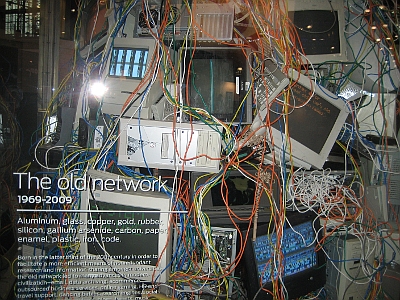
The Network is dead, long live the Network. Art installation on the show floor.
At the cloud expo in Santa Clara earlier this month I ran into Rick German, CEO of Stoneware, Inc. I had previously heard of Stoneware since they are partnering with Dell on a cloud offering for education but I knew that was just one area in which they played. I sat down with Rick and learned about all they did.
Some of the topics Rick tackles:
Helping customers to build their own private clouds within their data centers and enabling them to plug in their own windows and webhosted apps (plugging public cloud apps into the data center). Taking orgs from client-centric to web-centric.
Delivery via a virtual web desktop accessed from a plethora of browsers: Firefox, IE, Chrome, Opera and Safari.
Stoneware’s 10-year history and how the advent of “cloud-o-mania” has helped or hurt them.
What to look for from Stoneware in the year ahead.
I’m currently in New York visiting customers and attending Interop/ Web 2.0. While these two conferences have different session tracks their expos are co-located and attendees of either can visit the whole lot. It was then in the Web 2.0 section earlier today where I met Keith Pijanowski, a Microsoft evangelist for Windows Azure.
Keith has been working with Azure the last year and half and telling customers how it can drive down costs and make their software development cycle more agile. I got Keith to take a quick break from booth duty and explain it to me. (I wanted to know what all those Dell servers were powering 🙂
Some of the topics Keith tackles
How it works: You develop on premise (the cloud environment is emulated on the developer’s desktop) and then upload your code to the cloud where you have all the services, resources and compute power needed to run your app. You then manage all your code and storage areas via a portal.
Azure is ready to use but Microsoft wont charge for another 2 mos. The last free month the customer will get a bill of what it would cost if they had had to pay.
What’s coming to Azure in the future, some examples:
Right now you have SQL Azure database in the cloud but they will build out the SQL Azure brand so that it has many of the same capabilities that customers are used to on premise.
When .net 4.0 becomes available they will have a work flow service
Will have synchronization services (SQL Azure sync) so customers can have a database in the cloud and one on premise and sync them.
With today’s post, I’m right at the mid-point of my series of video interviews from Cloud Computing Expo. Today’s post offers a two-for-one special, Gluster CEO Hitesh Chellani along with Jack O’Brien who heads Gluster’s product management.
Some of the topics Hitesh and Jack tackle:
Gluster as a general-purpose open source cluster platform that runs on top of commodity hardware like Dell.
Their goal to transform the storage market the way Red Hat transformed the server market (Gluster employs a subscription model just like Red Hat).
What would you do after spending time at Lawrence Livermore National Labs putting together the second fastest super computer in the world? Hitesh thought he’d distill the experience and apply it to the storage space.
Some of the performance-driven verticals Gluster started out in.
The new hot area of virtual storage next to virtual servers.
A couple of weeks ago on the show floor of Cloud Computing Expo in Santa Clara I ran into Adam Hawley, Director of product management for Oracle VM. When Adam finished his stint in the Oracle booth he sat down with me to talk about what was going on at Oracle in the world of virtualization and the cloud.
Some of the topics Adam tackles:
Oracle VM, Oracle’s sever virtualization and management platform, while based on Xen is all Oracle on top of it.
The Virtual Iron acquisition which is in the process of being incorporated within the Oracle portfolio and is slated for release in 2010.
The Cloud as a higher level of automation on top of virtualization, compared to what traditional virtualization has provided.
Where Oracle will play in the cloud space (hint: think private).
The Oracle assembly builder that Adam was showing off at the show.
Given Larry’s views on cloud computing, is “cloud” a dirty word at Oracle?
At the cloud computing expo in Santa Clara last week I was able to grab some time with Rob Walters, director of product management at Houston-based The Planet. Rob, who has an atypical Texas twang, talked to me about how The Planet has been dipping its toe in the cloud waters and how it is soon planning on taking the plunge.
Some of the topics Rob tackles:
The Planet began its foray into cloud computing over a year ago by partnering with Nirvanix and providing a storage cloud for back-up and archive.
They have spent the last 9 months working on a cloud compute offering which will launch in Q1.
The Planet will look to offer the cloud capabilities to their dedicated hosting customers. They will use the concept of virtualization which these customers understand and appreciate to create an understanding of the cloud, a concept that these customers are still a little leery of.
Kicking off my series of videos from last week’s Cloud Expo in Santa Clara, here is a chat I had with Oren Teich, of Heroku. Heroku, if you’re not familiar is a 2-yr old Platform as-a-Service company targeting Ruby developers. Oren recently joined Heroku as their head of product management and had the following to say:
Some of the topics Oren tackles:
Where the name “Heroku” comes from and why they were going for a Japanese sounding name.
Why did they choose Ruby and why did they go with a cloud-based plaform?
How Heroku is similar/different from Google App Engine and Engine Yard.
The majority of the folks who have created the 39,000+ apps on the site are hobbists. That being said, the folks who pay their bills are those who are creating social media apps for platforms like Facebook, Twitter and the iPhone.
How Heroku makes their money: they charge as you scale and they charge for add-ons.
What they plan to concentrate on in the year ahead
This week I made the trek out of the Lone Star state and headed west to the Bay Area. I spent the first day in San Francisco where I took our sales folks through my cloud presentation and then had meetings with a few members of the press. Here is the outcome of a couple of those meetings:
From the city I headed down to Santa Clara and the Cloud Computing Expo. I don’t think I saw a single customer at the event but I did run into a bunch of interesting companies in attendance. With my trusty Flip Mino I even recorded a bunch of interviews that I will be rolling out in the days to come. Here’s the list
On Friday I grabbed lunch with Geoff Tudor, SVP of business development and co-founder of Nirvanix . After they cleared the plates I talked to Geoff about what Nirvanix does and where he saw cloud storage heading.
Some of the topics Geoff tackles:
Providing cloud storage for the enterprise from five data centers around the world that are pooled and presented as one large global file server.
The Nirvanix “secret sauce”: the file virtualization layer that sits on top of pooled/virtualized commodity storage.
How Nirvanix’s offering is different than Amazon’s S3 (hint: one’s targeted at enterprises and one’s targeted at developers)
Customers such as the NASA/ASU library which is the largest cloud storage use ever and stores images from the Lunar Reconnaissance Orbiter camera.
Security and how Nirvanix addresses customer’s concerns.
Yesterday Gartner distinguished analyst Tom Bittman, who covers cloud computing and virtualization, posted some thoughts and observations from the Gartner Symposium in Orlando.
Private Cloud-o-maina
Based on Tom’s observations, private cloud (however defined) seems to have captured the hearts and minds of IT. Before he began his talk on virtualiztion he did a quick poll asking how many in the audience considered private cloud computing to be a core strategy of theirs. 75% raised their hands. While not overly scientific, that’s a pretty big number.
Little Miss Appropriation
The logical next question one may ask is what do people mean when they say “private cloud.” According to Tom the three most common ways private clouds are being (mis) described are:
IT defending its turf: Shared services that were being re-labelled as private clouds (but without a self-service interface, or much automation at all)
Vendors defending their products: Old products being re-labelled as private clouds in a box (I described most of these as “lipstick on a pig”)
Advanced server virtualization deployments: Although few have a true self-service interface, the intention is certainly there
So it looks like there is quite a bit of misappropriation of the term. However, as we previously learned, just because there is hype and misuse of terms, doesn’t mean there isn’t value in the concept of “private cloud.” The question is what is that value?
Tom sees private cloud’s value as a means to end and concludes his post by saying
The challenge with private cloud computing, of course, is to dispel the vendor hype and the IT protectionism that is hiding there, and to ensure the concept is being used in the right way – as a stepping-stone to public cloud… [italics mine]
(I’m not your) Stepping Stone
This is where I disagree. I believe that while private cloud can be a path to the public cloud, it can also be an end unto itself. Unfortunately (or fortunately) we will always have heterogeneous environments and in the future that will mean a mixture of traditional IT, virtualized resources, private clouds and public clouds. In some case workloads will migrate from virtualizaiton out to the public cloud but in other cases they will stop along the way and decide to stay.
IT will become more efficient and more agile as the cloud evolves but there will be no Big Switch (see above illustration), it (IT) will need to manage a portfolio of computing models.
Just a little while ago Steve Shankland posted an article from the front lines of the Gartner Symposium ITxpo in Orlando. The article is based on a presentation given today by Gartner addressing the top 10 trends that will be coming in IT in 2010.
And what found itself moving up two spaces from last year and claiming the top spot? Cloud computing.
Gartner’s cloud advice, notes Shankland, is
…companies should figure out what cloud services might give them value, how to write applications that run on cloud services, and whether they should build their own private clouds that use Internet-style networking technology within a company’s firewall.
(On a side note, it’s interesting to see that last year’s leader virtualization has been tri-sected into: Client Computing, Reshaping the Data Center and Virtualization for Availability)
Back on top
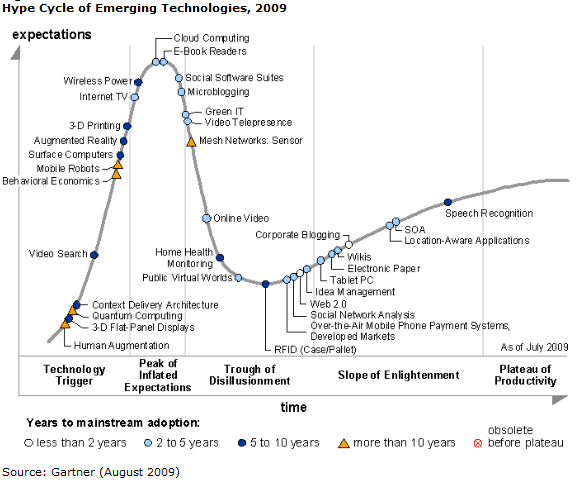
Being at the top of a Gartner chart is nothing new for Cloud Computing as you can see in this Hype Cycle from a couple of months ago:
So I guess the moral of this story is, just because something is over-hyped doesn’t mean its still not important. Ignore the cloud at your peril 🙂
Pau for now…
Endnote: A word from our sponsor
If you happen to be at the Gartner event and you want to see Dell’s take on the cloud, check out Tim Mattox’s presentation tomorrow at 3:30 – 4:30: Leveraging the Cloud to Reduce your IT costs.
Jimmy Pike is the director of systems architecture for the Data Center Solutions group here at Dell and self-proclaimed “head geek.” Using a tool case with its insides stripped out, part of an old inbox and a bunch of off the shelf components he has created the world’s first portable “data center.” (All for the princely sum of ~$2,000)
This former toolkit now holds:
Two dual-socket servers featuring 2.5GHz Intel processors
One server running Windows ’03 acting as the DHCP and domain server and the other running Red Hat linux.
Last Friday I got together with Michael Cote of Red Monk and John Willis of Canonical for a podcast. We met up at a nearby coffee shop and chatted about a whole bunch o’ stuff.
You can listen to the actual podcast on Cote’s blog.
Dell’s cloud building business, focused on a small group of hyper-scale customers (Azure and Facebook being a couple I can name), delivering a high volume of highly customized machines for these customers.
Some of the learnings we’ve gained with working with this group.
Our intent to take this effort to a much wider group of customers and offer complete cloud solutions made up of hardware, third party software, a reference architecture and services.


 Posted by Barton George






 Barton's Blog