A little over a week ago, Dell’s Data Center Solutions (DCS) group marked its fifth birthday. As Timothy Prickett Morgan explains in his article subtitled, “Five years old, and growing like a weed”:
DCS was founded originally to chase the world’s top 20 hyperscale data center operators, and creates stripped-down, super-dense, and energy-efficient machines that can mean the different between a profit and a loss for those data center operators.
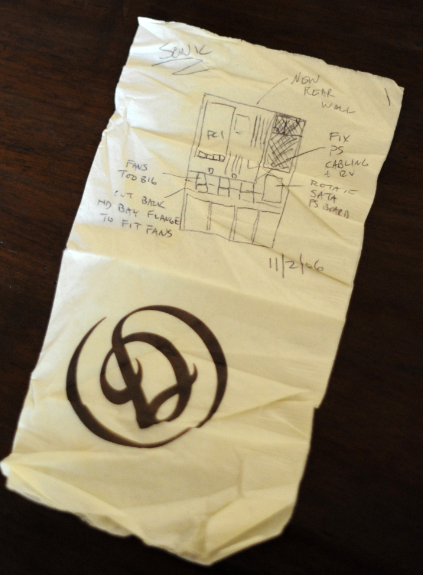
This team, which now represents a greater than $1 billion dollar business and has expanded beyond just custom systems to include standard systems built for the “next 1000,” all started on a simple napkin.
The origin of DCS -- Ty’s Sonic sketch - November 2, 2006
From napkin to “Frankenserver,” to today
Ty Schmitt who was one of the original team and now is the executive director of Dell’s modular infrastructure team within DCS, explains:
This was sketch I made over drinks with Jimmy Pike late one night after visiting a big customer on the west coast. We we were working on a concept for a 1U system for them based on their requested requirements. As you can see by the date (Nov 2006) it was actually before DCS became official … we were a skunk works team called “Sonic” consisting of a hand full of people. We wanted to take an existing chassis and overhaul it to fit 4 HD’s, a specific MB, and SATA controller. When we got back to Austin, I modified the chassis in the RR5 machine shop (took parts from several different systems and attached them together) and Jimmy outfitted it with electronics, tested it, and it was sent to the customer as a sample unit.
This first proto was described by the customer as “Frankenserver” and was the beginning of the relationship we have with one of our biggest customers.
A little over five years later, Dell’s DCS team has gone from Frankenserver to commanding 45.2 percent revenue share in a market that IDC estimates at $458 million in sales last quarter. Pretty cool.
Yesterday, DevOpsDays Austin kicked off at National Instruments. If you’re not familiar with DevOps, its the idea of using people, processes and tools to break down the wall that traditionally exists between developers and operations with the idea of removing friction and increasing velocity to better support and drive the business.
The Austin event was maxed out the day after it was announced a couple months ago and there was a waiting list of over one hundred people. About half the crowd was from out of town with a big contingent from the Valley and New York. Near the end of the day yesterday I caught up with one of the organizers, Damon Edwards to learn more about the event and how it came to be.
A little while ago, EnterpriseDBs VP of Biz Dev, Sean Doherty popped in for a visit. While he was here I got him to tell me what EnterpriseDB, the certified professional distribution of the PostgreSQL open source DB, has been up to and fill me in on their new cloud database.
Some of the ground Sean covers:
What is EnterpriseDB and what is their business model
1:10 Where does EnterpriseDB fit in the overall database landscape and where is it used
In a recent post that highlighted the demise of the midrange server market, Timothy Prickett Morgan talked about the new server classification that IDC has just started tracking, “Density-optimized”:
These are minimalist server designs that resemble blades in that they have skinny form factors but they take out all the extra stuff that hyperscale Web companies like Google and Amazon don’t want in their infrastructure machines because they have resiliency and scale built into their software stack and have redundant hardware and data throughout their clusters….These density-optimized machines usually put four server nodes in a 2U rack chassis or sometimes up to a dozen nodes in a 4U chassis and have processors, memory, a few disks, and some network ports and nothing else per node.
Source: IDC -- Q3 2011 Worldwide Quarterly Server Tracker
Here are the stats that Prickett Morgan calls out (I particularly like the last bullet :-):
By IDC’s reckoning these dense servers accounted for $458 million in sales, up 33.8 percent in a global server market that fell by 7.2 percent to $14.2 billion in the quarter.
Density optimized machines accounted for 132,876 servers in the quarter, exploding 51.5 percent, against the overall market, which comprised 2.2 million shipments and rose 2 percent.
Dell, by the way, owns this segment, with 45.2 percent of the revenue share, followed up by Hewlett-Packard with 15.5 percent of that density-optimized server pie.
Last summer at OSCON Dell announced the availability of our OpenStack solution in the US and Canada. Today at World Hosting Days in Rust Germany we are now announcing that our OpenStack-Powered Cloud Solution is available in Europe and Asia.
If you’re not familiar with it, OpenStack is an open source cloud project built on a foundation of code initially donated by NASA and Rackspace. The project kicked off a little over a year and a half ago here in Austin and it has gained amazing traction since then.
Dell’s offering
Dell’s OpenStack cloud offering is an open source, on premise cloud solution based on the OpenStack platform running on Ubuntu. Its composed of:
The OpenStack cloud operating system
PowerEdgeC servers: C6100, C6105, C2100 and, coming soon, Dell’s new C6220 and R720
The Crowbar deployment and management software framework – developed and coded by Dell 🙂
Dell’s OpenStack reference architecture
Dell Services
Crowbar software framework
To give a little more background on the Crowbar software framework, its an open source project developed initially at Dell and you can grab it off github. The framework, which is under the Apache 2.0 license, manages the OpenStack deployment from the initial server boot to the configuration of the primary OpenStack components, allowing users to complete bare metal deployment of multi-node OpenStack clouds in hours, as opposed to days.
Once the initial deployment is complete, you can use Crowbar to maintain, expand, and architect the complete solution, including BIOS configuration, network discovery, status monitoring, performance data gathering, and alerting. Beyond Dell, companies like VMware, Dreamhost and Zenoss have built “barclamps” that allow them to utilize Crowbar’s modular design. Additionally, customers who buy the Dell OpenStack-Powered Cloud Solution get training, deployment, and support on Crowbar.
So as of today, customers in the UK, Germany and China can purchase the Dell OpenStack-Powered Cloud Solution. As customer demand grows in other regions we will be adding more countries so stay tuned. If the first 18 mos of the project are any indication of whats the pace is like to come, we are all going to be in for a lot more excitement.
As I mentioned in my last several entries, during SXSWMichael Cote and I, on behalf of Dell, organized a series of mini meet-ups focusing on developers, tech and social media folks. These were relaxed informal affairs with the idea of getting people together to learn what they were up to and for us to let them know what had been keeping us busy.
The final meet up was held on Sunday evening at the Hilton bar, Finn and Porter. Here is a mini-montage from the event:
I asked the folks to say who they are, where they’re from, who they work for and what they hope to get out of SXSW.
During SXSW Michael Cote and I, on behalf of Dell, organized a series of mini meet-ups focusing on developers, tech and social media folks. The second event we held was on Saturday on the top level of Speakeasy. Being Saturday night, this turned out to be the biggest of the three get togethers.
Here is a small sampling of the folks who dropped by (notice the atmospheric lighting, for half of them they were literally lit by candle light):
Last night we held our first SXSW meet up at Opal Divines. Opals is very close to the worldwide headquarters of Gazzang, which last week was named by GigaOm one of The 10 Austin startups you need to meet at SXSW 2012. Gazzang focuses on securing your data in the cloud via transparent data encryption.
Given the proximity and the promise of free beer, I was able to twist the arms of four members of their development team and get them to join us. Here is a quick video featuring Dustin Kirkland, Sergio Pena, Hector Acosta, and Eddie Garcia.
This is the 26th year of the SXSW (South by Southwest), the annual music, film, and interactive conference. Everybody whose anybody, and even a few who aren’t, are here. Yesterday the 10-day event kicked off. As a company, Dell is a big participant and sponsor from panels, to music lounges, to an entrepreneur’s UnConference, to education, to gaming.
As for the Web|Tech vertical we have taken our own guerrilla approach to participation in this shindig in our own backyard. Besides going to parties that customers and partners are throwing, Cote and I have organized a series of informal “chill and chat” meet ups for developers and tech types.
Last night we held our first soiree at Opal Divines. Here is a mini-montage I made featuring a few of the attendees:
I asked the folks to say who they are, where they’re from, who they work for and what they hope to get out of SXSW.
Yesterday morning, Laura Yecies, CEO of SugarSync stopped by for some meetings here at Dell. SugarSync, if you’re not familiar with it, provides instant and secure online file sync and backup for your PC, Mac, or mobile device. Before Laura’s first meeting we grabbed a cup of coffee and did a quick video. Here it is:
Some of the ground Laura covers
An intro to SugarSync: what it is and who it’s targeted at
0:43 — How do you get SugarSync and what’s their business model
1:32 — How Laura got involved with the company and how they’ve been doing
2:06 — How does SugarSync differ from something like Dropbox, how does it work and the power of cross-platform solutions
4:09 — What’s next for the company and the product
Last month I mentioned that Dell was launching a Web|Tech vertical targeted at those companies who use the internet as their primary platform. Well, a couple of weeks ago at our annual sales kick off (FRS) we debuted our six new commercial verticals to our sales teams from around the world.
At the show, which was held in Vegas, we had booths on the expo floor to talk about our solutions. We also delivered breakout sessions to present an overview of customer needs and concerns for each of the six — Retail, Manufacturing, Financial Services, Web|Tech, Energy and TME (Telco, Media & Entertainment), as well as for our existing three verticals in the Public space, Government, Education and Healthcare.
Here is a quick overview I did of the Web|Tech vertical from the show floor in a mocked up developer’s cube in our booth.
Extra-credit reading
Web|Tech page on Dell.com – (Note: This is for a general audience, we will be developing a separate location targeted at developers)
Dell corporate strategist by day, entrepreneur by night, Prabhakar Gopalan recently launched a SaaS offering called kanban2go that helps you manage and share your task list in the cloud. Prabhakar’s endeavor provides a quick overview of what it means to launch a cloud-based app today. Take a listen as he talks about the process and what he learned:
At our sales kickoff in Vegas, Rob Hirschfeld chose a unique vehicle to succinctly convey our Big Data story here at Dell. Check out the video below to hear one of our chief software architects for our Big Data and OpenStack solutions explain, in less than 90 seconds, what we are up to in the space and the value it brings customers.
With O’Reilly’s big data conference Strata coming up in just a couple of weeks, I thought I might as well get around to finally writing up my notes from Hadoop World . The event, which was put on by Cloudera, was held last November 8-9 in New York city. There were over 1,400 attendees from 580 companies and 27 countries with two thirds of the audience being technical.
Growing beyond geek fest
The event itself has picked up significant momentum over the last three years going from 500 attendees, to 900 the second year, to over 1400 this past year. The tone has gone from geek-fest to an event focused also on business problems e.g. one of the keynotes was by Larry Feinsmith, managing director of the office of the CIO at JP Morgan Chase. Besides Dell, other large companies like HP, Oracle and Cisco also participated.
As a platinum sponsor, Dell had both a booth and a technical presentation. At the event we announced that we would be open sourcing the Crowbar barclamp for Hadoop and at out booth we showed off the Dell | Hadoop Big Data Solution which is based on Cloudera Enterprise.
Cutting’s observations
Doug Cutting, the father of Hadoop, Cloudera employee and chairman of the Apache software foundation, gave a much anticipated keynote. Here are some of the key things I caught:
Still young: While Cutting felt that Hadoop had made tremendous progress he saw it as still young with lots of missing parts and niches to be filled.
Big Top: He talked about the Apache “Bigtop” project which is an open source program to pull together the various pieces of the Hadoop ecosystem. He explained that Bigtop is intended to serve as the basis for the Cloudera Distribution of Hadoop (CDH), much the same way Fedora is the basis for RHEL (Redhat Enterprise Linux).
“Hadoop” as “Linux“: Cutting also talked about how Hadoop has become the kernel of the distributed OS for big data. He explained that, much the same way that “Linux” is technically only the kernel of the GNU Linux operating system, people are using the word Hadoop to mean the entire Hadoop ecosystem including utilities.
Interviews from the event
To get more of the flavor of the event here is a series of interviews I conducted at the show, plus one where I got the camera turned on me:
Hadoop: An open source platform, developed at Yahoo that allows for the distributed processing of large data sets across clusters of computers using a simple programming model. It is designed to scale up from single servers to thousands of machines, each offering local computation and storage. It is particularly suited to large volumes of unstructured data such as Facebook comments and Twitter tweets, email and instant messages, and security and application logs.
MapReduce: a software framework for easily writing applications which process vast amounts of data (multi-terabyte data-sets) in parallel on large clusters of commodity hardware in a reliable, fault-tolerant manner. Hadoop acts as a platform for executing MapReduce. MapReduce came out of Google
HDFS: Hadoop’s Distributed File system allows large application workloads to be broken into smaller data blocks that are replicated and distributed across a cluster of commodity hardware for faster processing.
Major Hadoop utilities:
HBase: The Hadoop database that supports structured data storage for large tables. It provides real time read/write access to your big data.
Hive: A data warehousing solution built on top of Hadoop. An Apache project
Pig: A platform for analyzing large data that leverages parallel computation. An Apache project
ZooKeeper: Allows Hadoop administrators to track and coordinate distributed applications. An Apache project
Oozie: a workflow engine for Hadoop
Flume: a service designed to collect data and put it into your Hadoop environment
Whirr: a set of libraries for running cloud services. It’s ideal for running temporary Hadoop clusters to carry out a proof of concept, or to run a few one-time jobs.
Sqoop: a tool designed to transfer data between Hadoop and relational databases. An Apache project
Hue: a browser-based desktop interface for interacting with Hadoop
This is the last in my three-part Web Glossary series. As I previously explained, in compiling this I pulled information from various and sundry sources across the Web including Wikipedia, community and company web sites and the brain of Cote.
The idea behind the glossary is to help our teams get a better understand of the wild and wacky world of the Web and Web developers as we move forward with our Web|Tech vertical. I figured I might as also share it with a few friends.
Today’s focus, having worked our way down from the top, is the infrastructure tier (with a short catch-all bucket at the end , “Misc.”)
Infrastructure
General Terms
DevOps: The goal of the DevOps movement is to drive out inefficiency in web shops by bridging the gap (and lessening conflict) between traditional development activity and operations activity. It seeks to address this issue by providing tools and practices to bring these two groups closer together and provide for greater automation of processes. Key tools in this effort are Opscode’s Chef and Puppet lab’s Puppet which automate the set-up and management of infrastructure.
PUE: Power Usage Effectiveness is a measure of how efficiently a computer data center uses its power; specifically, how much of the power is actually used by the computing equipment (in contrast to cooling and other overhead). PUE is the ratio of total amount of power used by a computer data center facility to the power delivered to computing equipment. The closer to 1.0, the better the PUE.
Distributed management: refers to the setup, provisioning, maintenance and management of the scale-out infrastructure (either physical or virtual) that has historically been characteristic of web firms and is increasing typical within traditional enterprise customers. This includes players like Chef and Puppet for provisioning and configuration, New Relic and Splunk for monitoring and management, and Loggly/Eucalyptus/OpenStack/ VMware for management monitoring.
Projects/Entities
Crowbar: Crowbar is a Dell-developed open source software framework designed to speed up the installation and configuration of open source cloud software onto bare metal systems. By automating the process, Crowbar can reduce the time needed for installation from days to hours. The software is modular in design so while the basic functionality is in Crowbar itself, “barclamps” sit on top of it to allow it work with a variety of projects. There have been barclamps built for OpenStack, Hadoop, CloudFoundry and Dreamhost.
Ubuntu: The most popular desktop linux distribution. On the server side they are supporting OpenStack and have an offering called the Ubuntu Enterprise Cloud. Backed by the commercial company Canonical.
Puppet: a configuration management tool designed to automate the set up and management of infrastructure. A key DevOps tool. It is produced by Puppet labs
Chef: a configuration management tool designed to automate the set up and management of infrastructure. A key DevOps tool. It is produced by Opscode, who hosts a cloud-based version of Chef called the Opscode Platform.
Nagios: a popular open source computer system and network monitoring software application. It watches hosts and services, alerting users when things go wrong and again when they get better.
Ganglia: an open source scalable distributed monitoring system for high-performance computing systems such as clusters and grids.
Misc
LAMP stack: Open source stack that provides a viable general purpose web server. The name comes from the first letters of its components: Linux, Apache web server, MySQL and PHP (or Perl or Python). LAMP has become a de facto development standard and is an excellent example of how open source software has made its way into enterprise environments through unofficial channels.
Apache Software Foundation: A decentralized group of developers that produce open source software under the Apache license. Notable projects include: Apache web server, Hadoop, CouchDB, Cassandra, Tomcat, Subversion
Nginx: an open source web server that recently has been gaining considerable traction
Recipes: They encapsulate collections of software resources which are executed in the order defined to configure a system.
Here is part two of three of the Web glossary I complied. As I mentioned in my last two entries, in compiling this I pulled information from various and sundry sources across the Web including wikipedia, community and company web sites and the brain of Cote.
Enjoy
General terms
Structured data: Data that can be organized in a structure e.g. rows or columns so that it is identifiable. The most universal form of structured data is a database like SQL or Access.
Unstructured data: Data that has no identifiable structure. Unstructured data typically includes bitmap images/objects, text and other data types that are not part of a database. Most enterprise data today can actually be considered unstructured. An email is considered unstructured data.
Big Data: Data characterized by one or more of the following characteristics: Volume – A large amount of data, growing at large rates; Velocity – The speed at which the data must be processed and a decision made; Variety – The range of data, types and structure to the data
Relational Databases (RDBMS) Management Systems: These databases are the incumbents in enterprises today and store data in rows and columns. They are created using a special computer language, structured query language (SQL), that is the standard for database interoperability. Examples: IBM DB2, MySQL, Microsoft SQL Server, PostgreSQL, Oracle RDBMS, Informix, Oracle Rdb, etc.
NoSQL: refers to a class of databases that 1) are intended to perform at internet (Facebook, Twitter, LinkedIn) scale and 2) reject the relational model in favor of other (key-value, document, graph) models. They often achieve performance by having far fewer features than SQL databases and focus on a subset of use cases. Examples: Cassandra, Hadoop, MongoDB, Riak
Recommendation engine: A recommendation engine takes a collection of frequent itemsets as input and generates a recommendation set for a user by matching the current user’s activity against the discovered patterns. The recommendation engine is on-line process, therefore its efficiency and scalability are key, e.g. people who bought X often also bought Y.
Geo-spatial targeting: the practice of mapping advertising, offers and information based on geo location.
Behavioral targeting: a technique used by online publishers and advertisers to increase the effectiveness of their campaigns. Behavioral targeting uses information collected on an individual’s web-browsing behavior, such as the pages they have visited or the searches they have made, to select which advertisements to display to that individual.
Clickstream analysis: On a Web site, clickstream analysis is the process of collecting, analyzing, and reporting aggregate data about which pages visitors visit in what order – which are the result of the succession of mouse clicks each visitor makes (that is, the clickstream). There are two levels of clickstream analysis, traffic analysis and e-commerce analysis.
Projects/Entities
Gluster: a software company acquired by Red Hat that provides an open source platform for scale-out Public and Private Cloud Storage.
Relational Databases
MySQL: the most popular open source RDBMS. It represents the “M” in the LAMP stack. It is now owned by Oracle.
Drizzle: A version of MySQL that is specifically targeted the cloud. It is currently an open source project without a commercial entity behind it.
Percona: A MySQL support and consulting company that also supports Drizzle.
PostgreSQL: aka Postgres is is an object-relational database management system (ORDBMS) available for many platforms including Linux, FreeBSD, Solaris, Windows and Mac OS X.
Oracle DB – not used so much in new WebTech companies, but still a major database in the development world.
SQL Server – Microsoft’ s RDBMS
NoSQL Databases
MongoDB: an open source, high-performance, database written in C++. Many Linux distros include a MongoDB package, including CentOS, Fedora, Debian, Ubuntu and Gentoo. Prominent users include Disney interactive media group, New York Times, foursquare, bit.ly, Etsy. 10gen is the commercial backer of MongoDB.
Riak: a NoSQL database/datastore written in Erlang from the company Basho. Originally used for the Content Delivery Network Akamai.
Couchbase: formed from the merger of CouchOne and Membase. It offers Couchbase server powered by Apache CouchDB and is available in both Enterprise and Community editions. The author of CouchDB was a prominent Lotus Notes architect.
Cassandra: A scalable NoSQL database with no single points of failure. A high-scale, key/value database originating from Facebook to handle their message inboxes. Backed by DataStax, which came out of Rackspace.
Mahout: A Scalable machine learning and data mining library. An analytics engine for doing machine learning (e.g., recommendation engines and scenarios where you want to infer relationships).
Hadoop ecosystem
Hadoop: An open source platform, developed at Yahoo that allows for the distributed processing of large data sets across clusters of computers using a simple programming model. It is designed to scale up from single servers to thousands of machines, each offering local computation and storage. It is particularly suited to large volumes of unstructured data such as Facebook comments and Twitter tweets, email and instant messages, and security and application logs.
MapReduce: a software framework for easily writing applications which process vast amounts of data (multi-terabyte data-sets) in parallel on large clusters of commodity hardware in a reliable, fault-tolerant manner. Hadoop acts as a platform for executing MapReduce. MapReduce came out of Google
HDFS: Hadoop’s Distributed File system allows large application workloads to be broken into smaller data blocks that are replicated and distributed across a cluster of commodity hardware for faster processing.
Major Hadoop utilities:
HBase: The Hadoop database that supports structured data storage for large tables. It provides real time read/write access to your big data.
Hive: A data warehousing solution built on top of Hadoop. An Apache project
Pig: A platform for analyzing large data that leverages parallel computation. An Apache project
ZooKeeper: Allows Hadoop administrators to track and coordinate distributed applications. An Apache project
Oozie: a workflow engine for Hadoop
Flume: a service designed to collect data and put it into your Hadoop environment
Whirr: a set of libraries for running cloud services. It’s ideal for running temporary Hadoop clusters to carry out a proof of concept, or to run a few one-time jobs.
Sqoop: a tool designed to transfer data between Hadoop and relational databases. An Apache project
Hue: a browser-based desktop interface for interacting with Hadoop
Cloudera: a company that provides a Hadoop distribution similar to the way Red Hat provides a Linux distribution. Dell is using Cloudera’s distribution of Hadoop for its Hadoop solution.
Solr: an open source enterprise search platform from the Apache Lucene project. Backed by the commercial company Lucid Imagination.
Elastic Search: an open source, distributed, search engine built on top of Lucene (raw search middleware).
As I mentioned in my last post, one of the ways we are helping our teams get a better understanding of the wild and wacky world of the Web and Web developers is via a glossary we’ve created. In compiling this I pulled information from various and sundry sources across the Web including wikipedia, community and company web sites and the brain of Cote.
Over the next several entries I will be posting the glossary. Feel free to bookmark it, delete it, offer corrections, comments or additions.
Today I present to you, the Application tier.
enjoy
General terms
Runtime: A programming language e.g. Java, .NET, JavaScript, PHP, Python, Ruby…
Application framework : Provides re-usable templates, methods, and ways of programming applications. Often, these frameworks will provide “widgets” and “libraries” that developers use to create various parts of their application – they may also include the actual tools to create, deploy, and run the final application. Some application frameworks create whole sub-cultures of developers, such as Rails which supports the Ruby programming language. Most application frameworks are open source and free, though there are also many closed source, not-free ones.
Continuous code development lifecycle: releasing software at more frequent intervals (30 days or less) by (a.) doing smaller batches of code, and, (b.) using tools and processes that enable a more lean approach to development. Software released in such a cycle tends to release many small features instead of, in contrast, “traditional” development where 100s of features are bundled up in one version of the software and released every 1-2 years.
Programming languages
Java/.NET: The incumbent enterprise development languages. Very powerful but relatively difficult to learn and take time to program in.
Dynamic languages: e.g. PHP, Perl, Python, JavaScript, and Ruby. They are popular for creating web applications since they are both simpler to learn and faster to code in than traditional enterprise standards like Java. This offers a substantial time to market advantage, particularly for smaller projects for which the benefits of Java are less applicable.
PHP: a server-side scripting language originally designed for web development to produce dynamic web pages. WordPress is written in PHP, as well as Facebook and countless web sites. PHP is infamous for being very quick and easy to get started with (which it is) but turning into a mess of “spaghetti code” after years of work and different programmers. PHP is open source, though Zend, the patron company behind PHP, and others sell “commercial” versions.
Perl: One of the original programming languages of the web, Perl emphasizes a very “Unix way” of programming. Perl can be quick and elegant, but like PHP can result in a pile of hard to maintain code in the long term. While Perl was extremely popular in the first Internet bubble, it has sense taken a back-seat to more popular development worlds such as PHP, Java, and Rails. Perl is open source and there are few, if any, commercial companies behind it.
Python: Like all dynamic languages, Python emphasizes speed of development and code readability. Its an object-oriented language. Python is something of an evolution of Perl, but it not that closely tied to it. Python emphases broadness of functionality while at the same time being a proper, object oriented programing language (not just a way to write “scripts”). Python enjoys steady popularity; Google uses Python as one of its primary programming languages.
JavaScript: once a minor language used in web browsers, JavaScript has become a stand-alone language on its own known and used by many programmers. Most web applications will include the use of JavaScript.
Ruby: Ruby and Python are very similar in ethos: emphasizing fast coding with a more human-readable syntax. Ruby became famous with the rise of Rails in the mid-2000s which was a rebellion against the “heavy weight” practices that Java imposed on web development. Ruby is still very popular. Ruby can also be run on-top of the Java virtual machine (via JRuby), providing a good bridge to the Java world. Salesforce’s acquired PaaS, Heroku, uses Ruby, and most modern development platforms use Ruby.
Ruby on Rails: a popular web application framework written in Ruby. Rails is frequently credited with making Ruby “famous”.
Scala: A somewhat exotic language, but it has quite a buzz around it. It’s good for massive scale systems that need to be concurrent (lots of people changing lots of things, often the same things, at the same time). Erlang is another language in this area. Scala runs on the Java Virtual Machine and Common Language Runtime. In April 2009 Twitter announced they had switched large portions of their backend from Ruby to Scala and intended to convert the rest. In addition, Foursquare uses Scala and Lift (Lift is a framework for Scala much in the same way Rails is a framework for Ruby.)
R: a programming language and software environment for statistical computing and graphics.
Node.js: (aka “Node”) What’s interesting about Node.js is the idea that it is taking JavaScript which was originally designed to be used in web browsers and using it as a server-side environment. It is intended for writing scalable network programs such as web servers. It was created by Ryan Dahl in 2009, and its growth is sponsored by Joyent, which employs Dahl.
Clojure: A recent dialect of the Lisp programming language and is good for data intense applications. It runs on the Java Virtual Machine and Common Language Runtime
Runtimes and Platforms
Common Language Runtime (CLR): is the virtual machine component of Microsoft’s .NET framework and is responsible for managing the execution of .NET programs.
Java Virtual Machine (JVM) – the underlying execution engine that the Java language runs on-top of. It controls access to the hardware, networks, and other “infrastructure” and services outside of the main application written in Java. Of special note is that many languages other than Java can run on the JVM (as with the CLR), e.g., Scala, Ruby, etc. There are many JVMs and ISVs (IBM, Oracle, etc.) will use their custom JVMs as key differentiators for middle ware, mostly around performance, scale-out, and security.
Projects/Entities
Openshift: Red Hat’s Platform as a Service (PaaS) offering. More specifically, OpenShift is a PaaS software layer that Red Hat runs and manages on top of third party providers – Amazon first with more to follow.
Heroku: A Platform as a Service (PaaS) offering that was acquired by Salesforce.com. It supports development of Ruby on Rails, Java, PHP and Python.
CloudFoundry: A Platform as a Service (PaaS) offering and VMware-led project. Cloud Foundry provides a platform for building, deploying, and running cloud apps using the Spring Framework for Java developers, Rails and Sinatra for Ruby developers, Node.js and other JVM languages/frameworks including Groovy, Grails and Scala.
Joyent: Offers PaaS and IaaS capabilities through the public cloud. Dell resells this capability as turnkey solution under the name The Dell Cloud Solution for Web applications. Joyent also sponsors the development of node.js and employs its creator.
GitHub: a web-based hosting service for software development projects that use the Gitrevision control system. GitHub offers both commercial plans and free accounts for open source projects.
But wait there’s more…
Stay tuned for the next couple of entries when I will cover first the Database tier and then the Infrastructure tier.
A couple years back, on the Public side of the house, Dell set up specific marketing teams to focus on customer needs in three areas: Healthcare, Government and Education. This vertical approach turned out to be a great way to get to better know our customers and their pain points and ultimately meet their needs.
Based on this success, a little while ago we kicked off a similar effort in our commercial business. The first six verticals we are setting up are: Retail, Manufacturing, Financial Services, Web|Tech, Energy and TME (Telco, Media & Entertainment). Web|Tech is the group I belong to (I lead marketing for the group).
Developers, Developers, Developers
In the Internet space we have already had a fair amount of success through our DCS group. The idea with the new Web vertical is to learn even more about the customer set, companies that use the internet as their platform, and take this knowledge along with our accumulated experience, to a wider audience. Two of the key areas of focus of this new vertical will be developers and open source software.
Look it up
One of the ways we are helping our teams get a better understand of the wild and wacky world of the Web and Web developers is via a glossary we’ve created. In compiling this I pulled information from various and sundry sources across the Web including wikipedia, community and company web sites and the brain of Cote.
The glossary is organized into the following sections:
[Update Feb 1: I’ve gone back and linked the entries below]
As I mentioned in my last entry, Mark Shuttleworth of Ubuntu fame stopped by Dell this morning on his way back from CES. Between meetings Mark and I did a couple of quick videos. Here is the second of the two. Whereas the first focused on the client, this one focuses on the Cloud and the back-end.
Mark Shuttleworth, founder of Ubuntu Linux and Chairman of Canonical the commercial distribution behind Ubuntu, stopped by Dell for a bunch of meetings this morning. Mark was visiting Austin on his way back from CES in Las Vegas where he and the team just unveiled Ubuntu TV.
I was able to grab a few minutes with Mark between meetings and get his thoughts on a bunch of topics. Here is the first of two videos we did. You’ll notice that this one ends a bit abruptly, that’s because we got booted out of the conference room we were squatting in. You’ll also notice when I post the second video that we found a much better location for round two.
Some of the ground Mark covers
How was CES and how was Ubuntu TV received?
What is the secret sauce behind Ubuntu TV and how is it different than Google TV
What is Ubuntu One and how is it different than Apples iCloud or Microsoft’s skydrive?
What is Unity an how it ties together the client experience together across devices.


 Posted by Barton George



 Barton's Blog