The 5 Tech Podcasts I Listen to (and You Should Too)

January 29, 2026

I listen to a lot of podcasts. Like many people, I listen in the car, in the morning while getting ready, at night before bed, and when doing things around the house. They run the gamut. Some are built around short stories, others take deep dives into individual songs, some are interview-based, others focus on world news, and, last but not least, a handful focus on tech.

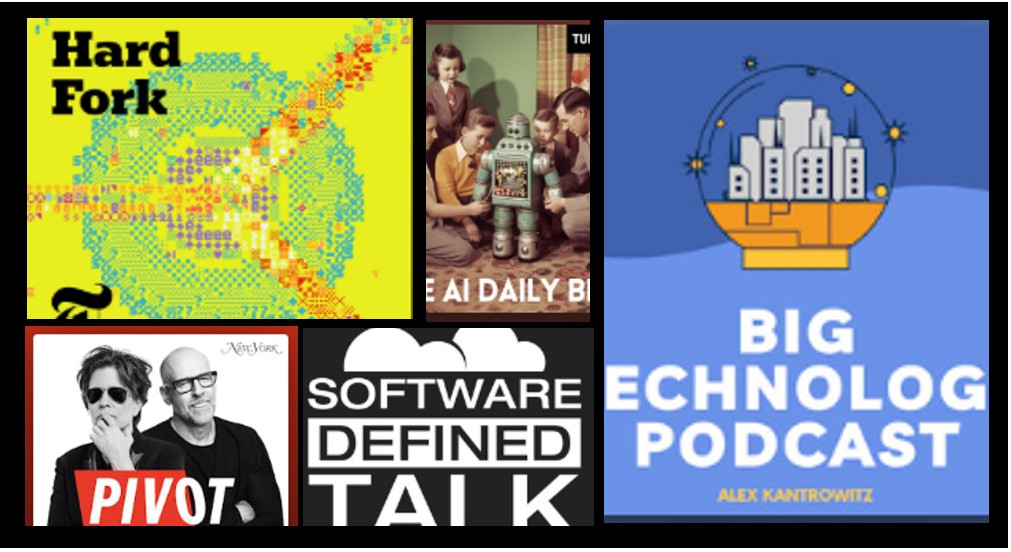
When it comes to tech podcasts, there are five that I listen to religiously and want to share. What follows are my quick thoughts on each. (FYI they’re listed from the least technical to the most, although none of these are really that technical). 

Pivot 

The first is Pivot, starring Scott Galloway and Kara Swisher. Scott is a marketing professor and former industry titan, and Kara is one of the premier journalists in Silicon Valley. Like most podcasts I enjoy, the appeal is really about chemistry and balance. Kara steers the show, while Scott offers insights and, at times, off-color jokes (though he’s toned that down a fair bit). Kara often takes the lead on the key topics, and they’re refreshingly willing to disagree with each other.

Kara, who’s a big fan of Kara, plays the “older sister” role in the relationship, usually keeping a cooler head while not suffering fools gladly. Scott, by contrast, can be goofy, and is unafraid to be vulnerable; he also comes to each show armed with a boatload of stats.  When warranted, both can go off on people and topics, dropping f-bombs and letting loose invective. 

The show is billed as covering “All things tech and business,” but they regularly dip into politics and social issues. (My one peeve is that they can spend too much time discussing media conglomerates and streaming services. I like to watch Netflix, not talk about it.) The podcast drops on Tuesdays and Fridays and typically runs a bit over an hour.


Hard Fork

The second is Hard Fork, with Casey Newton from Platformer and Kevin Roose from The New York Times. Their banter is excellent. Casey plays the instigator, while Kevin laughs at Casey’s antics and bad jokes (props to Kevin for being able to laugh heartily at the drop of a hat). The show was supposed to be focused on crypto but AI happened and, like everywhere else, became the central focus. 

While they tend to align in their views, they do a good job explaining complex topics by having one take the lead while the other asks clarifying questions. Most episodes feature just the two of them, but they also bring on guests, including journalists with deep expertise and people from industry. When they talk to industry guests, they’re really good at asking tough questions and pressing them instead of simply tossing softballs.  Hard Fork comes out on Fridays and usually runs about an hour. 


Big Technology Podcast

The third is imaginatively entitled, Big Technology Podcast. It’s hosted by Alex Kantrowitz, a journalist and frequent tech commentator on outlets like CNN. Most weeks he does a single interview, some I listen to and some I skip, and on Fridays he hosts a show with Ranjan Roy from Margins. Ranjan brings a finance background and tends to be more technical than Alex who steers the conversation. Although it took me a bit, I’ve come to appreciate Alex’s dry delivery, and I like the way the two play off each other.


The AI Daily Brief

Number four is The AI Daily Brief which is the only podcast with a solo host.  For a long time, I was convinced the host was AI-generated – the delivery was flawless, there are no “you knows,” “ums,” or verbal stumbles.  It turns out however that it’s actually hosted by a human, Nathaniel Whittemore.  I don’t know who edits the show but they should get a medal.  (Of course that could be where the AI comes in). 

The shows tend to run about 25 minutes, with the first five minutes covering AI news, followed by a longer segment that goes deeper on a specific topic. The tone is more formal than the others, but he does a solid job backing up his points with tweets, articles, and other sources.

As the name suggests, it comes out daily (I don’t know how he keeps up the pace). I don’t listen to every episode, but I usually try to catch at least the first five minutes. Some episodes are better watched on YouTube, especially when he’s showing apps, demos, or stats. (I should have mentioned that all these pods can also be watched on YouTube)


Software Defined Talk

Last but not least is Software Defined Talk. Clocking in at 500+ episodes this one tends to focus on developers, open source, corporate culture, and a mix of topics that range from arcane to mundane. It stars Michael Coté, Brandon Whichard, and Matt Ray, all three of whom are or were developers. They’re the only trio in my top five, though all three aren’t always on every episode depending on the week (I’ve even had the opportunity to sit in a couple of times, so you know it’s got to be good).

Each person brings a distinct area of expertise and style. Matt Ray is the most technical and also the primary investor voice. Brandon brings product management experience, corporate culture insight, and a steady, rational perspective. Coté rounds things out with strategic insights, thoughtful musings, and occasional stories about life in the Netherlands. Coté also typically handles the closing of the show where they list upcoming conferences, give their recommendations for the week (usually books or TV shows) and Brandon gives a shout out to those around the world who he’s sent SDT stickers to. 


So there you are and there you have it, my top five.  I’m curious to know how many folks out there listen to one or more of these and if you have any not on the list and why?

Pau for now…


Production, Operations Mgt and BPM at Texas State

May 28, 2009

Dave Angelow, adjunct professor at Texas State University just finished teaching a semester long course in Production and Operations Management.  The course, which focuses on the supply chain and value chain as well as some production methods, is a core requirement in the school of management.

I talked with Dave to hear how the course went and how BPM fit into the syllabus.

>>My talk with Dave (5:12): Take a Listen

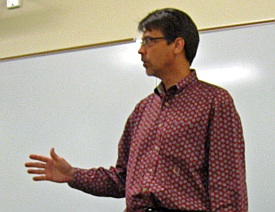
Prof. Dave Angelow of Texas State

Prof. Dave Angelow of Texas State in action.

Some of the topics Dave tackles:

  • How a fair number of students also have day jobs (the course is taught at night) and how this allows them to directly apply what they’ve learned.
  • How BPM, both Business Process Management and Modeling, fit under the quality management section
  • BPM as a means of compressing cycle time and extracting more value for customers.
  • Using Blueprint for a hands on modeling exercise and value the students saw in the tool.

Blueprint Educational Program

Lombardi provides free Blueprint subscriptions for educational use.  If you are teaching or taking a course where you think Blueprint would be appropriate, please contact us at blueprint@lombardi.com to learn more.

Pau for now…


Symantec, process improvement and Blueprint

April 21, 2009

Devin Rickard is a Senior Director of Business Process Improvement at Symantec, the company best known for its Norton line of security products.  The team that Devin belongs to acts as internal process consultants at the company and they’ve adopted Lombardi Blueprint as the common process modeling tool for the group.  What they found however is that Blueprint has a wide appeal beyond their group.

I caught up with Devin to learn about process improvement at Symantec and how his team was using Blueprint.

>>My talk with Devin (11:53): Take a Listen

Devin Rickard of Symantec's Business Process Improvement team

Devin Rickard of Symantec's Business Process Improvement team

Some of the topics Devin tackles:

  • Symantec has grown through rapid organic growth as well as acquisition.  This has led to processes being executed in islands. Devin’s group works with the islands to try and “pull them together into a single continent.”
  • The team practices “stealth six sigma.”  They have adapted the processes and tools from Six Sigma so that they fit the Symantec corporate culture.
  • What started as a nice tool for the practitioners has ended up becoming the core catalyst that brings together individuals and helps them to visualize what they are trying to improve upon for Symantec customers and partners.
  • As business owners or process managers become engaged they are becoming aggressive adopters of Blueprint.  They find it gets them a picture of their business that they’ve never had before and they want to find the areas within their own processes that they can make improvements to.
  • The interest/involvement of the business has noticeably shortened the time to improvements.
  • Some of the projects Devin and team have used Blueprint for: transforming the quote to cash process and the procure to pay process (Blueprint helped to cut the time to pay employee expense reports from 3-5 weeks to 2-3 days) as well as working on ways to make the process of integrating acquisitions smoother.

Pau for now…


Mark Shuttleworth dicusses the Cloud and Ubuntu

March 30, 2009

Last month Mark Shuttleworth, founder of Ubuntu Linux, CEO of Cannonical Ltd and First African in Space, announced that Ubuntu was going to be making a big push into cloud computing with their release slated for October.  This will add to early cloud support that’s debuting in next month’s release, Ubuntu 9.04.  (BTW, For a good backgrounder on Mark and Ubuntu, check out Ashlee Vance’s story in the New York Times from January).

I  was interested to get some more details so I reached out to Mark to find out his master Cloud plan, his thoughts on Cloud Computing today and where he thought it was going.  This is what he had to say:

My interview with Mark (9:51)  Listen (Mp3) Listen (ogg)


Mark and myself at the Ubuntu Developer Summit in Boston at the end of ’07 (Mark’s the one without the “Barton” name tag.)

Some of the topics Mark Tackles:

  • Ubuntu has picked two anchor points for its cloud strategy: Amazon EC2 and UCSB‘s (go Gauchos!) Eucalyptus.  Eucalyptus is for those looking to create “private clouds” on their own and on the Amazon side they are making it easy for users to plug into EC2 as well as offering folks the ability to run Ubuntu-based machines on their cloud.
  • Why they went with EC2 and Eucalyptus.  On the Eucalyptus side it has to with it being Java-based, which meshes nicely with the work Ubuntu did with Sun to get the Java stack “straightened out” on Ubuntu for  app servers.
  • The constraints that EC2 imposes actually make it more interesting by providing discipline, much in the same way that http applied the discipline of being completely connectionless.
  • We haven’t yet seen the “definitive cloud” in  the way that Google came along and captured the spirit (and revenues) of the web.  It will still be 5 -10 years before the cloud computing is nailed.
  • Portability in the Cloud is key if we want to avoid gross lock-in issues.  People are trying to tackle this in a variety of ways but it makes sense to look at the way http came to dominance.
  • Any truth to the rumor that Google is planning on using Ubuntu as a Netbook OS? (listen how Mark deftly responds 🙂
  • Last time we spoke, back in August, Mark said he was looking at profitability in 18 months to two years, is he still on track?

Pau for now…

Update: Here is the Register article based on the above podcast.


Teaching Process

February 6, 2009

Yesterday I chatted with Dr. Joyce Statz who has been teaching a course at St. Edwards University in its school of management and business.  Her course, “Multiple project and portfolio management” is offered as part of the Masters of Science in Project Management degree, and teaches how to manage multiple portfolios of project work in an organization.

I recently learned that Joyce introduced Lombardi Blueprint as a tool within her class and had a lot of success.  I called her up to learn more.

Take a listen:

>> My talk with Joyce (6:11): Listen (mp3) Listen (ogg)

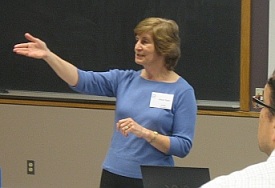
Joyce Statz in the process of teaching process.

Joyce Statz in the process of teaching process.

Some of the Topics we tackle:

  • Who are the students that make up her class and what are their backgrounds?
  • Mixing concepts with hands-on exercises
  • Replacing Visio/Word/Excel in the classroom
  • How the strongest Visio advocates at the beginning of the term became the biggest Blueprint champions at the end of the course.

Blueprint Educational Program

Lombardi provides free Blueprint subscriptions for educational use.  If you are teaching or taking a course where you think Blueprint would be appropriate, please contact us at blueprint@lombardi.com to learn more.

Pau for now…


Talking “Cloud” with Rajen Sheth — Inventor of Google Apps

February 2, 2009

The week before last, the Cloud Connect event in Mountain View kicked off with an “Evening in the Cloud.”  Representatives from Google, Amazon Web Services, and Force.com pitched heads of IT on why they should move all their IT to the cloud.  (Not sure who convinced whom, but it was an interesting debate nonetheless 🙂 )

Representing Google was Ragen Sheth, its lead Product Manager and the person credited with inventing Google Apps.  After he finished speaking I was able to grab a few minutes with Ragen to learn more about what Google’s been doing in the Cloud.  Check it out.

Take a listen:

>> My talk with Rajen (9:47): Listen (mp3) Listen (ogg)

Rajen Sheth of Google Apps.

Rajen Sheth of Google Apps.

Some of the Topics we tackle:

  • How Google Apps is Google’s platform for businesses to run applications in the cloud.
  • Google App Suite is all about bringing the cool things Google has created on the consumer side and presenting it to the businesses.
  • Gmail opened up a whole new model for people to build web-based applications by bringing in AJAX.
  • Over the last 3-4 years a lot of really advanced apps have been built in the browser that utilize the unique leverage points of the cloud.
  • CIO’s have switched from “no way,” to talking feature sets when the subject of the cloud is brought up.
  • What will we see in 09 in the cloud?   (The recession should help to drive adoption.)
  • Is Rajen seeing more cloud-interest from big or small companies?
  • When will we hit the Cloud tipping point?

Stay tuned

More Google tomorrow when I post a video I did with with Rajen’s partner in crime, Kevin Gough.

Pau for  now…


West Bend Insurance uses BPM and Process Mapping to Create New Offerings and Streamline Operations

January 14, 2009

Over the the holiday break I chatted with Stacie Kenney, a Business Process Analyst with West Bend Mutual Insurance. West Bend is located in Wisconsin and has been around since 1894.  They offer property/casualty insurance for businesses, homes, autos, and personal property through independent agencies in six states.

stacie_westbend-edited1Stacie and I discussed how she worked over the last year to help create a small commercial offering which, before BPM and process mapping, had not been practical to offer.

We also discussed the role that process mapping played in the recent IT department re-org, helping to streamline processes and breakdown silos.

West Bend Business Analyst and Blueprinter, Stacie Kenney

Take a listen:

>> My talk with Stacie (7:17): Listen (mp3) Listen (ogg)

Some of the Topics we tackle:

  • West Bend’s “Smart Business” offering and how it leverages new technologies like services, content generation tool and Teamworks.
  • Given that the “Smart Business” premiums were small, the goal was to de-complicate the process so that the agencies could set up the policy with very little time up front.
  • Before Blueprint, the BA’s leveraged Visio for flows along with a “mammoth” spec doc in Word.  The biggest issue with this approach was keeping the content in sync.
  • West Bend was drawn to Blueprint by its collaboration and document generation capabilities.
  • The “Road To Excellence” and the IT re-org, breaking down silos and centralizing the BA’s.
  • Using process mapping to document the flow of work coming into the BA group from the business, categorize it and then deliver it back on a monthly basis.

Pau for now…


The Cloud — Looking back at ’08 and forward to ’09: Taking with Rackspace’s Head of Strategy

January 7, 2009

I first met Lew Moorman, Rackspace’s Chief strategy officer, at Rackspace’s big Cloud Event back in October.  It was at this event that Rackspace, through acquisitions as well their friendly annexation of  Mosso, positioned itself as a major cloud player.

I caught up with Lew during the slow time over the holidays and we chatted about his thoughts and predictions for Cloud Computing.

lewmoorman

Lew, a self-portrait (lifted from his twitter page)

Take a listen:

>> My talk with Lew (13:18): Listen (mp3) Listen (ogg)

Some of the Topics we tackle:

  • The reason cloud computing is getting all the attention it is is because it represents the paradigm shift of consuming IT as a service.
  • The cloud is all about consuming your IT over the web, on the WAN as opposed to the LAN, from a centralized provider and you don’t have a concept of the assets that are being used to deliver that IT.
  • How the recessionary environment is helping to speed along the adoption of the cloud.
  • How Rackspace plays in all three areas of cloud computing: Infrastructure as a Service (storage and compute power are the cornerstones), Platform as Service (the ability to deploy code on ready-made platform) and Applications as a Service (aka SAAS).
  • Is “Internal Cloud” an oxymoron?
  • Which type of players are likely to be the winners in this space.

Pau for now…


Talking with the President of Dell Americas about Cloud Computing and the Economy

December 1, 2008

When I attended the RackSpace Customer event back at the end of September I was impressed with the talk that Paul Bell of Dell gave (Paul reports to CEO Michael Dell and is responsible for all business operations for Dell in North and South America).

dell_cloudsedited1

Dell and the Cloud(s) (sources: my hand + the football Dell gave out at the conference + Friday’s sunset)

In his keynote Paul talked about Cloud Computing and the challenges the economy was presenting Dell and its customers.  I caught Paul after his talk (BTW Lombardi is a Dell customer and Dell is a Lombardi Teamworks customer) and asked if I could tape a podcast with him.  He graciously agreed and here’s the result that I recorded at the beginning of last week.

Take a listen:

>> My talk with Paul (11:59): Listen (mp3) Listen (ogg)

Some of the Topics we tackle:

  • The key Cloud characteristics: Speed to deployment and ease of turning on/off
  • The need to separate the “real” from the fictitious when it comes to the Cloud
  • The interest Paul is seeing in the Cloud from smaller companies
  • Two of the biggest ways Dells plays in the cloud 1) supplier of infrastructure 2) deliverer of IT as a service
  • How on one hand the tough economy is driving interest in utilizing the cloud while at the same time it is causing a slow down in the sales of cloud infrastructure
  • The economy (starts ~7:30): Looking back at what happened in 2001 and trying to gain insight
  • How the economic malaise that hit North America has finally caught up with South America
  • How Dell is planning to help customers during these tough times.

Pau for now…


Morphis: Accidental Process Consultants

November 17, 2008

Morphis is a company that provides currency supply chain management software and counts among its customers the U.S. Federal reserve as well as central banks, ATMs and armored car companies around the world.  Process mapping was the furthest thing from their minds when they started in business but they quickly found out that if they didn’t start leading their customers in process mapping sessions they wouldn’t be able to sell their product.

Last week I chatted with Gary Faulkner of Morphis about how they found themselves unexpectedly leading process mapping sessions for customers or, as Gary likes to describe the turn of events, “A funny thing happened on the way to the software business.”

Take a listen:

>> My talk with Gary (6:59):  Listen (mp3) Listen (ogg)

pair-o-dime_shiftsmallarrow3

Blueprint enabled a pair-o-dime shift for this currency manager. (sources: my fingers and my dimes)

Some of the Topics we tackle:

  • Conundrum: Morphis is meant to be customized to fit a customer’s process but if a customer can’t describe their process how can Morphis be customized?
  • Being new to process mapping they were looking for something that was intuitive and easy to use.
  • The power of seeing the process laid out visually and the importance of working on the exercise collaboratively.
  • How Morphis’s implementations are all done virtually over Webex around the globe

Pau for now…


Rackspace’s CTO John Engates and his “Cloudy” thoughts

November 11, 2008

Last but not least in the three podcasts I taped at the Rackspace Customer Event is my conversation with John Engates, Rackspace CTO.  Like Lanham and Jonathan, John was a very approachable and likable guy.  I checked out John’s presentation earlier in the day and then caught up with him in the afternoon to chat.

Take a listen:

>> My talk with John (20:11): Listen (mp3) Listen (ogg)

rck_johnengates

The radiant John Engates.

Some of the Topics we tackle:

  • John’s definition or “characteristics” of the cloud
  • The various shades of the cloud and who plays where
  • Why Amazon has gone with such geeky names e.g. EC2, S3, AWS
  • Making the cloud accessible so that you don’t need a comp sci degree to use it
  • The Microsoft announcement and why they’re a natural fit
  • The founding and evolution of Mosso
  • Combining hosting elements and cloud elements (Blueprint leverages both)
  • The pitfalls of the cloud, real and perceived (and what is a “server hugger”)

Pau for now…


Chattin’ with Mosso co-founder, Jonathan Bryce

November 10, 2008

At the Rackspace Customer Event the week before last, I caught up with Mosso co-founder Jonathan Bryce.  Jonathan walked me through how Mosso, now officially a Rackspace division, got started and where he sees it going.

Take a listen:

>> My chat with Jonathan (10:52):  Listen (mp3) Listen (ogg)

rck_jonathanbryce1

Jonathan chillin’ in the Baroque Westin Riverwalk lobby.

Some of the Topics we tackle:

  • How while at Rackspace, Jonathan and a buddy moonlighted as web app developers and when they couldn’t find a place to host the apps and sites they developed, they got funding from Rackspace and created Mosso.
  • How Mosso was being founded as people were getting burned by the undelivered promises of Utility computing.
  • How Jonathan defines cloud computing (hint: it has three layers).
  • The characteristics and examples of IaaA, PaaS, SaaS and where Rackspace/Mosso plays.
  • The joy of 15 cents a GB per month storage that Mosso will be providing and which Blueprint will be leveraging in our next release.
  • The relationship between Rackspace and Mosso and why the Mosso site is so much cooler.
  • What role open source plays in the Cloud and Mosso.

Extra-credit

If you want to catch Jonathan live, he will be presenting at the Cloud Computing expo in San Jose November 19 – 21.

Pau for now..


Talkin’ with Rackspace’s CEO Lanham Napier about the Cloud and Hosting

November 6, 2008

Last week I attended the Rackspace customer event down in San Antonio.  On the first day of the event I was able to grab sometime with Rackspace’s CEO, Lanham Napier.  We chatted about going public, the company’s recent acquisitions and its foray into the cloud via Mosso.

Take a listen:

>> My Interview with Lanham (8:11): Listen (mp3) Listen (ogg)

rck_lanhamnapier2

CFO turned CEO, Lanham Napier (who sounds like someone famous)

Some of the Topics we tackle:

  • What does Rackspace do and what’s the company’s ultimate goal.
  • Why Rackspace decided to IPO in the choppy seas of August.
  • How the company decided on SliceHost and JungleDisk as acquisition targets
  • Rackspace’s two service sets, Managed Hosting and Cloud Hosting, and what’s the difference (Blueprint utilizes both)
  • Lanham’s thoughts on Microsoft’s Cloud announcement and the relationship between the two companies.

But wait, there’s more

Stay tuned, in the next few days I will be posting the other two podcasts I did last week, one with  CTO John Engates as well as one with Mosso co-founder Jonathan Bryce.

Pau for now…


The Tillamook Podcast — 99 yr old Dairy Cooperative embraces Process Mapping

November 3, 2008

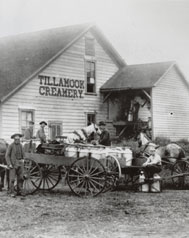
If you’re not familiar with the name, Tillamook is a 99 year-old cooperative made up of over 150 dairies that produces high-end dairy products.  The award-winning cooperative, officially named the Tillamook County Creamery Association, is located up in the north west corner of Oregon.

Until recently, processes were passed down from artisan to artisan in the form of what Steve Burge, who runs TIllamooks’ Business Process Management Office, jokingly refers to as “tribal knowledge.”

There’s a new Sheriff in town and he’s a fan of BPM

When Tillamook’s new CEO came on board he realized that he needed to get a handle on the company’s processes in order to move forward and compete in today’s market.  It was Steve’s job to put together a Process Management Model to lead the collection and documentation of the company’s processes.

>> My Interview with Steve (7:06) : Listen (mp3) Listen (ogg)

Some of the topics we tackle:

  • How Steve built a core team where IT was in the minority and the majority of the members came from the business side.
  • How the team decided where to begin.
  • Why they decided to abandon Visio and cocktail napkins for Blueprint and the value they saw in a hosted application.
  • How they involved over 150 people, from all over the company, to help detail the processes
  • How they got process owners from the business to own execution after the initial documentation effort.

Pau for now…