Tuesday I listened in on the RighScale webinar: How to Build Scalable Websites in the Cloud. This is part two of my thoughts and notes from the event. (Note: it doesn’t look like it’s been posted yet but it should be available here soon).
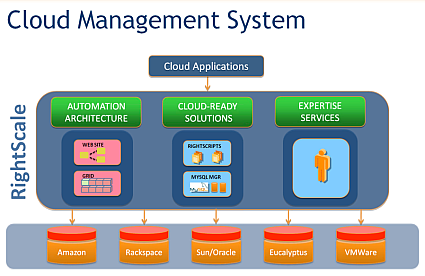
The clouds providers that Right Scale works with.
As I discussed last time, RightScale acts as a management platform between cloud providers and Apps.
Which Cloud Providers do they work with?
If you double click on the IAAS bit in the yesterday’s slide you get something like the above. Right Scale works on top of Amazon, coming soon to Rackspace’s Slicehost, Sun/Oracle’s cloud), Eucalyptus theEC2-compatible open source alternative that allows you to set up “private clouds” (BTW as anyone who attended Austin Cloud camp knows I’m using “private cloud” under duress, Gordon Haff does a good job explaining my heartburn) and VMWare.
Linux more robust than Windows
When asked about OS’s supported the answer was Windows as well as Ubuntu and CentOS. Their CEO did admit that currently Windows support is not as robust as Linux. They actually began with CentOS and according to one of their team have recently begun supporting Ubuntu more fully. When I asked about other Linux flavors, Debian, SuSE etc. they said that there were “licensing issues” standing in the way. I should have asked about OpenSolaris 🙂
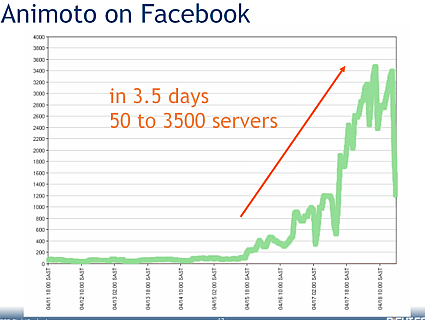
Animoto, the well used example of how server demand can explode.
Why do you look to the clouds?
During the webinar they polled the 200 odd attendees: “what’s driving you to the cloud?” The results (as you’ll notice, you were allowed to vote for more than one):
80% Scalability
73% Cost Savings
59% On Demand access
28% Back-up and recovery
06% Other
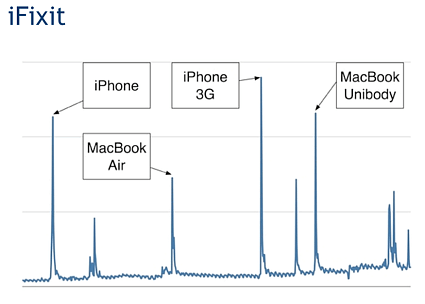
Not surprisingly Scalability came in number 1. As if to underscore the point they brought out everbody’s favorite case study of exploding demand, Animoto. Thankfully they had another example of uneven demand, iFixit (see below). As an aside, one example I’d like to see charted is the attendee who mentioned that their agency is responsible for posting election results and were “not prepared for the interest worldwide, for Proposition 8.”
It was interesting to see that cost savings came in a close second, its always hard to measure particularly over the long haul but the perceived cost benefit is definitely strong in most folks mind.
iFixit's traffic could be said to be a tad "spikey."
Right Scale fighting for Server voting rights
And in conclusion…I’m always intrigued with the way English language morphs and evolves so I thought it was really interesting how the word “vote” is being used in the cloud (or at least by RightScale). Basically they use a “voting process” when scaling. Here’s how one of their team explained it.
Once a machine hits the scale up threshold it places a vote to scale up. When enough machines vote to scale up i.e. 51% if that that is what the decision threshold is set at, then new servers are provisioned and configured. The same goes for scaling down.
Don’t know if this usage is new or a throw back from mainframes or from some other industry but I like it.
Yesterday I attended a webinar that RightScale put on entitled: How to Build Scalable Websites in the Cloud. It was basically a welcome to RightScale, welcome to the cloud presentation but overall interesting and credible.
The presenters were their CEO, their head of marketing and a mini team of techies. Below is part one of some of my thoughts and takeaways. But first a slight digression…
Enter the Dolphin Master
One thing I noticed during the presentation and which warmed my heart was that MySQL played prominently in a bunch of the slides. It was only today when I was poking around the RightScale site that I saw the press release from a few weeks ago announcing that Marten Mickos, former MySQL CEO and Sun employee joined the RightScale board of directors. Its interesting but not surprising to note in the release that Marten calls out Sun and Canonical (the commercial sponsor behind Ubuntu) as two strategic partners helping to expand the RightScale ecosystem.
Where Right Scale fits within the tri-sected cloud.
Where they play in the Cloud(s)
RightScale positions themselves as a cloud management platform or as I like to think of it “a cloud tamer.” If you split the cloud in three — software as a service, platform as a service and infrastructure as a service — they play in the last space. Basically Right Scale sits on top of Infrastructure as a Service (IAAS) and can handle all the tricky bits so you don’t have to.
Choose or choose not to choose
For those who want more control over their infrastructure RightScale will allow you to “choose among a variety of development languages, software stacks, data stores and cloud providers.” For those less intrepid in the cloud they have server templates that you can start off with.
One of the key benefits they stressed was getting rid of vendor lock-in, “so that you never get locked in to a single provider.” You’ll notice on the X axis above they show lock-in decreasing and portability increasing as you move to the right. My question however is that with Right Scale aren’t you simply locked in to a different layer of the cloud? Doesn’t the control point simply move up the stack? Just wondering…
My blogging has been a bit anemic lately. We had our big Blueprint launch in the middle of last month accompanied by the post launch clean up of all the stuff I had designated as “get to it after the launch.” And then there was strep throat and visiting relatives…blah…blah..blah.
So here I am back in the saddle and finally getting around to posting my slides from Cloud Camp Austin where Lombardi Blueprint was a gold sponsor. You’ll notice in the transfer to slideshare, some of the formatting is off and in slide 6 you don’t get to see the great build where the poor person collecting the process data gets buried under a mound of random documents – but you’ll get the idea.
To get some of the narrative behind this and more, check out the interview Redmonk’s Michale Cote did with me at the event.
But wait, there’s more…
For those brave enough to go beyond the last slide you’ll get a special bonus slide of all the cheesy 80’s bands used as code names for Blueprint’s releases right up to the the most recent, “Survivor.”
Last year I did a podcast with Mosso (“The Rackspace Cloud”) co-founder Jonathan Bryce. Last Saturday at Cloud Camp Austin I caught up with the other co-counder of Mosso, Todd Morey to get his side of the story.
Some of the topics Todd tackles:
How Todd and Jonathan formed a good partnership, Todd on UI and design and Jonathan on the development side.
Starting Mosso out of a desire to have place where they could run their code without having to worry about the infrastructure.
Mosso’s integration back into Rackspace
Will Mosso bring some of its hipness to Rackspace? (editorial note: looking at the Rackspace’s site it looks like Mosso has already influenced it for the better)
At Austin Cloud Camp on Saturday I ran into Ubuntu linux developer and Canonical employee, Dustin Kirkland. Dustin is on the server developer team at Canonical and, as he explains it, focuses on various aspects of virtualization, the plumbing layer below cloud computing. I grabbed Dustin for a few minutes and chatted with him about last week’s release and what he’s been working on.
Michael Cote of Redmonk welcomes us all. (credit Dave Nielsen)
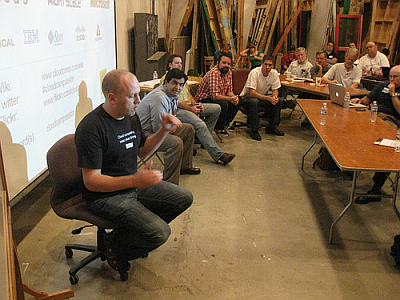
This past Saturday, Cloud Camp Austin was held down on the UT campus. There was a very healthy turnout and a lot of great discussions were generated.
Sequence of Events
After opening salutations, camp got underway with a series of six five-minute lightening talks delivered by the camp’s gold sponsors.
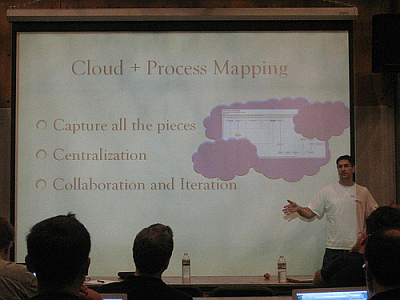
My lightening talk: Mapping Processes in the Cloud (credit: Dave Nielsen)
The Main Event
From there, Dave Nielsen, the man who originally developed the cloud camp format (and who took most of the pictures in this post — see them all), guided us through the process of coming up with topics for session discussions. That process, appropriately enough given that this was an unconference, began with an “unpanel.”
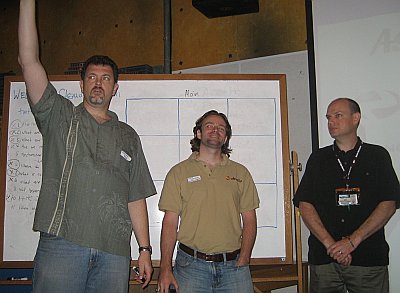
The Unpannel: Michael Wilde of Splunk, (not sure), Dustin from Canonical, Cote, myself (credit Dave Nielsen)
All Together Now
The way it worked was the room first brainstormed a list of topics they were interested in discussing/learning more about. Anyone who thought they were an expert on one or more of these topics got to get up from their seats and form a five person panel at the front of the room. Each member of the panel then answered two questions from the board and as the question was answered the audience was asked if the topic had been covered by the answer or if it warranted further discussion in an afternoon session
(L->R) Dave Nielsen leads us through our unconference set up. Canonical's Dustin Kirkland and hero-for-hire John West lend a hand.
A Schedule is Born
After the panel, as a group we all decided what the final sessions would be and who would lead them. To lead a session you could either be knowledgeable in the area or completely clueless but wanted to learn about it.
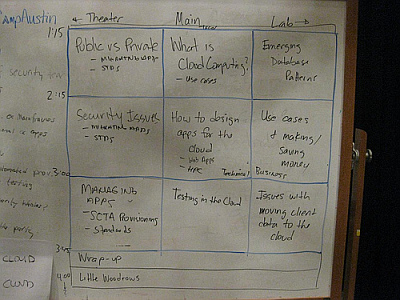
The completed schedule: three sessions ran at a time and there were three time slots (credit Dave Nielsen)
Coming Soon
While at camp I did a couple of video interviews, one with Dustin Kirkland of Canonical and one with Todd Morey of Mosso/Rackspace. I should be posting those in the next few days. I also found myself on the other end of the microphone being interviewed by Mr. Cote. That should be appearing in the near distant future on his blog.
To get some insight into the release and what it means, I grabbed some time with Simon Wardley of Canonical. Simon, who joined Canonical near the end of last year, is the person tasked with looking into cloud computing for the company in order to figure out what it means for them, what it means for the industry and ultimately, determining what Canonical should be doing about this change that’s occurring in our industry.
Simon Wardley, setting the controls for the heart of the cloud.
Some of the topics Simon tackles:
How did Simon get his present job and what was he doing before?
When looking at adopting cloud computing three risks need to be evaluated
The risk of doing nothing (which should be balanced against the next two)
Transitional risk
Out sourcing risks
Cloud standards will emerge through the marketplace rather than via committee
Why Ubuntu went with Amazon EC2 and Eucalyptus.
Today’s release is a technical preview, “a starting point in a journey.”
For the “Karmic Koala” release due in October, they will be focusing on persistency, policies and portability. They are also working with a bunch of management tool providers to allow users a choice of how they want to manage their environment.
Whats coming next year in the cloud space:
A hybrid model: Private clouds that allow bursting between them and public clouds.
Portability between providers will become a big issue.
A lot of standardization at the infrastructure layer of the stack
An explosion of innovation
The IT department will face real governance issues
Open source will continue to be critically important
Rackspace, Microsoft and Sun find themselves in good company 🙂
As an application that leverages all the agility and reach that the cloud provides, we thought it only appropriate that Lombardi Blueprint help sponsor Cloud Camp Austin 2009.
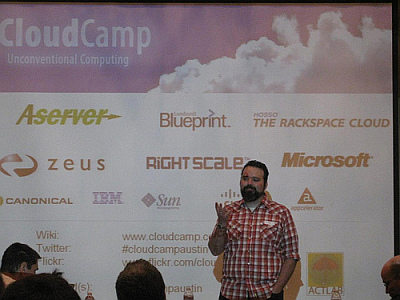
Along with lesser known companies like Microsoft, Sun and Rackspace, Lombardi Blueprint is a gold sponsor of the event (actually since I took the screenshot to the left, Aserver, Rightscale and Zeus have also joined the golden ranks).
As a gold sponsor we get to deliver a 5-7 minute lightening talk at the beginning of the event. The only restrictions are that it be cloud related and it can’t be a product pitch. I will be talking about the cloud and democratization of information.
What, When, Where…
The event takes place next Saturday, April 25th from 10AM – 4PM down at Austin City Limits on the UT campus.Here’s how the webpage sums up the event:
CloudCamp is an unconference where early adopters of Cloud Computing technologies exchange ideas. With the rapid change occurring in the industry, we need a place we can meet to share our experiences, challenges and solutions. At CloudCamp, you are encouraged you to share your thoughts in several open discussions, as we strive for the advancement of Cloud Computing. End users, IT professionals and vendors are all encouraged to participate.
(Here are a few more thoughts regarding the event from co-organizer and Red Monk analyst Michael Cote.)
Free for All
The cost of the event is FREE and all you need to do is register online so they know how many folks are coming (heck, I bet if you showed up that day they probably wouldn’t turn you away.) So come on down next Saturday and enjoy and learn. And remember, since its an unconference that means anyone can propose and lead a session and we all learn from each other.
Last week Rackspace announced the appointment of Lew Moorman as president of Rackspace’s Cloud Computing Efforts. As luck would have it, Lew was attending Web 2.0 and I was able to grab a few minutes of his time to shoot a video. Not only that but as added bonus, recent Rackspace conscriptRobert Scoble joined the conversation as well.
To watch in High Quality: after clicking play, click the “HQ” button that will appear on the bottom.
Some of the topics Lew and Robert tackle:
What does it mean to be president of Rackspace’s computing efforts?
What’s “building 43” about and what is Robert’s mission at Rackspace?
How did Rackspace decide on hiring Robert and Rocky?
Rackspace added to the NASDAQ index (even though they trade on the NYSE)
Robert asks Lew about Slicehost and Rackspace’s plans there.
Lew out at Web 2.0 meeting with a lot of developers and looking to help them sell their tools to Rackspace customers.
Last month Mark Shuttleworth, founder of Ubuntu Linux, CEO of Cannonical Ltd and First African in Space,announced that Ubuntu was going to be making a big push into cloud computing with their release slated for October. This will add to early cloud support that’s debuting in next month’s release, Ubuntu 9.04. (BTW, For a good backgrounder on Mark and Ubuntu, check out Ashlee Vance’s story in the New York Times from January).
I was interested to get some more details so I reached out to Mark to find out his master Cloud plan, his thoughts on Cloud Computing today and where he thought it was going. This is what he had to say:
Mark and myself at the Ubuntu Developer Summit in Boston at the end of ’07 (Mark’s the one without the “Barton” name tag.)
Some of the topics Mark Tackles:
Ubuntu has picked two anchor points for its cloud strategy: Amazon EC2 and UCSB‘s (go Gauchos!) Eucalyptus. Eucalyptus is for those looking to create “private clouds” on their own and on the Amazon side they are making it easy for users to plug into EC2 as well as offering folks the ability to run Ubuntu-based machines on their cloud.
Why they went with EC2 and Eucalyptus. On the Eucalyptus side it has to with it being Java-based, which meshes nicely with the work Ubuntu did with Sun to get the Java stack “straightened out” on Ubuntu for app servers.
The constraints that EC2 imposes actually make it more interesting by providing discipline, much in the same way that http applied the discipline of being completely connectionless.
We haven’t yet seen the “definitive cloud” in the way that Google came along and captured the spirit (and revenues) of the web. It will still be 5 -10 years before the cloud computing is nailed.
Portability in the Cloud is key if we want to avoid gross lock-in issues. People are trying to tackle this in a variety of ways but it makes sense to look at the way http came to dominance.
Any truth to the rumor that Google is planning on using Ubuntu as a Netbook OS? (listen how Mark deftly responds 🙂
Last time we spoke, back in August, Mark said he was looking at profitability in 18 months to two years, is he still on track?
Pau for now…
Update: Here is the Register article based on the above podcast.
At SXSW interactive I came across the booth for the cloud-based app Animoto. I was intrigued since I have seen a couple of Amazon Web Services presentations and both held up Animoto as a great example of an application that would have been impossible to deliver any other way.
Animoto, which creates videos for consumers and corporations, relies on a huge amount of processing power and has had gigantic spikes in usage (e.g. going from 70 servers to 8,500 servers in 5 days). You can say they put the “elastic” in Amazon’s “Elastic Compute Cloud.”
Here is an interview I did with Animoto co-founder and President Jason Hsiao.
To watch in High Quality: after clicking play, click the “HQ” button that will appear on the bottom.
Some of the things Jason talks about:
Total number of servers owned by Animoto = 0
The most expensive piece of equipment in the office is the espresso machine.
How the enterprise side of the business has taken off.
Why they’re based in New York and where the founders came from.
How their extreme processor intensiveness allows them to work extra closely with Amazon.
See how he deftly avoids the question about what feature he is looking forward to seeing from Amazon, they must be working on something 😉
Salesforce.com was one of the Platinum Sponsors at Cloud Connect. I stopped by their booth and had a quick chat with Kavindra from developer marketing, Ash, a Force.com evangelist and Ryan a technical marketer.
To watch in High Quality: after clicking play, click the “HQ” button that will appear on the bottom.
Some of the topics Kavindra, Ash and Ryan Tackle:
Speed Geeking and Chalk Talks.
Why Force.com is great for building enterprise Apps.
On the second day of Cloud Connect I caught up with Kevin Gough of Google. Kevin leads marketing efforts for Google Apps, website search, enterprise search and geospatial products and we chatted a bit about the evolution of the Google Apps team.
To watch in High Quality: after clicking play, click the “HQ” button that will appear on the bottom.
Some of the topics Kevin Tackles:
Growing the Enterprise team from less than 20 to over 500.
The evolution from Search -> Maps -> Earth -> Google Apps (Google’s thrust into the cloud for businesses)
Python and App Engine, going with what’s familiar and plans to expand
The week before last, the Cloud Connect event in Mountain View kicked off with an “Evening in the Cloud.” Representatives from Google, Amazon Web Services, and Force.com pitched heads of IT on why they should move all their IT to the cloud. (Not sure who convinced whom, but it was an interesting debate nonetheless 🙂 )
Representing Google was Ragen Sheth, its lead Product Manager and the person credited with inventing Google Apps. After he finished speaking I was able to grab a few minutes with Ragen to learn more about what Google’s been doing in the Cloud. Check it out.
I grabbed some time (2:31) with Alistair after his panel to follow up on a comment he made during the session regarding meta-data in the cloud and who owns it. I also asked about his predictions for ’09.
To watch in High Quality: after clicking play, click the “HQ” button that will appear on the bottom.
The first full day of Cloud Connect last week in Mountain View began with a panel discussion on standards and the cloud. One of the panelist was Sam Charrington, the VP of product management and marketing at Appistry. I was able to grab a few minutes (2:37) with the affable Sam after his session and talk a little about Appistry and how they play in the cloud.
To watch in High Quality: after clicking play, click the “HQ” button that will appear on the bottom.
Some of the topics Sam Tackles:
Offering a cloud platform delivered as software and tailored for enterprise users (think Google app-engine available as software and deployable on your cloud platform of choice e.g. private clouds or Amazon EC2 or GoGrid.
Freeing customers from lock-in and elevating the customer experience from managing individual virtual instances.
Last week at Cloud Connect I was able to grab a few minutes with my old boss from Sun, Ian Murdock. Ian, the founder of the Debian Linux distribution, came to Sun to lead the Open Solaris charge and after that tackled Developer relations. Turns out that with the latest Sun re-org Ian has now landed in the Cloud Computing group as the VP of Strategy.
To watch in High Quality: after clicking play, click the “HQ” button that will appear on the bottom.
Some of the topics Ian Tackles:
How cloud computing today reminds him of the Open Source world back in 1993 when he first got involved with Linux and Free Software.
What might be the equivalent of the Linux distro in the cloud space.
The importance of standards and how Sun might play there.
Ok well maybe its not live but here’s a short (3:34) video I shot yesterday with David Berlind, the man behind Cloud Connect. The conference kicked off Tuesday night and continues, as I type, until this evening.
To watch in High Quality: after clicking play, click the “HQ” button that will appear on the bottom.
This video was shot right in the middle of the “speed geeking” section yesterday where attendees visited nine different cloud demos being presented by the sponsors: Amazon Web Services, IBM, Mosso, Google, Right Scale and Salesforce.com.
In the Video David talks about
The idea behind Cloud Connect and whats going on
Where the cloud works best
His predictions for whats going to happen in the cloud space in ’09 (hint, watch out for the big boys).
But wait, there’s more…
If you’re interested in hearing more from Cloud connect Check back here over the next week since I’ll be posting about six more videos as well as an audio podcast with the founder of Google Apps.
Next week I’m making my way back to the Bay Area to attend the Cloud Connect un-conference that is being held Jan 20-22 at the Computer History Museum in Mountain View.
The conference is being held in the unstructured un-conference style which I prefer. It allows more time for meeting people and talking about what you want to talk about. That being said, the event won’t be total anarchy and in fact I’m looking forward to the talk David Berlind is moderating Tuesday night. There is also a cool panel that Red Monk analyst and fellow Eph, Stephen O’Grady is leading the following day on the Cloud and Lock-in.
I will be attending the conference armed with an audio recorder as well as a brand new Flip Mino to try my hand at Video podcasting. Attendees, you are forewarned 🙂
Checking out Blueprint in Action
While I’m out in the Valley I’m going to visit a couple of big accounts to see first-hand how they are using the Lombardi Blueprint and also get their input on what they’d like to see in the way of new functionality going forward.
The other area that I want to research is the applicability of Blueprint in the supplier chain/operations world. I think it would be a great fit but i want to check with some contacts out there to get their thoughts.
I first met Lew Moorman, Rackspace’s Chief strategy officer, at Rackspace’s big Cloud Event back in October. It was at this event that Rackspace, through acquisitions as well their friendly annexation of Mosso, positioned itself as a major cloud player.
I caught up with Lew during the slow time over the holidays and we chatted about his thoughts and predictions for Cloud Computing.
Lew, a self-portrait (lifted from his twitter page)
The reason cloud computing is getting all the attention it is is because it represents the paradigm shift of consuming IT as a service.
The cloud is all about consuming your IT over the web, on the WAN as opposed to the LAN, from a centralized provider and you don’t have a concept of the assets that are being used to deliver that IT.
How the recessionary environment is helping to speed along the adoption of the cloud.
How Rackspace plays in all three areas of cloud computing: Infrastructure as a Service (storage and compute power are the cornerstones), Platform as Service (the ability to deploy code on ready-made platform) and Applications as a Service (aka SAAS).
Is “Internal Cloud” an oxymoron?
Which type of players are likely to be the winners in this space.


 Posted by Barton George





 Barton's Blog