Devin Rickard is a Senior Director of Business Process Improvement at Symantec, the company best known for its Norton line of security products. The team that Devin belongs to acts as internal process consultants at the company and they’ve adopted Lombardi Blueprint as the common process modeling tool for the group. What they found however is that Blueprint has a wide appeal beyond their group.
I caught up with Devin to learn about process improvement at Symantec and how his team was using Blueprint.
Devin Rickard of Symantec's Business Process Improvement team
Some of the topics Devin tackles:
Symantec has grown through rapid organic growth as well as acquisition. This has led to processes being executed in islands. Devin’s group works with the islands to try and “pull them together into a single continent.”
The team practices “stealth six sigma.” They have adapted the processes and tools from Six Sigma so that they fit the Symantec corporate culture.
What started as a nice tool for the practitioners has ended up becoming the core catalyst that brings together individuals and helps them to visualize what they are trying to improve upon for Symantec customers and partners.
As business owners or process managers become engaged they are becoming aggressive adopters of Blueprint. They find it gets them a picture of their business that they’ve never had before and they want to find the areas within their own processes that they can make improvements to.
The interest/involvement of the business has noticeably shortened the time to improvements.
Some of the projects Devin and team have used Blueprint for: transforming the quote to cash process and the procure to pay process (Blueprint helped to cut the time to pay employee expense reports from 3-5 weeks to 2-3 days) as well as working on ways to make the process of integrating acquisitions smoother.
Rackspace, Microsoft and Sun find themselves in good company 🙂
As an application that leverages all the agility and reach that the cloud provides, we thought it only appropriate that Lombardi Blueprint help sponsor Cloud Camp Austin 2009.
Along with lesser known companies like Microsoft, Sun and Rackspace, Lombardi Blueprint is a gold sponsor of the event (actually since I took the screenshot to the left, Aserver, Rightscale and Zeus have also joined the golden ranks).
As a gold sponsor we get to deliver a 5-7 minute lightening talk at the beginning of the event. The only restrictions are that it be cloud related and it can’t be a product pitch. I will be talking about the cloud and democratization of information.
What, When, Where…
The event takes place next Saturday, April 25th from 10AM – 4PM down at Austin City Limits on the UT campus.Here’s how the webpage sums up the event:
CloudCamp is an unconference where early adopters of Cloud Computing technologies exchange ideas. With the rapid change occurring in the industry, we need a place we can meet to share our experiences, challenges and solutions. At CloudCamp, you are encouraged you to share your thoughts in several open discussions, as we strive for the advancement of Cloud Computing. End users, IT professionals and vendors are all encouraged to participate.
(Here are a few more thoughts regarding the event from co-organizer and Red Monk analyst Michael Cote.)
Free for All
The cost of the event is FREE and all you need to do is register online so they know how many folks are coming (heck, I bet if you showed up that day they probably wouldn’t turn you away.) So come on down next Saturday and enjoy and learn. And remember, since its an unconference that means anyone can propose and lead a session and we all learn from each other.
I love taking pictures of San Francisco, I think its one of the most photogenic cities in the world. I was back in the Bay Area a couple of weeks ago for Web 2.0 and I got a few shots as I was walking around downtown.
The obligatory cable car picture.
The Apple store on Market, conveniently located next to the Men's Wearhouse.
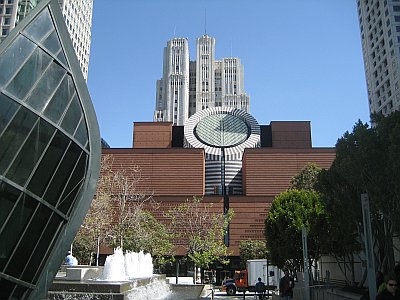
SF MoMA and the Bay Bridge thru my dirty hotel window.
Next month I’ll be heading over to Houston to attend APQC’s knowledge management conference. One of the talks I’m interested in checking out will be given by Bryant Clevenger, the global leader for IBM GBS’s knowledge sharing strategy.
On the KMedge blog, Bryant explains what they’ve been up to:
At IBM, leveraging knowledge has always been an important part of our business. Last year, we undertook a massive overhaul of the technology and approach we use for knowledge management, moving from a centrally managed, linear, taxonomy- and repository-based system to one that leverages the best of Web 2.0, including social software, user participation, and key market-driven concepts like sponsored links.
As a promo for his talk, Bryant put together the following video, complete with a rockin’ BTO instrumental soundtrack :).
Some of the topics the video addresses:
How do you harness the expertise and leverage the knowledge that is spread across 387,000 people located in 170 countries?
1 in 4 workers has been with their current employer for less than 12 months.
People are using web 2.0 in their daily lives, they expect the same tools in the workplace.
The IBM employee knowledge portal allows users to
Search across multiple content repositories
Create social tags, peer ratings and tag content
Locate experts and contact them.
The portal surfaces: 1) the highest rated internal content, 2) Leadership priorities and 3 external competitor info.
Bryant’s “modest” vision for the portal: Unprecedented access to content and experts will shorten the sales cycle and will expand the reach of information…removing country and organization barriers and enabling the globally integrated enterprise.
Goodness for any size
Whether this project actually leads to the “enabling of the globally integrated enterprise” or not I think this effort will create considerable value. I also believe that you don’t have to be a huge multinational like IBM to benefit from the availability of Web 2.0-based tools in the workplace. Web 2.0 tools are built around the principles of linking, sharing, participation and collaboration — valuable elements for a company of any size.
Don’t touch that dial
BTW, If you are interested increasing linking, sharing, participation and collaboration in your organization you’ll want to check out our next Blueprint release, coming soon to a browser near you. Stay tuned 🙂
One of the more interesting people I met last week at Web 2.0 was Gaurav Mishra who is visiting the US from India as a Yahoo! Fellow in Residence. As a Yahoo! Fellow, Gaurav is doing research and teaching at Georgetown University in the field of social media. I was able to grab some of his time and learn what he’s up to.
To watch in High Quality: after clicking play, click the “HQ” button that will appear on the bottom.
Some of the topics that Gaurav tackles:
Looking at social media from an international perspective and examining how businesses, civil society and governments make use of it.
The seminar Gaurav teaches is one of the 2 or 3 social media courses that Georgetown offers.
What Gaurav was doing in India before he got the fellowship.
Social media and activism
The analysis and measurement of social media and how to tie it back to business processes, civil society goals or government objectives.
Last week Rackspace announced the appointment of Lew Moorman as president of Rackspace’s Cloud Computing Efforts. As luck would have it, Lew was attending Web 2.0 and I was able to grab a few minutes of his time to shoot a video. Not only that but as added bonus, recent Rackspace conscriptRobert Scoble joined the conversation as well.
To watch in High Quality: after clicking play, click the “HQ” button that will appear on the bottom.
Some of the topics Lew and Robert tackle:
What does it mean to be president of Rackspace’s computing efforts?
What’s “building 43” about and what is Robert’s mission at Rackspace?
How did Rackspace decide on hiring Robert and Rocky?
Rackspace added to the NASDAQ index (even though they trade on the NYSE)
Robert asks Lew about Slicehost and Rackspace’s plans there.
Lew out at Web 2.0 meeting with a lot of developers and looking to help them sell their tools to Rackspace customers.
I’m currently attending Web 2.0 here in San Francisco. One of the cooler talks I saw yesterday was given by Scott Monty, the head of Ford Motor’s Social Media efforts. I was so intrigued that I thought I would grab him for an interview. He graciously agreed and here’s the result. Enjoy 🙂
To watch in High Quality: after clicking play, click the “HQ” button that will appear on the bottom.
Some of the topics Scott tackles:
Ford’s goal of becoming one of the world’s leading social brands.
Setting content free.
Innovation is made up of small tweaks on existing platforms that build value over time.
How did Ford come to decide they needed a head of social media and how did they pick Scott.
The two things coming up that Scott is most excited about: the Fiesta Movement and the evolution of Fordstory.com into Ford’s social media hub.
BTW, If you want to follow Scott on Twitter, its @scottmonty.
I came across an article in yesterday’s NetworkWorld.com that listed today’s “Top 10 Technology skills.” The list was based on work done by Foote Partners, which conducts quarterly assessments of IT pay trends in the US.
Foote Partners’ CEO David Foote says “what’s unique about this downturn is that IT departments are hiring talent in certain areas – such as business process modeling and project management – while laying off in others connected to weak product lines.”
And, indeed, coming in at the top of the list was Business Process Modeling:
1. Business Process Modeling
Business process management, methodology and modeling is one of the few IT niches that saw pay gains in the fourth quarter of 2008, according to the quarterly IT salary survey compiled by Foote Partners. In particular, companies were willing to pay for workers with ITIL IT best practices and CobiT IT governance experience. Pay for these skills was up 10.3% from a year ago and 5.6% from the previous quarter, the Foote report says.
Kevin Faughnan, director of IBM’s Academic Initiative, says business process modeling is one of the key skills that business majors should be studying. “It’s about how does our business work, what are the business processes and how do we analyze them,” Faughnan says, adding that this is a key issue for companies to consider before applying IT to solve business problems.
This seems to make sense to me. It is always important to know your business processes in order to be able to modify and refine them to keep pace with change… and today there is an extra helping of change that we all must not only keep pace with but get ahead of. Business Process Modeling is a key first step.
Last month Mark Shuttleworth, founder of Ubuntu Linux, CEO of Cannonical Ltd and First African in Space,announced that Ubuntu was going to be making a big push into cloud computing with their release slated for October. This will add to early cloud support that’s debuting in next month’s release, Ubuntu 9.04. (BTW, For a good backgrounder on Mark and Ubuntu, check out Ashlee Vance’s story in the New York Times from January).
I was interested to get some more details so I reached out to Mark to find out his master Cloud plan, his thoughts on Cloud Computing today and where he thought it was going. This is what he had to say:
Mark and myself at the Ubuntu Developer Summit in Boston at the end of ’07 (Mark’s the one without the “Barton” name tag.)
Some of the topics Mark Tackles:
Ubuntu has picked two anchor points for its cloud strategy: Amazon EC2 and UCSB‘s (go Gauchos!) Eucalyptus. Eucalyptus is for those looking to create “private clouds” on their own and on the Amazon side they are making it easy for users to plug into EC2 as well as offering folks the ability to run Ubuntu-based machines on their cloud.
Why they went with EC2 and Eucalyptus. On the Eucalyptus side it has to with it being Java-based, which meshes nicely with the work Ubuntu did with Sun to get the Java stack “straightened out” on Ubuntu for app servers.
The constraints that EC2 imposes actually make it more interesting by providing discipline, much in the same way that http applied the discipline of being completely connectionless.
We haven’t yet seen the “definitive cloud” in the way that Google came along and captured the spirit (and revenues) of the web. It will still be 5 -10 years before the cloud computing is nailed.
Portability in the Cloud is key if we want to avoid gross lock-in issues. People are trying to tackle this in a variety of ways but it makes sense to look at the way http came to dominance.
Any truth to the rumor that Google is planning on using Ubuntu as a Netbook OS? (listen how Mark deftly responds 🙂
Last time we spoke, back in August, Mark said he was looking at profitability in 18 months to two years, is he still on track?
Pau for now…
Update: Here is the Register article based on the above podcast.
At SXSW interactive I came across the booth for the cloud-based app Animoto. I was intrigued since I have seen a couple of Amazon Web Services presentations and both held up Animoto as a great example of an application that would have been impossible to deliver any other way.
Animoto, which creates videos for consumers and corporations, relies on a huge amount of processing power and has had gigantic spikes in usage (e.g. going from 70 servers to 8,500 servers in 5 days). You can say they put the “elastic” in Amazon’s “Elastic Compute Cloud.”
Here is an interview I did with Animoto co-founder and President Jason Hsiao.
To watch in High Quality: after clicking play, click the “HQ” button that will appear on the bottom.
Some of the things Jason talks about:
Total number of servers owned by Animoto = 0
The most expensive piece of equipment in the office is the espresso machine.
How the enterprise side of the business has taken off.
Why they’re based in New York and where the founders came from.
How their extreme processor intensiveness allows them to work extra closely with Amazon.
See how he deftly avoids the question about what feature he is looking forward to seeing from Amazon, they must be working on something 😉
Charlene was at SXSW as a speaker and I caught up with her not long after she finished her session in the main ballroom. You can check out the slide deck she presented below. You can also access the Twitter feed and a summary of the presentation from Charlene’s post. [BTW don’t miss the blooper reel at the bottom]
To watch in High Quality: after clicking play, click the “HQ” button that will appear on the bottom.
Some of the topics Charlene covers:
Groundswell: How company leaders can leverage social networks rather than fear them
Which companies are making the best use of social networks
What social tools Charlene uses and her use of twitter (how it got her quoted in the Wallstreet Journal)
What Charlene is most excited about in the coming year with regards to social networks
The Blooper Reel
You may have noticed that there a few cuts in the video above. This is because they were shutting down the show floor and kept announcing it over the intercom. Check out the blooper reel below for proof — and these aren’t even all the interruptions. (Unfortunately I didn’t capture the part when the Elvis impersonator started singing.)
To watch in High Quality: after clicking play, click the “HQ” button that will appear on the bottom.
Whats particularly interesting, which my old boss Simon turned me on to, is the fact that Union Jack (technically the Union Flag) is actually made up of the flags of the three of the four guys above:
Turns out the reason St David didnt get his flag included is because Wales was a principality and not a kingdom. Thats a bummer cause I think it would have been totaly cool to have a dragon right in the middle of the Union Jack!
A few weeks ago I blogged about the Forrester review of Blueprint that was published in early February.
We recently purchased licensing rights to the report, “Vendor Snapshot: Lombardi Blueprint Bridges Gap Between Process Discovery And Execution” and it is now available here.
Quotable Quotes
Here are some of my favorite quotes from the report:
Blueprint provides a process modeling and discovery platform that blends collaboration and documentation capabilities into an easy-to-use, low cost, software-as-a-service offering that can be used by beginner to expert process analysts.
Blueprint combines the best of both worlds for analysts: the “ready-to-use” feel of office productivity tools and the comprehensive knowledge repository found in traditional BPA tools.
Lombardi Blueprint represents a new way of developing, delivering, and interacting with software — the combination of SaaS, Web 2.0, and business process.
From the very beginning, BPM suite vendors sold business and process analysts on empty promises of easy-to-use modeling capabilities. Lombardi is one of the first BPM suite vendors to deliver on the promise of ease of use for process analysts. Lombardi Blueprint combines collaboration, ease of use, and a centralized process repository into an inexpensive and elegant SaaS-based offering.
But don’t take Forrester’s word for it…
And if those quotes don’t get you to sign-up for a free 30-day trial of Blueprint, I don’t know what will. 🙂 Check Blueprint out for yourself. Sign-up for a free trial here.
Well today is Saint Patrick’s day, a day for revelry and libations in many locations across the globe.
Now most people know that St. Pat is the patron saint of Ireland, the guy who chased all the snakes out of Eire. (Fun facts to know and tell: St. Patrick’s real name was Maewyn Succat. Can you imagine saddling a kid with that moniker? I bet he was teased a lot growing up.)
The question is, can you name the other three patron saints that make up the fab four of Great Britain and Ireland? That is to say, who are the patron saints of England, Scotland and Wales?
Tune in next time for the answers (no fair using Google).
As I previously mentioned, on Saturday I headed down town to the Austin convention center and SXSW. Although I’ve lived here in Austin for 2 years this is the first time I’ve checked it out. I drove down after lunch and bought myself a day pass to the show floor.
The entrance to the convention center
While the biggest part of SXSW, Music, doesnt start until later this week, the Interactive and Film festivals kicked off on Friday. Film and Interactive had a combined “Trade Show” which ran from Saturday thru today and that’s where I hung out on Saturday.
Although the show floor was a modest size it was chock-a-block full of tech and cinema offerings (here’s the map and list of booths — my unofficial guess would be it was 80% tech/20% film). I hung out there for about four hours catching up with old friends and checking out the various offerings.
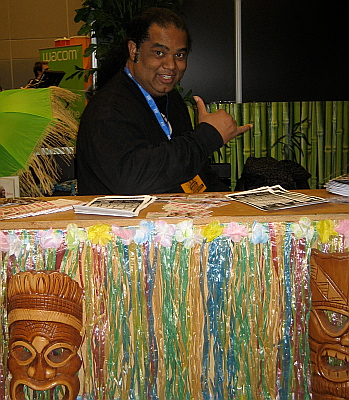
Artifacts from the event: Rackspace tube socks, business cards, BarCamp pass, Montana film board leather coaster, a brochure from "Austin's only tiki shop" etc.
As you would guess, social media apps dominated the tech offerings and a lot things seemed to be some derivative of facebook/twitter/craigslist/linkedin with an innovative (or not so innovative) spin. Microsoft had a big booth as did Sun who was showing off its JavaFX.
Don’t touch that dial!
Coming up later this week, the video podcasts I did with Charlene Li of the Altimeter Group and Jason Hsiao of Animoto.
There were a fair amount of apps that looked like this.
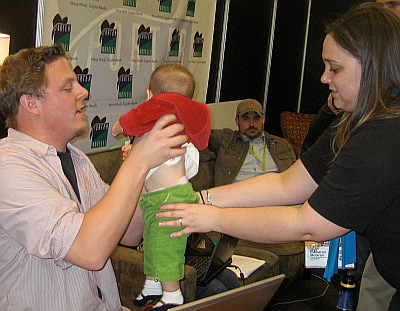
Here are a few of the faces from the show floor.
A picture of Guy Kawasaki taking a picture of the Lunarr booth.
The ever helpful Josh Dilworth of Porter Novelli working the press info stand.
Ka’awa was there promoting a tour of singers from Hawaii.
Kevin takes the hand-off. PR firm Porter Novelli gives new meaning to the expression "booth babe."
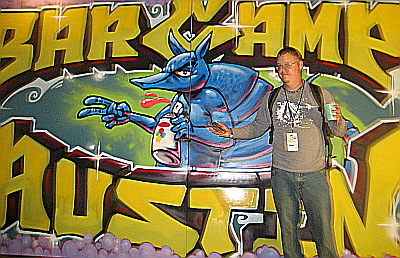
As I mentioned in my last entry, yesterday I hit SXSWi. When the show floor closed, I moseyed over 311E 5th St. to experience the wild and wackiness that is BarCamp Austin. To accompany my video from the event, here are some stills. Enjoy…
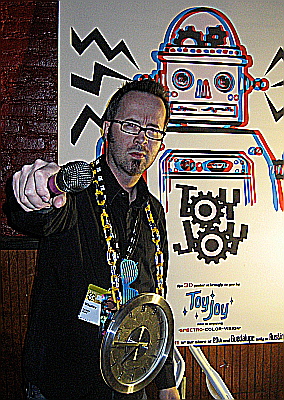
MC Whurley: The Man behind it all.
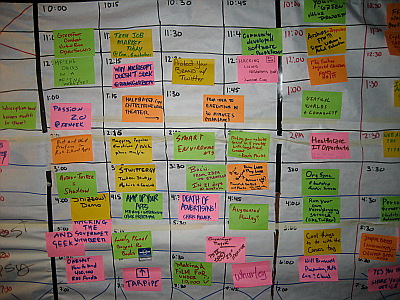
The Schedule.
What’s in a Name
If you’re not familiar with BarCamp, contrary to what you may think, it has nothing to do with libations:
The name “BarCamp” is a playful allusion to the event’s origins, with reference to the hacker slang term, foobar: BarCamp arose as a spin-off of Foo Camp, an annual invitation-only participant driven conference hosted by open source publishing luminary Tim O’Reilly —Wikipedia
BarCamps started in 2005 and they follow the un-conference format where topics are posted the morning of the event. Yesterday’s BarCamp was Austin’s 4th and masterfully arranged by Whurley and Sara Dornsife.
Update: An inside look into organizing BarCampAustin and how they leveraged the cloud.
The Bar Camp Bar. Serving Vodka & Red Bull and cheese hot dogs.
A portrait of the artist and his work -- Cody, the guy who did the BarCamp mural.
The pressure finally gets to organizers Sara Dornsife and William Hurley and they snap like cheap toothpicks.
I just got back from SXSWi and Bar Camp. I will post pictures from there as well as interviews with Charlene Li of the Altimeter Group and Jason Hsiao of Animoto in the next few days. Before then I wanted to post this one minute walk-thru of Bar Camp that I shot near the end of the event. Heck, watch this and you’ll feel like you’re actually there ;-).
To watch in High Quality: after clicking play, click the “HQ” button that will appear on the bottom.
On Friday Jon Hansen of Procurement Insights, sent me a link to a virtual Business Process conference that he had received an invite to. I thought it was kind of intriguing.
The conference is called Process 2010 and will take place in March next year. This BPM showcase offers the most up to date insight on business process strategy and operational agility and will feature process excellence studies and successes across all industries, Workshop tutorial sessions and Keynotes on both old and new methods, and looking at advancing process management using new combinations of techniques and tools such as GIS (Geospacial Information), Workflow Artificial Intelligence and Virtual World Process Simulation.
Pretty heady stuff. Who knows howthis will come off but I’m interested in following its progress. (BTW according to organizer Theo Priestley’s status on Linkedin, Microsoft signed up yesterday). And the number one reason Theo cites for holding a Virtual event? Cost.
In today’s current economic climate, cost reduction is king. What better way to reduce over-burdening costs for flights and accommodation as well as the attendance price than to remove them entirely.
Speaking of the Economy…
Next month is our annual customer/partner conference, “Driven.” We knew that times are tough so back in December we surveyed our customers to see what their chances of attending the event were. At that time 75% told us attending would be a possibility. As we haven gotten closer, however, we’ve started getting a bunch of feedback that many companies are now on travel restrictions (read: no travel).
As a result, today we made the decision to change our format to meet the need and are taking the conference online. While we will lose out on the personal interaction that is a big part of Driven we have already heard from a ton of customers this afternoon that this new format will allow more people at their company to participate and get educated on BPM.
So maybe there is a silver lining to this global economic downturn after all? 😉
A bunch of cool Lombardi-related news bits came out last week. I’ve been a bit slow on the uptake so I thought I’d put them together into one entry.
Lombardi Announces ’08 Results
A cause for celebration!
Last week we announced results for last year (our fiscal and calendar years are the same). It was our best year yet and particularly cool was that fact that our software sales grew 47% year over year.
My favorite quote from the release was from our president Phil Gilbert, “[customers] need to lose fat while building muscle. Lombardi helps our customers do both.”
SaaS Adoption: Surpassed 4,500 companies using Lombardi Blueprint, an on-demand process-documentation tool that is used to collaboratively map an organization’s business processes, identify problems, and prioritize improvement opportunities, making it the most widely used Software as a Service (SaaS) BPM product.
Cap Gemini goes with Lombardi
Under the heading “with a little help from our friends” (especially the ones who are big Systems Integrators), we announced that Cap Gemini’s Business Process Outsourcing Platform “will deploy Lombardi Teamworks as the standard process framework for all of its BPOpen 2.0™ BPO managed processes and will make it available to both existing and future customers as a way to help drive further efficiencies in their businesses.” (And for those of you prefer your announcements in French, voila). (Or Dutch).
Gartner 2009 BPMS Magic Quadrant released
And under the heading “everyone’s favorite 2×2 matrix,” Gartner released its ’09 Magic Quadrant for Business Process Management Suites. (Man are there a lot of players in the space these days!) Lombardi was very pleased to find itself in the leaders quadrant once again. To see exactly where, click here.
Interestingly enough, the product that Lombardi Blueprint most often replaces for process mapping is not some high-end tool but rather Visio. So to let Visio users know that there was a better way to document their processes we launched a PPC campaign on Friday.
The campaign takes the user to a landing page on our site where we feature a 2:49 video (starring yours truly in his very first role as a video pitchman). After a brief intro, the video takes the viewer through a high-level overview of Blueprint and compares it to Visio. Check it out:
If you like what you see and want to try a 30-day free trial you can sign up here.



 Posted by Barton George











 Barton's Blog