At last year’s Oracle financial meeting, Larry Ellison went on rant on the over-hyping of the term “cloud computing:”
I can’t think of anything that isn’t cloud computing with all of these announcements. The computer industry is the only industry that is more fashion-driven than women’s fashion. Maybe I’m an idiot, but I have no idea what anyone is talking about. What is it? It’s complete gibberish. It’s insane. When is this idiocy going to stop?
Well its been a year later and the abuse of the term cloud has gone from bad to worse. As a result, when Mr. Ellison appeared at the Churchill Club last week and the question of Oracle’s possible demise at the hand of the cloud came up, he became a bit animated. Enjoy!
(I love Ed Zander’s bemusement and reactions)
A man of few words
Of note is Larry’s succinct definition of cloud computing: “A computer attached to a network.” And its business model? “Rental.”
Mark Shuttleworth, founder of Ubuntu and the head of Canonical, the commercial entity behind the popular linux distribution, is currently making his rounds in the States. Yesterday he was quite busy, taking the stage at both the Intel Developer Forum in San Francisco as well as at LinuxCon up in Portland Oregon.
Today he popped by Dell here in Austin to chat. I grabbed him for a few minutes right before lunch. Here is the result:
I was scrolling through my blog reader and came across a post by Dave Rosenburg that piqued my interest: “KDDI chooses 3 Terra for cloud infrastructure.” Having lived in Japan many moons ago I’m always interested in getting updates on whats happening in tech over there and since this involved the cloud, I was doubly piqued.
Gaijin Clouds gathering
Turns out that KDDI, the number 2 telecom provider in Japan (which makes them pretty humongous) has not only become a cloud provider as of late but have gone with gaijin technology to do so. KDDI’s recently launched “KDDI Cloud Server Service” is powered by 3Tera‘s Applogic cloud compute platform. According to the 3Tera press release:
Initial offerings include virtual systems and virtual private data centers run at the KDDI Telehouse domestic data centers. This allows KDDI to offer both Infrastructure-as-a-Service and Platform-as a-Service solutions, where customers can run their existing applications on the IT platform or use KDDI’s prepared applications to significantly lower their initial investment and operational costs.
As Dave points out in his blog, its interesting not only to see a Japanese company embrace the cloud but using outside technology to do so.
KDDI has made a big step forward, it will be interesting to see what the uptake is like.
Fun facts to know and tell: The word for cloud in Japan (kumo) is the same word for spider (kumo). Now the characters used for both are different and the Japanese use the English word “cloud” when talking about cloud computing but still, I’m looking forward to getting the chance to present on cloud computing in Japan and make some bad pun involving the two. Corny? Yes, but that’s how I roll.
Last but not least in my series of video’s from last month’s Cloud World/Open Source World I present to you Ken Oestreich, VP of Product marketing at Egenera. I grabbed some time with Ken to learn about Engenera, the cloud and how they’re working with Dell.
Some of the topics that Ken tackles:
While a hypervisor abstracts software, Egenera’s PAN manager abstracts the “plumbing” e.g. NIC cards, switches, host bus adaptor cards etc.
PAN manager allows you to consolidate networks, fail-over entire machines and, in the case of disaster recovery, recover and reproduce entire compute environments.
Egenera is working with Dell in the form of the Dell PAN system to provide agility in your infrastructure.
This Infrastructure as a Service system can be used inside or outside your firewall.
What developments Ken is most excited about in the upcoming year.
I’m getting down to the end of the videos I recorded last month at Cloud World/Open Source World and I’ve saved some of the best for last. My penultimate interview is with Michael Crandell, CEO of Right Scale.
Right Scale, based in sunny Santa Barbara California, makes a cloud management platform that provides greater control over the cloud and makes it easy for companies to begin to migrate applications to the cloud or start building new ones there. See what Michael has to say…
Some of the stuff Michael discusses:
Right Scale focuses on three things: 1) Automation, 2) Providing a library of cloud ready solutions, 3) doing all this in an open and transparent way that allows portability among cloud platforms.
How Right Scale came to be. Their founder was teaching a class at UCSB about how to build an ecommerce site. Amazon granted him some free compute time to use in his class. He realized he needed a framework for managing and monitoring the classes usage, he also realized there was a business to built around this idea…
Where Right Scale will be putting its efforts in the up coming year:
Supporting more cloud platforms as the come online
Increasing their partner program and their cloud-ready solutions
Increasing support for enterprise level editions and features e.g. security and compliance, user control, billing, metering…
The CEO and founder of GoGrid, John Keagy, made an interesting assertion at Cloud World/Open Source World: over the next decade, the IT economy will shrink from $1.5 trillion to $500 billion. I thought this was an interesting statement so I followed up with him after his talk and we sat down for a quick interview:
Some of the things John talks about:
GoGrid plays in the Infrastructure on demand space and has been doing so since 2002.
They work with partners in the layers above infrastructure and don’t have plans to venture north.
The IT economy shrinkage will be driven by automation and reduced capex (commodity hardware is a big component of this)
Right now its hardly a competitive market in the IaaS space (“its GoGrid and a bookstore”) so you can expect to see prices drop as the competition heats up.
If you’re not doing your test and development and QA in the cloud, your not engaging in best practices.
The article which supplies short profiles of 85 cloud players, isn’t wishy-washy about what it believes is the inevitability of the cloud model. While it feels there will both a backlash against cloud-mania as well as a well publicized disaster the article states:
Still, the bad news won’t kill the cloud. We can’t ever go back to enclosed datacenters. The cloud is simply easier, faster and more flexible.
“Who says Dell is just a hardware firm?”
Dell comes in at number 10 on the list of the fab 85. One of the big focuses of the Dell section is Dell’s Datacenter Solutions Group (which I am a part of):
…the company launched DCS – Data Center Solutions – to target an audience of businesses that need help configuring a cloud-based datacenter. DCS handles everything from optimization to project management to global consulting. Who says Dell is just a hardware firm? Referring to DCS, Dell CEO Michael Dell toldBusinessweek in 2008 that, “We created a whole new business just to build custom products for those customers. Now it’s a several-hundred-million-dollar business, and it will be a billion-dollar business in a couple of years—it’s on a tear.”
It also keys in on some of Dell’s recent acquisitions in this space:
Dell has made a number of acquisitions to build out the software side of its cloud offering, including Everdream (desktop management software), Silverback Technologies (remote monitoring) and Message One (email management). The goal, it appears: provide one-stop shopping for businesses that want to build an automated datacenter running commodity boxes, all optimized for the cloud. That is likely a lucrative strategy.
If they think this is cool stuff, wait until they see what we have planned 🙂
Reductive Labs, the company behind Puppet, recently received $2 million in funding. Puppet, a framework for automating system administration across the network at scale, allows an admin to build and configure a passel of servers in a period of hours rather than months.
Earlier this month at Cloud World/Open Source World I sat down with Luke Kanies of Reductive Labs to learn more about Puppet, who uses it and what they plan to do with all that money.
Some of the stuff Luke talks about:
In the cloud you can turn on 100s or 1000s of servers at the click of a mouse, but what happens when you want to configure them?
Users include Red Hat, Sun, Dell, Rackspace and Google. Google manages their entire corporate infrastructure with Puppet.
No GUI for you! Puppet has its own simple language that you use to program your infrastructure and then Puppet runs it across your entire infrastructure. The language is based on Perl + Ruby + Nagios.
A good portion on the $2 million will be spent on building some GUI tools (along with a little sales and marketing)
Puppet is 100% open source and based on Ruby. There are no commercial features (yet).
Puppet has a pretty vibrant community: 1,200 – 1,400 on the user list along with what could be the largest system focused IRC channel.
At Cloud World/Open Source World earlier this month I grabbed some time with Forrester’s “Mr. Cloud” James Staten. I wanted to get his take on Cloud Computing and what was hot and what is not. Here is the result.
Some of the things James talks about:
How the conversation about cloud has changed over the last year.
He spends a lot of time telling people what the cloud is not.
The three things they’ve learned (coming soon to Forrester report near you):
First thing to do in the cloud is test and development
Organizations can take short term web promotions and marketing efforts and drop them into the cloud (witness Wendy’s 99c promotion)
Put apps that are triggered by revenue into the cloud
Rather that “Public vs Private” clouds, Forrester segments it into “internal vs. hosted vs. public
Cloud is not an all or nothing proposition, it’s another tool in the toolkit.
I first met Chander Kant, CEO of open source cloud back provider Zmanda, last year at the MySQL conference. At that time we did an audio interview. Just like Jonathan, this time around I caught him on “film.”
Earlier this month at Cloud World/Open World I bumped into Jonathan Bryce one of the two founders of the cloud platform formerly known as “Mosso” (now known as Rackspace Cloud).
Last year when I interviewed Jonathan, I did an audio podcast. This time around I was armed with my Flip Mino and caught it all on video for the little(r) screen.
Some of the topics Jonathan addresses:
When Rackspace funded employees Jonathan and Todd to go off and start their cloud venture 4 years ago, why didn’t they brand it “Rackspace?”
Why did they recently decide to roll Mosso back into the mothership and rebrand it?
The progression of in-house -> colocation -> managed hosting -> cloud.
The three pieces of Rackspace Cloud: Cloud Servers & Cloud Files (infrastructure as a service) and Cloud Sites (platform as a service with the option of using either the LAMP or .NET stack).
Which offering is getting the most traction.
Why their customer Fresh Books went with Cloud Files.
James Urquhart of Cisco and author of “The Wisdom of Clouds” blog on Cnet, gave a talk last week at Cloud World entitled, “Virtualization to Cloud.” I wanted to capture some of the topics he talked about and learn a bit more so I grabbed him for a podcast after he got off stage. Here is the result…
Some of the topics James tackles:
Whereas four months ago the question was “What is cloud” the conversation has recently shifted to “how can I replicate some of the success stories that I’ve heard about?”
One effect of the cloud is that has greatly lowered the VC capital that start-ups require to get set up and going.
Internal IT needs to realize they are no longer delivering a product but are delivering a service. To be of value to the business they don’t have to wire servers, they can help them through the process of getting the right compute power for each app.
Regulatory and industry standards will be what dicates the speed of the evolution of the cloud, not technology.
On the first day of Open Source World/Cloud World/Etc World I attended Brian Aker’s talk entitled “Drizzle, Rethinking MySQL for the Web.” For those not in the know, Drizzle is a reworking of the MySQL database to slim it down and make it more appropriate for web-infrastructure and cloud computing . I caught up with Brian after his talk to learn a little bit more about Drizzle, where its come from and where its going.
Some of the topics that Brian tackles:
Looking at what customer needs were not being addressed by MySQL.
Stripping stuff out of MySQL and setting up Drizzle as a microkernel design that modules can be added to.
One of the main goals was to allow greater community involvement in the development (currently Sun folks only make up 6-7% of those making contributions).
Is Drizzle production ready?
What cloud bits have been contributed to the project?
The opening day keynote was provided by Dell. In all honesty, it wasn’t our best effort. It was particularly tricky since the speaker who was supposed to deliver the presentation had a medical emergency and Judy Chavis, director for business development and global alliances at Dell had to step up and pinch hit at the 11th hour. Here are two pieces written about the keynote, one more positive than the other.
Chinatown, Clouds and Cable Car
Not exactly jam packed
I’ve been to Linux World a couple of times before and this year’s show, despite the amalgamation, was much smaller. Those who came to talk to customers or generate leads must have been dissapointed since there seemed to be hardly any around. That being said, I found it a great event to network and talk to various cloud players in the industry. I was even able to record nine video podcasts that I will be posting over the next few weeks.
Coming attractions
So stay tuned for conversations with the following folks:
Brian Aker — Lead architect for Drizzle
James Urquhart — Big cloud thinker from Cisco
Michael Crandell — CEO of Right Scale
Ken Oestreich — VP of product marketing at Egenera
John Keagy — CEO of GoGrid
James Staten — Analyst covering cloud computing at Forrester
Luke Kanies — Founder of Reductive Labs, maker of Puppet
Today we felt like day trippin’ so I got out our central Texas guide book and picked a destination: Wimberley. This town of ~5,000 is about an hour south of Austin and is made up of an interesting mix of artists and ranchers. We had no idea what to expect but were pleasantly surprised by the lush river trail and the cute town center.
Here are a few pics from our adventure:
The three monkeys in the lead as we start off on the river trail.
Pretty lush for central texas during one of the worst droughts in decades.
This afternoon I finished my first week at Dell. Needless to say it was a bit of whirlwind, but hey, I haven’t quit yet :).
I spent the week trying to get set up — fighting with printers, getting used to Microsoft Vista, figuring out how to put my laptop to sleep etc. — as well as meeting with a slew of people who I will be working with going forward.
On Day 2 the Datacenter Solutions group, which I’m a part of, had their second half of the year kick-off. It was a good opportunity to see where the group has come from and where they’re going. This team has done/is doing some pretty impressive things with some of the world’s most humongous cloud providers.
My cube at the end of Day 1. No phone but a laptop and monitor.
The folks I met with were both within and outside the Datacenter team. Outside of the Datacenter folks, I met with analyst relations, PR, members of Dell’s social media team, a former Sun compadre and even randomly ran into and had lunch with a neighbor. I’ve been very impressed with how friendly and nice everyone’s been. It will take a little while to learn the subtleties of the culture but it seems to be pretty WYSIWYG.
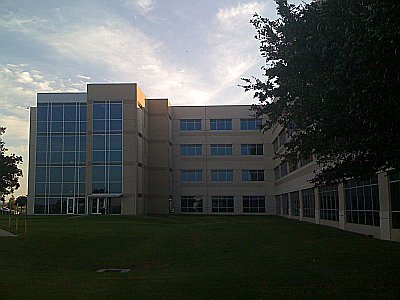
Parmer 2, the building I work in. (Note the clouds. Coincidence? I think not)
Next week I’m in the office on Monday and then off with the Datacenter Solutions chief architect and a few people from Dell’s open source team to Cloud World/Open Source World/Next Generation Datacenter in San Francisco (the event formally known as Linux World). Dell has a keynote as well as a couple of talks and a booth. It will be a good opportunity for me to learn more about what Dell’s doing in the space as well as meeting with folks in the industry in my new role as Cloud Evangelist.
Let the wild rumpus start.
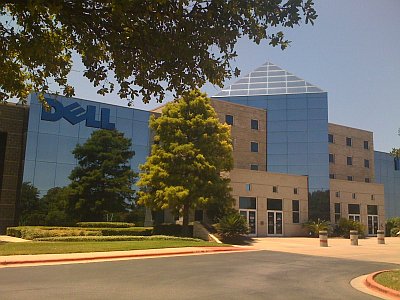
Building 1 on the Round Rock campus.
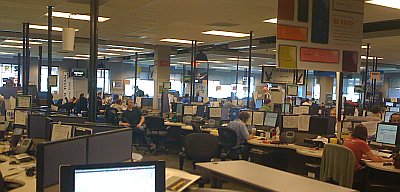
One of the call centers for customer support.
Teammate Drew, patent holder and product planner, who has the good fortune of sitting across the aisle from me.
Monday morning I’m starting a new gig. I will be joining Dell as their cloud computing evangelist.
So what’s that mean?
As the cloud computing evangelist I will act as Dell’s ambassador to the cloud computing community (not sure if the sash is provided or if I have to supply my own). I will also work with analysts and press and be responsible for messaging as well as Dell’s cloud blog.
Dell, who provides the infrastructure for the major cloud players from Google to Amazon to Salesforce, is about to kick their cloud computing effort up a notch and Im very glad to be part of the team!
Earlier this summer, XML co-inventor and director of Web Technologies at Sun, Tim Bray was asked to give a convocation speech at his Alma Mater.
The whole speech is excellent, but the part that particularly resonated with me was his “Law of Explanation”
The first half says “When you’re explaining something to somebody and they don’t get it, that’s not their problem, it’s your problem.” Anything that’s important, that’s deep enough to matter, is probably not self-evident; it’s going to require a lot of explanation, and that’s an essential part of your job.
The second half says “When someone’s explaining something to you and you’re not getting it, that’s not your problem, it’s their problem.” The effect of this one is that you have to do a very courageous thing: say “No, I don’t understand.”
In a post at the end of last month, Frank Gens of IDC explained that, cloud concerns notwithstanding, within a few years the Public Cloud will be a humongous source of IT services. The reason for the popularity of the public cloud will be the same reason any platform is successful: the apps. And who’s responsible for the apps? You guessed it, developers:
The online shift of the latest and greatest business solutions to the Web is happening because the Cloud is winning the war for developers: a rapidly growing number of developers see the Web as the most attractive “platform” on which to quickly and affordably deploy their solutions. It’s not a mystery: the Cloud dramatically reduces the barriers for customer adoption (and upgrade) and dramatically expands the market reach for solution developers. Can you imagine a developer of a hot new solution choosing not to deploy in a Cloud/SaaS mode? Hard to imagine. They might not do so exclusively – they may continue to also develop for the big on-premise platforms, and many will also deploy their public cloud solution as a software appliance in a private cloud. But it’s easy to see that the public cloud will be the number one deployment target for a large majority of solutions.
If you want to see where technology is going, follow the developers.
The other day, I came across an entry on CIO.com discussing a recent Forrester report. The report, snappily entitled “Conventional Wisom is Wrong About Cloud IAAS,” details the results of a recent survey administered to small and large enterprises located in the Europe and North America.
The survey’s key findings were:
Confirmation of a strong interest in cloud infrastructure-as-a-service (IaaS).
Large firms are more interested in cloud IaaS than small firms.
Firms are interested in cloud services slightly more than internal cloud.
Firms are equally comfortable with all major workload types in the cloud and are almost as comfortable with productions apps as they are with test and development usage.
And in conclusion…
So the big takeaways are 1) IaaS isn’t just for test and development any more and 2) many people out there are ok with skipping internal clouds and going directly to external providers. As pointed out in CIO.com, more specifically the survey shows that:
More than one-third of both large and medium enterprises are ready to put enterprise applications into production in external cloud providers.
These results paint enterprises as far more intrepid, when it comes to the cloud, than has been thought. It will be interesting to see how matters actually unfold and if enterprises end up putting their money apps where their mouth is.


 Posted by Barton George










 Barton's Blog
