Yesterday, the announcement went out that the Dell | Canonical Enterprise Cloud, Standard Edition was out and ready for consumption. What this cloud-in-a-box allows folks to do is to set-up affordable Infrastructure-as-a-Service (Iaas)-style private clouds in their computer labs or data centers. The cool thing is that, because the Ubuntu Enterprise Cloud (UEC) software is compatible with Amazon Web Services EC2 and S3 services, it enables IT admins and developers to move workloads between public and private clouds.
Who cares?
Application developers and IT service providers and admins who are setting up cloud POC’s are perfect candidates for this pre-configured testing and development environment. With regards to industries, areas where there is a lot of software development work like Hosters, Telco & Communications, Media & Entertainment and Web 2.0 businesses are prime markets for the Dell UEC solution.
So what’s in it?
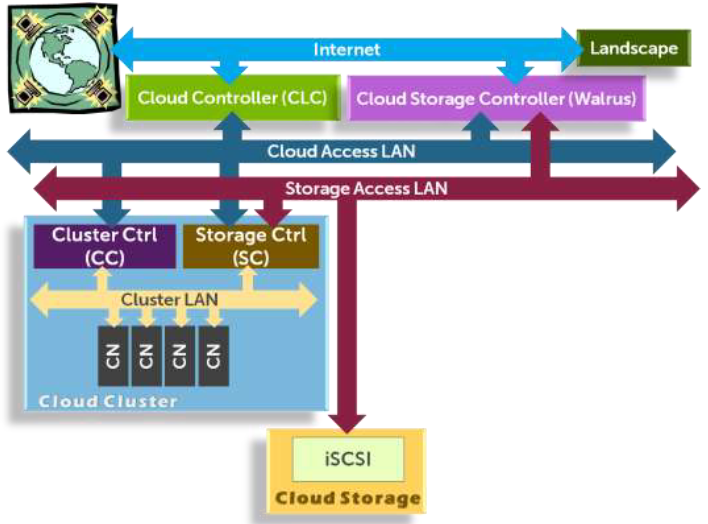
The solutions’ basic components are Dell PowerEdge C systems plus a Dell-specific download of the Ubuntu Enterprise Cloud (made up of the Ubuntu operating system and the Eucalyptus platform for private cloud computing). To simplify getting the whole shebang up and running Dell and Canonical are providing the following:
Walrus Controller – the cloud’s storage repository
Cluster Controller (CC) – the controller for a up to 1024 compute cores grouped together as a cluster
Storage Controller (SC) – the controller for cluster’s storage repository
Compute Node (CN) – cloud’s compute node
And on the support side…
If you’re looking for systems management and support services with your order, you are in luck. Canonical, the company behind Ubuntu, has put together UEC Assist, a support service built specifically for Dell customers deploying SE Edition and which is delivered by Canonical’s Global Services and Support team.
Its all about efficiency
From a Dell DCS (the group at Dell behind this) point of view, this offering fits in well with our strategy of bringing total solutions to market that optimize efficiency at every layer, from code to servers to storage. The open source Dell UEC solution is tailor made to deliver a ready to go IaaS solution.
Last not but least in my series of videos from the OpenStackdesign summit, is an interview I did with David Lemphers of Price Waterhouse Coopers. David recently joined PWC as their director of cloud computing after spending six years at Microsoft, most recently as one of the principle engineers on the Windows Azure platform.
I talked with David to get his thoughts on OpenStack and here is what he had to say:
Some of the ground Dave covers:
Dave’s background
What he’s doing at PWC as the cloud director
Why decided to attend (and present at) the OpenStack summit and why he’s so bullish on the platform.
Today the OpenStackdesign summit wrapped up down in San Antonio. The summit featured close to 300 attendees representing 90 different companies. One of the key partners since the project kicked off back in July has been Citrix. On Wednesday I caught up with Gordon Mangione, Vice President of cloud at Citrix to get his thoughts on the project and this week’s summit. Here’s his enthusiastic response:
Continuing in my series of videos from the OpenStack design summit this week in San Antonio, here is an interview I did yesterday with Eucalyptus systems co-founder Graziano Obertelli.
Eucalyptus allows enterprises to set up open source infrastructure-as-a-service private clouds. Eucalyptus is also one of the key ingredients in the Ubuntu Enterprise Cloud that is being certified to run on Dell’s PowerEdge C systems as part of our cloud ISV program.
Here is what Graziano had to say:
Some of the ground Graziano covers:
What goals do the Eucalyptus team have for the summit
They’ve recently hired a community manager – Mark Atwood
Yesterday, near the end of day two of the OpenStack design summit, I caught up with Rick Clark, chief architect of the OpenStack platform. I wanted to get Rick’s thought’s on how the four-month old open source cloud computing project and the summit were going.
Here’s what he had to say:
Some of the ground Rick covers:
The goal of the summit as well as the goal of the next two releases.
One of the featured speakers during the kick off of the OpenStack design summit yesterday was NASA CTO of IT, Chris Kemp. OpenStack is an open source cloud platform and the compute side of the project is based on code from NASA’s Nebula cloud.
I got some time with Chris and learned about NASA’s involvement in the project:
Some of the ground Chris covers:
Nebula and the cloud computing platform code base
NASA’s huge data needs and what they do with the data
Serendipity: NASA’s cloud engine + Rackspace’s file system engine
How NASA is working with the project: a two-way street
Last but not least in my series of interviews from last month’s Cloud Summit at OSCON I present to you my conversation with Simon Phipps. Simon, who until earlier this year was the chief Open Source officer at Sun Microsystems, recently joined the start-up ForgeRock as their chief strategy officer. Here is what Simon says:
Some of the topics Simon tackles:
ForgeRock offers access management and authentication software based on open source code that was developed at Sun.
Since the software is open source you can download it for free at ForgeRock.
ForgeRock makes its money by selling subscriptions that provide various grades of SLAs.
Even though they are 4 mos old, they already have 20 customers including the world’s largest gambling exchange.
At OSCON last week I ran into a compadre from a previous life, Fred Kohout. Fred is now the CMO at UC4, a pure play software automation company, and he, like I, was in Portland to attend OSCON and the Cloud Summit.
At the summit Fred did to me what I’ve done to so many others, he got me on the receiving end of a video camera to talk about where Dell plays in the cloud and how we see the cloud evolving.
You can check out Fred’s blog from the Summit where he posted my video as well as the interview he did with another former compadre, Peder Ulander, CMO at cloud.com.
Don’t touch that dial
If you’re interested in OSCON be sure to stay tuned. I’ve got four more interviews from the event that I will be posting soon.
Today Rackspace and NASAannounced OpenStack, an open source cloud platform that they are collaborating on and building a community around. Last week the inaugural OpenStack design summit was held here in Austin with 20 companies from around the world, including Dell, participating.
During one of the breaks I grabbed sometime with Rackspace’s cloud president, Lew Moorman to learn more about the effort and get his thoughts:
Some of the topics Lew tackles:
What is OpenStack (an opensource set of technologies for building clouds…)
Why Rackspace decided to opensource their code .
How Rackspace got hooked up with NASA and what each brings to the party.
Taking Nebula’s core foundation and adding some elements from Rackspace’s side in order to put together a release candidate that should be available to the community this Fall.
At the inaugural design summit for OpenStack, an open source set of technologies for building clouds, Nebula’s chief architect Josh McKenty played a prominent role in leading the assembled folks. I caught Josh during a break and chatted with him about Nebula and NASA’s role in the newly announced OpenStack project. Here’s what he had to say:
Some of the topics Josh tackles:
What is Nebula (hint: NASA’s, primarily IaaS, cloud computing platform)
The history of Nebula and how it morphed from nasa.net.
Why NASA wants a cloud – and the importance of having an elastic set of resources.
NASA and Nebula’s use of open source and how it has evolved (they don’t simply fling tarballs over the wall anymore and they can use licenses other than the “NASA open source agreement”)
A match made in heaven: NASA has put together a strong compute platform and was looking to building a real object store, Rackspace had a strong object store and work looking for a new compute platform.
Yesterday at the GigaOM Structure conference here in San Francisco, I ran into Marten Mickos, the recently appointed CEO of Eucalyptus systems. Eucalyptus is one of the key ingredients in the Ubuntu Enterprise Cloud that is being certified to run on Dell’s PowerEdge C systems as part of our cloud ISV program.
Marten, the former CEO of MySQL took the helm of Eucalyptus about three months ago, and was at Structure both as an attendee and participant, sitting on two panels at this two-day cloud-a-polooza. At the end of the day-one I got some time with Marten and asked him about his new gig.
Some of the topics Marten tackles:
How he made the decision to go to Eucalyptus. (Hint: he asked the question, what’s bigger than Open Source)
What is Eucalyptus and whats it based on?
How will Marten’s experience at MySQL and Sun help him in his new role at Eucalyptus?
MySQL was a disrupter of the old whereas Eucalyptus is an innovator of the new.
Sun’s company culture was phenomenal, the technology was phenomenal, the business…um…
Following on my entry from yesterday, here is something pretty cool I learned while doing research on what’s happening in public sector cloud computing: Forge.mil
From their FAQ they explain:
Forge.mil is a DISA-led activity designed to improve the ability of the U.S. Department of Defense to rapidly deliver dependable software, services and systems in support of net-centric operations and warfare.
What really surprised me was the emphasis they place on “early and continuous collaboration” and their embracing of open source software. In fact, in an October 16 memo, the DoD’s deputy CIO, reiterated the fact that open-source software “meets the definition of ‘commercial computer software,’” and can “provide advantages” given DOD’s need to “update its software-based capabilities faster than ever.” (source: Wyatt Kash’s article)
Here are some high level stats on Forge.mil’s usage since it started last year:
4,000 Registered users
170 hosted projects
Produced more than 500 software releases
The service itself is broken into two cloud-based offerings — SoftwareForge and ProjectForge. Here are the highlights:
Software Forge
A free service, open and community source DoD software
Default is open view access
Project Forge
For fee, non-community source
Default is private
Originally limited to Army & Navy but on Jan 13 it was made available to other military branches and DoD civilian employees and contractors
Tom Henderson and Brendan Allen of ExtremeLabs published a great walk-thru of the Ubuntu Enterprise Cloud (UEC) last week in NetworkWorld. Canonical, the commercial sponsor behind Ubuntu, is one the first members of our Cloud Partner Program and we will soon be offering UEC running on top of our PowerEdge C line accompanied by reference architectures.
If you’re not familiar with UEC, which leverages the open source Eucalyptus private cloud platform, here is a quick backgrounder:
Basically, Ubuntu Enterprise Cloud can be deployed on internal hardware to run job/batch applications. The idea is to initially allocate storage, then rapidly build multiple virtual machines to process data, collect the data, then tear down the infrastructure for re-use by a subsequent purpose.
Ubuntu Enterprise Cloud provides internal cloud control methods that closely mime what can be done on Amazon’s public cloud infrastructure. Its tools can be used to process recurring jobs or one-shot distributed applications, like DNA analysis, video rendering, or database table reformatting/reindexing.
Walk this way
The Review, which is a concise 3 and a half pages, steps you through:
Getting started
Installation*
Setup/configuration
Image Bundles
Usage/Monitoring
*My favorite line from this section is: “Installation was very simple; we inserted the Ubuntu Server CD, selected Ubuntu Enterprise Cloud, and drank energy drinks.”
If you’re interested in learning about UEC this article is a great place to start.
Extra-credit reading
If the above whets your appetite, you may want to dig into the following:
Last month when I was out in the Bay Area for our launch, I was able to catch up with Rich Wolski, founder and CTO of Eucalyptus. Eucalyptus is one of the key ingredients in the Ubuntu Enterprise Cloud that is being certified to run on Dell’s PowerEdge C systems as part of our cloud ISV program. Here is what Rich had to say:
Some of the topics Rich tackles:
How Eucalyptus started at the University of California at Santa Barbara. They wanted to show how old-style large scale computing (NSF super computer centers) could be combined with new large-scale computing (in the form of Amazon) in the service of science. Wanted to also include 4-6 university data centers.
They put the code out as open source and got deluged by science and commercial industry about potential applications. Grew too big to continue as a research project so they brought it outside.
Working with Canonical and Ubuntu and how the relationship began. UEC and what part Eucalyptus makes up.
How NASA is offering a production Eucalyptus cloud to NASA researchers and other governmental agencies.
Where Rich sees Eucalyptus going in the next two years. The importance of the open source community and their continued focus on private clouds in the enterprise.
At last week’s Dell Launch, “Solutions for the Virtual Era,” we unveiled the first three systems in our new PowerEdge C line. These “hyper-scale inspired” systems are based on designs that we have built for our largest scaled-out customers such as Windows Azure, Facebook, Ask.com and Tencent.
The PowerEdge C line is targeted at both Public and Private cloud builders as well as HPC, Web 2.0, gaming and large scaled out web farms. In the video below, Dell solutions architect Rafael Zamora walks us through the PowerEdge C6100, C1100 and C2100.
Upcoming posts
In the days to come I will be posting individual walk-thrus of each of the three systems. I will also be posting interviews I did with executives from our cloud partners Joyent, Aster Data, Greenplum and Eucalyptus (who’s not a partner but provides a key component of our partner Canonical’s Ubuntu Enterprise Cloud).
My favorite cosmonaut-coder Mark Shuttleworth stopped by our offices this morning for a visit. Mark is the founder of both the Linux distribution Ubuntu and its commercial sponsor Canonical. Mark and I sat down in the lobby and caught up. Here is a short interview we recorded.
The 10.4 Ubuntu release Lucid Lynx and what to expect: a strong cloud focus on the enterprise side and a lot of shiny new bling on the desktop as well as making the desktop “social” (e.g. Tweet straight from your desktop)
What Ubuntu is doing in the Netbook space
What excites Mark the most in technology today and why cloud is like HTTP in the early 90’s
With today’s post, I’m right at the mid-point of my series of video interviews from Cloud Computing Expo. Today’s post offers a two-for-one special, Gluster CEO Hitesh Chellani along with Jack O’Brien who heads Gluster’s product management.
Some of the topics Hitesh and Jack tackle:
Gluster as a general-purpose open source cluster platform that runs on top of commodity hardware like Dell.
Their goal to transform the storage market the way Red Hat transformed the server market (Gluster employs a subscription model just like Red Hat).
What would you do after spending time at Lawrence Livermore National Labs putting together the second fastest super computer in the world? Hitesh thought he’d distill the experience and apply it to the storage space.
Some of the performance-driven verticals Gluster started out in.
The new hot area of virtual storage next to virtual servers.
Mark Shuttleworth, founder of Ubuntu and the head of Canonical, the commercial entity behind the popular linux distribution, is currently making his rounds in the States. Yesterday he was quite busy, taking the stage at both the Intel Developer Forum in San Francisco as well as at LinuxCon up in Portland Oregon.
Today he popped by Dell here in Austin to chat. I grabbed him for a few minutes right before lunch. Here is the result:
I first met Chander Kant, CEO of open source cloud back provider Zmanda, last year at the MySQL conference. At that time we did an audio interview. Just like Jonathan, this time around I caught him on “film.”
On the first day of Open Source World/Cloud World/Etc World I attended Brian Aker’s talk entitled “Drizzle, Rethinking MySQL for the Web.” For those not in the know, Drizzle is a reworking of the MySQL database to slim it down and make it more appropriate for web-infrastructure and cloud computing . I caught up with Brian after his talk to learn a little bit more about Drizzle, where its come from and where its going.
Some of the topics that Brian tackles:
Looking at what customer needs were not being addressed by MySQL.
Stripping stuff out of MySQL and setting up Drizzle as a microkernel design that modules can be added to.
One of the main goals was to allow greater community involvement in the development (currently Sun folks only make up 6-7% of those making contributions).
Is Drizzle production ready?
What cloud bits have been contributed to the project?

 – the cloud’s storage repository


 Posted by Barton George
 Barton's Blog