Savtira Corporation, who provides outsourced Cloud Commerce solutions, has chosen Dell DCS’s PowerEdge C line of servers and solutions to deliver streamed media and apps from the cloud. Dell’s gear will help power the Savtira Cloud Commerce platform and Entertainment Distribution Network (EDN).
With a little help from PowerEdge C, businesses will now be able to use EDN to stream all digital media (business apps, games, music, movies audio/ebooks) from the cloud to any device. One of the particularly cool features is, since the state and configuration are cloud-based, consumers can switch between devices and pick up exactly where they pushed pause on the last device.
Talk about supercharging
To power Savtira’s EDN data center, the company picked PowerEdge C410xs packed with NVidia Tesla M2070 GPUs and driven by PowerEdge C6145s. If you think GPUs are just for rendering first-person shooters, think again. GPUs can also cost-effectively supercharge your compute-intensive solution by offloading a lot of the processing from the main CPUs. According to NVidia, for 1/10 the cost and with only 1/20 of the power consumption, GPUs deliver the same performance as CPUs.
To help you get an idea of the muscle behind this solution, the PowerEdge C410x PCIe expansion chassis holds up to 16 of the Tesla M2070s GPUs, each of which exceeds over 400 cores. Two fully populated C410xs are in turn powered by one PowerEdge C6145 for a combined total of 33 Teraflops in just 7U.
Talk about a lot of power in a little space 🙂
Extra-credit reading
PowerEdge C6145 — Dell DCS unveils its 4th HPC offering in 12 months, and its a beefy one
PowerEdge C410x — Say hello to my little friend — packing up to 16 GPGPUs
NVIDIA: from gaming graphics to High Performance Computing
Last Thursday a group of us from Dell attended and participated in the unveiling of Facebook’s Open Compute project.
Much the way open source software shares the code behind the software, the Open Compute project has been created to provide the specifications behind the servers and the data center. By releasing these specs, Facebook is looking to promote the sharing of data center and server technology best practices across the industry.
Pre-Event
The unassuming entrance to Facebook's Palo Alto headquarters.
The Facebook wall.
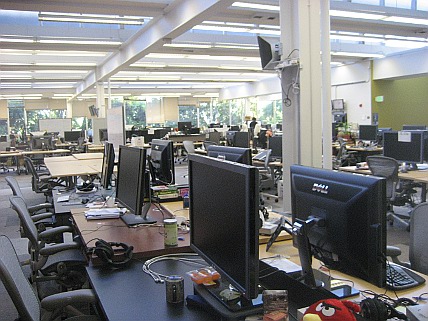
Facebook headquarters at 8am. (nice monitors! 🙂
Words of wisdom on the wall.
The Event
Founder and CEO Mark Zuckerburg kicks off the Open Compute event.
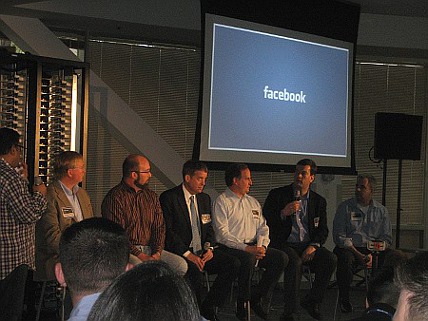
The panel moderated by Om Malik that closed the event. Left to right: Om, Graham Weston of Rackspace, Frank Frankovsky of Facebook, Michael Locatis of the DOE, Alan Leinwand of Zynga, Forrest Norrod of Dell (with the mic) and Jason Waxman of Intel.
Post-event show & tell: Drew Schulke of Dell's DCS team being interviewed for the nightly news and showing off a Dell DCS server that incorporates elements of Open Compute.
This morning, at Facebook’s headquarters in Palo Alto, the company unveiled the Open Compute project. Also on hand to support the announcement were partners such as Dell and Intel, who served on a panel alongside representatives from Rackspace, the Department of Energy, Zynga and Facebook. Forrest Norrod, GM of Dell’s server platform division represented Dell on the panel.
I caught up with Forrest after the event to get his take on the Open Compute project and what it means for Dell.
Today at its headquarters in Palo Alto, Facebook and a collection of partners such as Dell, Intel and AMD — as well as kindred spirits like RackSpace’s founder (the company behind OpenStack) and the CIO of the Department of Energy — are on hand to reveal the details behind Facebook’s first custom-built data center and to announce the Open Compute project.
Efficiency: saving energy and cost
The big message behind Facebook’s new data center, located in Prineville Oregon, is one of efficiency and openness. The facility will use servers and technology that deliver a 38 percent gain ìn energy efficiency. To bring the knowledge that the company and its partners have gained in constructing this hyper-efficient hyper-scale data center Facebook is announcing the Open Compute project.
Much the way open source software shares the code behind the software, the Open Compute project has been created to provide the specifications behind the hardware. As a result, Facebook will be publishing the specs for the technology used in their data center’s servers, power supplies, racks, battery backup systems and building design. By releasing these specs, Facebook is looking to promote the sharing of data center and server technology best practices across the industry.
How does Dell fit in?
Dell, which has a long relationship with Facebook, has been collaborating on the Open Compute project. Dell’s Data Center Solutions group has designed and built a data center solution using components from the Open Compute project and the server portion of that solution will be on display today at Facebook’s event. Additionally Forrest Norrod, Dell’s GM of server platforms will be a member of the panel at the event talking about the two companies’ common goal of designing the next generation of hyper efficient data centers.
A bit of history
Dell first started working with Facebook back in 2008 when they had a “mere” 62 million active users. At that time the three primary areas of focus in with regards to the Facebook IT infrastructure were:
Decreasing power usage
Creating purpose-built servers to match Facebook’s tiered infrastructure needs
Having tier 1 dedicated engineering resources to meet custom product and service needs
Over the last three-plus years, as Facebook has grown to over 500 million active users, Dell has spefically helped out to address these challenges by:
Building custom solutions to meet Facebook’s evolving needs, from custom-designed servers for their web cache, to memcache systems to systems supporting their database tiers.
Delivering these unique servers quickly and cost effectively via Dell’s global supply chain. Our motto is “arrive and live in five”, so within five hours of the racks of servers arriving at the dock doors, they’re live and helping to support Facebook’s 500 million users.
Achieving the greatest performance with the highest possible efficiency. Within one year, as the result of Dell’s turnkey rack integration and deployment services, we were able to save Facebook 84,000 pounds of corrugated cardboard and 39,000 pounds of polystyrene during that same year.
Congratulations Facebook! And thank you for focusing on both open sharing and on energy efficiency from the very beginning!
Today Dell is announcing that it is continuing to put its money where its mouth is when it comes to its transformation into a solutions provider, this time to the tune of $1 Billion. The goal of this investment, which is being made this year, is to provide customers with a complete set of resources and services to enable business agility, efficiencies and competitive advantage.
Specifically Dell is announcing:
Cloud Data Centers: The building of multiple cloud data centers around the world that will allow customers to take advantage of such offerings as Infrastructure as a Service, Desktop as a Service, Storage as a Service and IT outsourcing.
Global Solutions Centers: The creation of a network of global solutions centers to help customers architect, validate and build the efficient enterprise from the data center to the edge of the network.
New Solutions: New open, capable and affordable solutions for data management, client virtualization and data center virtualization:
Dell vStart: a single unit infrastructure solution that runs 100 to 200 vm’s and comes racked and cabled from the Dell factory.
Dell|Microsoft management and virtualization solutions partnership to deliver integrated management solutions made up of Dell’s Virtual Integrated System, our Advanced Infrastructure Manager and Microsoft’s System Center.
Dell Email and File Archive Solutions
Dell Desktop Virtualization Solutions
A little more detail:
Next generation cloud data centers
Over the next 24 months Dell is building out a host of cloud data centers around the world. Rather than old-school, giant raised-floor data centers these cloud data centers will be much smaller (approximately 10,000 square feet), more efficient and designed to take advantage of modular, hyper-scale and high-density principles. Dell’s modular strategy will let the company quickly expand capabilities as demand grows.
These data centers will feature private, public and hybrid cloud options. They will provide the foundation for Dell’s next generation services and solutions and offer IaaS, and SaaS capabilities as well as IT outsourcing for customers.
Global solutions center network
This year Dell will open 12 Global Solutions centers and is planning ten more over the next 18 months. These centers are customer facing facilities that will act as a “living lab” providing an environment and the support for customers to architect, build and test proof of concepts involving Dell products, services and solutions. The centers will also support solution integration, technical briefings and validation and ISV certification to meet regional requirements.
Starting with the upgrading of the existing Austin, Limerick and Frankfurt centers, further facilities will be opened this year in the Americas (Washington DC, Chicago, Northern California and Brazil), APJ (Shanghai, Singapore, Tokyo and Sydney) and EMEA (Paris).
With today’s announcement Dell his taken its evolution into a services and solutions company and kicked it up a notch. In the “Virtual Era” technology is rapidly changing and it along with new delivery models such as cloud are changing the way businesses operate and create advantage. Through its cloud and solution centers and new solution offerings Dell is bringing new ways to help customers harness and leverage these changes.
OpenStack, the open source cloud platform based on code donated by NASA and Rackspace, has gained considerable traction since it was launched eight months ago. The community has rapidly grown and there have been several releases. Now its time to get potential customers trying it out and kicking the tires.
With the idea of removing friction to adoption and make the testing out of the platform as easy as possible, Dell, Equinix and Rackspace are announcing today the availability of a free OpenStack cloud demonstration and test environment.
The idea of the demo environment is to allow organizations to easily evaluate OpenStack and assess application performance on the platform in a low risk environment for free. The next step after a successful demo would be a proof of concept.
Movin workloads around the country
This demo environment is initially available in three U.S. data centers and in Q2 of this year this offering will also be available in Equinix data centers in Europe and Asia. The initial data centers are:
Equinix Silicon Valley
Equinix Asburn, VA
Rackspace Chicago
By having geographically dispersed facilities customers are able to test out the moving of applications and workloads between them.
The various parts
The OpenStack demo environment is made up of the following components
Platform Equinix, a global delivery platform of 92 network neutral data centers in 35 metro markets
Widening the circle
The name of the game here is making the trying out of OpenStack as easy as possible. There are a lot of community members and open source aficionados who are already testing out OpenStack. The idea with OpenStack cloud demonstration environment is to provide a set up where a greater number of organizations feel comfortable evaluating the platform for themselves.
Dell’s Data Center Solutions group (DCS) is no longer a toddler. Over the weekend we turned four!
Four years ago on March 27, 2007 Dell announced the formation of the Data Center Solutions group, a special crack team designed to service the needs of hyperscale customers. On that day eWeek announced the event in their article Dell Takes On Data Centers with New Services Unit and within the first week Forrest Norrod, founding DCS GM and currently the GM of Dell’s server platform division, spelled out to the world our goals and mission (in re-watching the video its amazing to see how true to that mission we have been):
The DCS Story
If you’re not familiar with the DCS story, here is how it all began. Four years ago Dell’s Data Center Solutions team was formed to directly address a new segment that begin developing in the marketplace, the “hyperscale” segment. This segment was characterized by customers who were deploying 1,000s if not 10,000s of servers at a time.
These customers saw their data center as their factory and technology as a competitive weapon. Along with the huge scale they were deploying at, they had a unique architecture and approach specifically, resiliency and availability were built into the software rather than the hardware. As a result they were looking for system designs that focused less on redundancy and availability and more on TCO, density and energy efficiency. DCS was formed to address these needs.
Working directly with a small group of customers
From the very beginning DCS took the Dell direct customer model and drove it even closer to the customer. DCS architects and engineers sit down with the customer and before talking about system specs they learn about the customer’s environment, what problem they are looking to solve and what type of application(s) they will be running. From there the DCS team designs and creates a system to match the customer’s needs.
In addition to major internet players, DCS’s customers include financial services organizations, national government agencies, institutional universities, laboratory environments and energy producers. Given the extreme high-touch nature of this segment, the DCS group handles only 20-30 customers worldwide but these customers such as Facebook, Lawrence Livermore National Labs and Microsoft Azure are buying at such volumes that the system numbers are ginormous.
Expanding to the “next 1000”
Ironically because it was so high-touch, Dell’s scale out business didn’t scale beyond our group of 20-30 custom customers. This meant considerable pent up demand from organizations one tier below. After thinking about it for a while we came up with a different model to address their needs. Leveraging the knowledge and experience we had gained working with the largest hyperscale players, a year ago we launched a portfolio of specialized products and solutions to address “the next 1000.”
The foundation for this portfolio is a line of specialized PowerEdge C systems derived from the custom systems we have been designing for the “biggest of the big.” Along with these systems we have launched a set of complete solutions that we have put together with the help of a set of key partners:
Dell Cloud Solution for Web Applications: A turnkey platform-as-a-service offering targeted at IT service providers, hosting companies and telcos. This private cloud offering combines Dell’s specialized cloud servers with fully integrated software from Joyent.
Dell Cloud Solution for Data Analytics: A combination of Dell’s PowerEdge C servers with Aster Data’s nCluster, a massively parallel processing database with an integrated analytics engine.
Dell | Canonical Enterprise Cloud, Standard Edition: A “cloud-in-a-box” that allows the setting up of an affordable Infrastructure-as-a-Service (Iaas)-style private clouds in computer labs or data centers.
OpenStack: We are working with Rackspace to deliver an OpenStack solution later this year. OpenStack is the open source cloud platform built on top of code donated by Rackspace and NASA and is now being further developed by the community.
These first four years have been a wild ride. Here’s hoping the next four will be just as crazy!
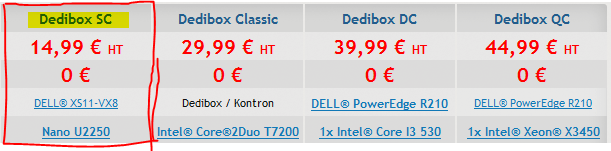
Online.net, owned by the Iliad group, is the second largest hoster in the French market. The company had traditionally been focused on the higher end of the dedicated hosting market with services starting at 29.99 euro/month and predominantly based on Dell’s rack mounted servers. About three years ago they began exploring the possibility of providing a lighter weight entry-level offering targeted at SMBs.
Online engaged Dell’s Data Center Solutions (DCS) group and the two teams began brainstorming around system designs to meet the needs of this new segment. The design that DCS came up with was the Via processor-based microserver the Dell X511-VX8, code name“Fortuna” (please note I had nothing to do with the official naming of this product :)). The system handles one OS and app per server, has one 1 CPU per server and features 12 servers per chassis.
Online.net's "START" line of offerings, beginning with the microserver enabled, Dedibox SC.
Thanks to these ultra cost-efficient systems, Online was able to provide SMB customers with an entry-level offering at half the price of their next lowest product. Not only that but this new offering allowed Online to grab significant share in the French market.
Tres tres cool et tres tres (geek) chic
If you want to see the Dell X511-VX8 in action or take a tour of Online’s datacenter and operations, all set to chill house music, check out the video below. (The rows and rows of X511s appear at the 1:40 mark and go until 2:40. You can also see a quick overview of one of the microservers themselves at the 4:36 mark).
Beyond the Dell X511-VX8
The success that Online had with the X511 gave DCS insight into the potential of the microserver market. Based on the concepts that came from the work with Online.net, DCS created a follow-on offering, code-named “Viking,” for our custom accounts.
This too was a big success, so much so that we will soon be taking this experience even broader as we look to announce our third generation microserver.
Last week and this, Austin’s downtown has been taken over by the South by Southwest festival (SXSW). What started out nearly 25 years ago as a music festival/conference has grown to include parallel film and interactive events as well. During the event every bar and venue downtown is occupied with bands, films or tech companies showing their stuff.
Check out the mini montage below that includes a quick interview I did with Dell solutions engineer Greg Althaus right after he finished the demo.
Don’t take our word for it
Dell is currently field testing crowbar and plans to donate the code to the OpenStack community after testing. If you are interested in testing crowbar yourself, email us at OpenStack@Dell.com.
Some of the ground the video covers
Intro montage: Welcome to the Kung Fu Saloon, setting up and a snippet of the demo
[0:40] Talking to Greg
What actually is crowbar and how does it work with OpenStack compute and storage?
How fast can you spin up a cloud using it?
Where does OpsCode’s Chef fit in?
Our plan to donate this code to the community after field testing.
One small step for OpenStack, one giant step for mankind! Ok, that may be taking it a bit far but today there is some exciting news that Dell and Rackspace have announced.
If OpenStack is new to you it’s the open source cloud platform based off of the Nebula cloud code base donated by NASA (hence all the rocket allusions) and the storage code base from Rackspace. The project is now about eight months old and its community is over 50 organizations strong including NASA, Citrix, AMD, Intel, NTT, cloud.com, RightScale, Dell, Opscode and Puppet labs.
To help the community and organizations get up and going building out their own OpenStack based clouds we are announcing the following:
Proof of Concepts: Rackspace and Dell are working together to deliver an OpenStack solution to market later this year. As the first step along the way we are currently seeking customers for OpenStack proofs of concept (POC). If you are interested in learning more about the POCs and possibly participating or getting engaged, email: OpenStack@Dell.com.
Code: Dell has developed an OpenStack installer that can be used to quickly install OpenStack on bare metal Dell PowerEdge C servers. This tool is being field tested, and Dell will contribute the code to the OpenStack community once testing is complete. To help users out further, once the OS is installed, the servers can be updated with all the latest packages and be automatically configured by Opscode’s Chef to provide their services in the OpenStack infrastructure.
Technical whitepaper: A technical whitepaper, “Bootstrapping OpenSource Clouds” which lays out the design of a hyperscale OpenStack cloud on Dell PowerEdge C servers.
But wait, there’s more, “Cloud Builders”…
To help support OpenStack deployments, Rackspace announced today that its launching a new division, “Cloud Builders.” Cloud Builders “will provide training, certification, deployment services and ongoing support and management to enterprises and service providers via the team of OpenStack experts and its partner network.”
Specifically the offerings will include (taken from the Rackspace blog):
Training & Certification – Rackspace Cloud Builders will provide training classes and certification testing for designing, developing and administering OpenStack Clouds. Rackspace also plans to empower a network of training and certification experts.
Deployment Services – Rackspace Cloud Builders, in conjunction with other experts from the OpenStack community, will help customers design and deploy OpenStack Clouds.
Support & Management – Customers will have ongoing access to remote support and escalation assistance from the OpenStack specialists, including proactive monitoring and fixes.
OpenStack is picking up momentum, stay tuned for more and in the meantime, set the controls for the heart of the sun! 🙂
Yesterday, the announcement went out that the Dell | Canonical Enterprise Cloud, Standard Edition was out and ready for consumption. What this cloud-in-a-box allows folks to do is to set-up affordable Infrastructure-as-a-Service (Iaas)-style private clouds in their computer labs or data centers. The cool thing is that, because the Ubuntu Enterprise Cloud (UEC) software is compatible with Amazon Web Services EC2 and S3 services, it enables IT admins and developers to move workloads between public and private clouds.
Who cares?
Application developers and IT service providers and admins who are setting up cloud POC’s are perfect candidates for this pre-configured testing and development environment. With regards to industries, areas where there is a lot of software development work like Hosters, Telco & Communications, Media & Entertainment and Web 2.0 businesses are prime markets for the Dell UEC solution.
So what’s in it?
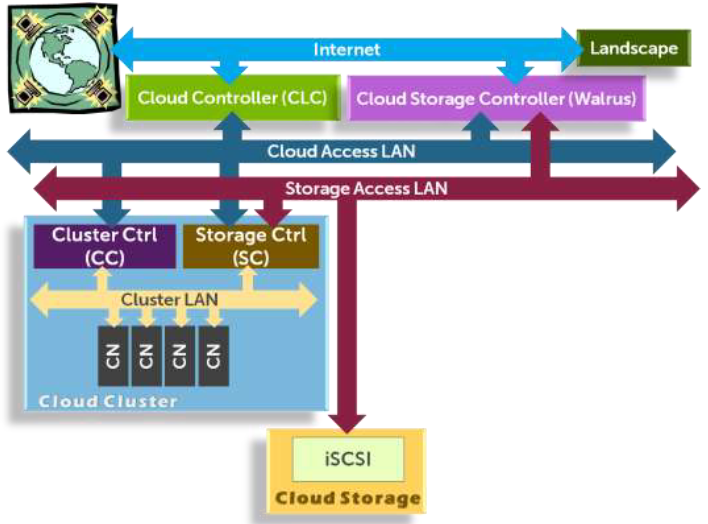
The solutions’ basic components are Dell PowerEdge C systems plus a Dell-specific download of the Ubuntu Enterprise Cloud (made up of the Ubuntu operating system and the Eucalyptus platform for private cloud computing). To simplify getting the whole shebang up and running Dell and Canonical are providing the following:
Walrus Controller – the cloud’s storage repository
Cluster Controller (CC) – the controller for a up to 1024 compute cores grouped together as a cluster
Storage Controller (SC) – the controller for cluster’s storage repository
Compute Node (CN) – cloud’s compute node
And on the support side…
If you’re looking for systems management and support services with your order, you are in luck. Canonical, the company behind Ubuntu, has put together UEC Assist, a support service built specifically for Dell customers deploying SE Edition and which is delivered by Canonical’s Global Services and Support team.
Its all about efficiency
From a Dell DCS (the group at Dell behind this) point of view, this offering fits in well with our strategy of bringing total solutions to market that optimize efficiency at every layer, from code to servers to storage. The open source Dell UEC solution is tailor made to deliver a ready to go IaaS solution.
Dell’s Data Center Solutions (DCS) group focuses on customers operating huge scaled out environments. Given the number of systems deployed in these environments we are always looking for ways to take energy out of our systems. A half a watt here, a half a watt there means big energy savings when multiplied across a hyper scale environment and translates into lower costs to our environment and to our customers’ operating budgets.
Recently we have adopted Samsung’s low voltage DIMMs (“Green DDR3”) in our efforts to drive efficiencies. Take a listen to DCS’s Executive Director of engineering and architecture, Reuben Martinez, in the video below as he walks you through how a seemingly small decrease in DIMM voltage can translate to millions of dollars of savings in hyper scale environments.
Some of the ground Reuben covers:
How much energy US data centers consume and how this has grown.
What is happening to the cost of energy (hint: its going up:).
How our PowerEdge C6105 is designed for power efficiency including utilizing Samsung’s low-voltage memory. (BTW, Samsumg’s Green DDR3’s are also available in our C1100, C2100 and C6100)
The amount of power consumed by memory compared to the CPU (you may be surprised)
[2:35] The TCO calculation that shows the savings that low voltage DIMMs can provide in a typical data center environment.
Joyent has been a provider of cloud services for the past five years, longer than the term cloud itself has been around. Today at a press conference in San Francisco, Dell announced the availability of the Dell Cloud Solution for Web Applications which offers the software from Joyent as a turnkey platform-as-a-service offering. This private cloud offering is offered on Dell’s specialized cloud servers and is targeted at IT service providers, hosting companies and telcos.
Up and running
One of the first customers to pick up and run with this offering is Uniserve, a Canadian Internet services provider. Uniserve has adopted the Dell Cloud Solution for Web Applications to offer on-demand access to a high-performance Internet application and consumer delivery platform, for customers to develop iPhone apps to commercial storefronts, to hosting and delivering Software-as-a-Service.
Thoughts from the top
Joyent CEO, David Young is featured in the short video above addressing the following questions about the Dell/Joyent solution:
Today at a press conference in San Francisco we announced the general availability of our Dell cloud solutions. One of the solutions we debuted was the Dell Cloud Solution for Data Analytics, a combination of our PowerEdge C servers with Aster Data’s nCluster, a massively parallel processing database with an integrated analytics engine.
Earlier this week I stopped by Aster Data‘s headquarters in San Carlos, CA and met up with their EVP of marketing, Sharmila Mulligan. I recorded the video above where Sharmila discusses the Dell and Aster solution and the fantastic results a customer is seeing with it.
Some of the ground Sharmila covers:
What customer pain points and problems does this solution address (hint: organizations trying to manage huge amounts of both structured and unstructured data)
How Aster’s nCluster software is optimized for Dell PowerEdge C2100 and how it provides very high performance analytics as well as a cost effective way to store very large data.
(2:21) InsightExpress, a leading provider of digital marketing research solutions, has deployed the Dell and Aster analytics solution and has seen great results:
Up and running w/in 6 weeks
Queries that took 7-9 minutes now run in 3 seconds
Yesterday morning at the Web 2.0 summit out in San Francisco I sat in a session led by RackSpace‘s CTO John Engates. After the session finished I grabbed some time with John to learn more about his thoughts on OpenStack, the open source cloud platform that Rackspace, along with NASA helped kick off.
Some of the ground John covers:
How OpenStack directly addresses some of the most common reservations people have about the cloud.
The beginning of this week I attended the Web 2.0 summit out in San Francisco. Dell was a sponsor and it turned out to be a great event with speakers like Mark Zuckerberg of Facebook, Robin Li founder of Baidu, Mary Meeker of Morgan Stanley, Eric Schmidt of Google and the list goes on.
While at the conference I ran into Social Media guru, author and founder of the Altimeter group, Charlene Li. I was able to grab sometime with Charlene and get her thoughts on a few topics. Here is the result:
Some of the ground Charlene covers:
How social media efforts are transitioning from tools and tactics to a strategic and holistic approach.
(3:01) Charlene’s thoughts on Monday’s Facebook announcement (Facebook Messages) and what she finds most interesting about the move
(4:22) What Charlene thinks of Dell’s social media efforts, what have we done well and where can we improve.
Last week, Tier5 who has taken over an old Mitsubishi facility in Adelaide was the first company globally to deploy Dell’s third generation Modular Data Center. Tier5 is an eight-person start up that is turning the former auto plant into a state-of-the-art data center park to be leased by wholesale tenants including managed service providers, resellers and large users.
Instead of building out a traditional data center Tier5 went with Dell’s Modular Data Center (MDC) which snaps together like ginormous Legos allowing systems to be up and running in as little as a week. The MDC’s modular nature also allows capacity to be added incrementally as needed.
For a great overview, check out the short video that ITNews did at the opening press conference on Tuesday.
Hand-in-hand
To get Tier5 exactly what they wanted Dell’s DCS team worked collaboratively with the Tier5 engineers over a period of nine to 10 months to nail down the exact specs. As Tier5 founder Marty Gauvin said, “Our engagement with Dell DCS was enormously collaborative. We were able to achieve our objectives in a very collaborative way, and then go beyond them.”
So what is this thing?
The shell of Dell’s MDC solution is formed by a steel frame, rather than a standard rigid shipping container. As a result of this design, Dell can deploy modules with different configurations to meet the needs of different customers. Each module houses up to 12 standard server racks and up to 2,500 servers. The design gives Tier5 the flexibility to mix and match hardware components within a module to better serve the specific needs of its customers.
The MDC solution contains two rows of custom-built racks with a center hot aisle, a design that allows easy access to components for servicing and maintenance. The module offers an easily accessible connection point for power and cooling as well as IT management. It also offers multiple cooling options, including chilled water, evaporative cooling and outside air. This enables users to choose the cooling option that works best for the site and the climate.
Keepin’ it green
Besides allowing Tier5 to be agile and not having to tie up capital until right before its needed, the MDC also saves on a tremendous amount of power. Tier5 estimates a best in class power usage efficiency (PUE) of 1.18 for the Adelaide modular data center. This in turn will result in their customers saving approximately AUD $8 million in power costs per year.
Where to next?
So the first third-generation Dell MDC has surfaced down under. Stay tuned to see where in the world the next one will pop up. 🙂
Ironically when Dell, the company that built its success around supply chain management excellence, started the Data Center Solutions group to serve the “biggest of the big,” supply chain and procurement were just bit players.
I recently sat down with Chris Thompson who heads up the DCS supply chain and procurement organization and learned how this changed and the importance of his group in meeting the needs of this very unique customer set.
Some of the topics Chris tackles:
How his group helps customers get to revenue faster.
To what extent the DCS supply chain org is independent of Dell “normal” processes and procedures and to what extent it leverages them.
How has Chris’ group affected traditional Dell supply chain practices.
Earlier this week Dell held an industry analyst summit in Boston. The event, “Dell Services and Solutions for the Virtual Era” was attended by analysts from around the world and was a follow-on to the event Dell held in San Francisco back in March.
Please take your seats, the summit is about to begin.
What went on
The two-day event featured presentations from Dell’s senior leadership, customer and partner panels, break out sessions and 1:1’s between analysts and Dell subject matter experts. The first day also culminated with a solutions expo and dinner held at the very cool Institute of Contemporary Art.
What were the key messages?
The high-level messages that Dell kept reiterating were:
We are executing on our strategy of delivering solutions that are open, capable and affordable which ultimately give our customers the power to do more.
We are undergoing a fundamental change in the way we’re approaching our customers. We are moving away from transactional selling motions toward a more consultative approach.
Right before the guests arrive. The solutions expo and dinner.
How was it received?
It will be interesting to see the reports that are generated from this week’s summit but we did receive some very positive tweets during the event (check out the whole twitter feed from the event):
Conclusion from [Dell Analyst Summit]: Dell 2.0 has arrived. We’ve called it 1.x to date. No longer. They’ve cracked the “solutions” code — Jonathan Eunice, Illuminata
Dell’s vision is quite clear and lingo shows detachment from manufacturer approach – openness remains as a mantra — Giorgio Nebuloni, IDC
Dell talking solution accelerators. Didn’t hear this message from them a few yrs ago. Highlights strengths of Perot & Dell 2gether — Tim Sheedy, Forrester
Great session with Dell Health IT team. Great progress and compelling positioning in the space. Good prog telling a sngl story — Crawford Del Prete, IDC
Updated 11/04
Here are interviews I did with two of the analysts who attended the summit:
In my last entry I talked about how Steve Perlman, CEO and founder of OnLive joined the recent press round table we had in New York. OnLive is a cloud-based gaming company that launched earlier this year and whose servers were custom built by Dell’s Data Center Solution (DCS) group.
To give you a bit more insight into how the two companies worked together, here is a short video with Bruce Grove, OnLive’s director of strategic relations talking about the relationship between Dell and OnLive.
Some of the ground Bruce covers:
The value, as a start up, of working with someone who knows how to do supply chain, logistics and build tons of servers.
Working together as a team to design the servers (engineering teams on both sides as well as manufacturing teams).


 Posted by Barton George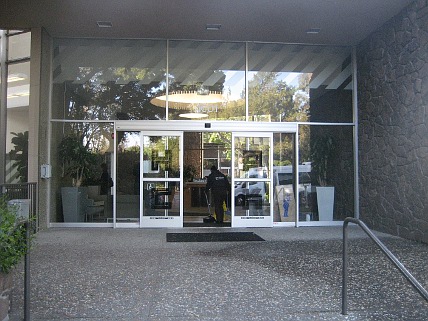







 – the cloud’s storage repository

 Barton's Blog