The Sassy part of the Cloud

December 18, 2008

These days when people describe cloud computing you’ll often hear them dividing it into three basic groups:

  1. Application Clouds (aka Software as a Service or SaaS)
  2. Platform Clouds (aka Platform as a Service or PaaS)
  3. Infrastructure Clouds (aka Infrastructure as a Service or IaaS)

Besides self-interest (a cloud-based app helps me pay my bills), I find the first group above the most interesting as well as the most tangible for the average bear.

So what does the board think?

A couple of weeks ago the Data Center Advisory board over at Searchdatacenter.com was asked to weigh in with their thoughts on cloud computing.  RedMonk analyst Michael Cote offered up his SaaSy perspective as follows:

IT managers should be looking at converting their on-premise infrastructure to what we recently called “Software-as-a-Service” and now the bucket of “cloud computing.” If your email isn’t in the cloud already, there should be a fantastically good reason, like regulations that prevent off-premises email.

Can you host your instant messaging in the cloud? How about file sharing and basic intranet functions? Even things like SharePoint look attractive. Essentially, you want to inventory all of the low-priority items you have on your intranet and ask if it’s cheaper to move them off-premise.

Although I would have chosen a less pejorative term than “low-priority items,” I think Cote’s advice is spot on.  He then goes on, while warning against irrational cloud exuberance, to clearly list the key advantages of move apps to the cloud:

Top of the list tends to be cost (both up-front and ongoing, especially when it comes to upgrading and maintenance) but also flexibility and new functionality that come with cloud-based applications.

How cloudy is your IT set-up?

Pau for now…


Blueprint: See what’s so cool about it

December 9, 2008

Yesterday, Dave Marquard posted a cool video on the Lombardi blog that provides a great introduction to Blueprint.  The video, which is less than three minutes long, was created by Nachi Chidambaram, a Lombardi Business Process Management Analyst.  Check it out below.

For those who prefer to read — Spoiler Alert!

The video starts out by showing how a process mapping project works using Visio and the tremendous amount of double-work that’s involved: transcribing from sticky notes, managing and incorporating a blizzard of feedback and keeping track of attachments.

With Blueprint on the other hand, as Nachi explains you can capture the original brainstorming session directly in the browser-based product and then, at a push of a button, transform your discovery map into a process flow diagram.   Also due to Blueprint’s collaborative and wiki-like nature, keeping track of feedback and input is easy and attachments are all stored in a central repository accessible to all.  And given that Blueprint is cloud-based you can get started as fast as you can enter your credit card number 🙂

Pau for now…


Talking with the President of Dell Americas about Cloud Computing and the Economy

December 1, 2008

When I attended the RackSpace Customer event back at the end of September I was impressed with the talk that Paul Bell of Dell gave (Paul reports to CEO Michael Dell and is responsible for all business operations for Dell in North and South America).

dell_cloudsedited1

Dell and the Cloud(s) (sources: my hand + the football Dell gave out at the conference + Friday’s sunset)

In his keynote Paul talked about Cloud Computing and the challenges the economy was presenting Dell and its customers.  I caught Paul after his talk (BTW Lombardi is a Dell customer and Dell is a Lombardi Teamworks customer) and asked if I could tape a podcast with him.  He graciously agreed and here’s the result that I recorded at the beginning of last week.

Take a listen:

>> My talk with Paul (11:59): Listen (mp3) Listen (ogg)

Some of the Topics we tackle:

  • The key Cloud characteristics: Speed to deployment and ease of turning on/off
  • The need to separate the “real” from the fictitious when it comes to the Cloud
  • The interest Paul is seeing in the Cloud from smaller companies
  • Two of the biggest ways Dells plays in the cloud 1) supplier of infrastructure 2) deliverer of IT as a service
  • How on one hand the tough economy is driving interest in utilizing the cloud while at the same time it is causing a slow down in the sales of cloud infrastructure
  • The economy (starts ~7:30): Looking back at what happened in 2001 and trying to gain insight
  • How the economic malaise that hit North America has finally caught up with South America
  • How Dell is planning to help customers during these tough times.

Pau for now…


Chattin’ with Mosso co-founder, Jonathan Bryce

November 10, 2008

At the Rackspace Customer Event the week before last, I caught up with Mosso co-founder Jonathan Bryce.  Jonathan walked me through how Mosso, now officially a Rackspace division, got started and where he sees it going.

Take a listen:

>> My chat with Jonathan (10:52):  Listen (mp3) Listen (ogg)

rck_jonathanbryce1

Jonathan chillin’ in the Baroque Westin Riverwalk lobby.

Some of the Topics we tackle:

  • How while at Rackspace, Jonathan and a buddy moonlighted as web app developers and when they couldn’t find a place to host the apps and sites they developed, they got funding from Rackspace and created Mosso.
  • How Mosso was being founded as people were getting burned by the undelivered promises of Utility computing.
  • How Jonathan defines cloud computing (hint: it has three layers).
  • The characteristics and examples of IaaA, PaaS, SaaS and where Rackspace/Mosso plays.
  • The joy of 15 cents a GB per month storage that Mosso will be providing and which Blueprint will be leveraging in our next release.
  • The relationship between Rackspace and Mosso and why the Mosso site is so much cooler.
  • What role open source plays in the Cloud and Mosso.

Extra-credit

If you want to catch Jonathan live, he will be presenting at the Cloud Computing expo in San Jose November 19 – 21.

Pau for now..


Talkin’ with Rackspace’s CEO Lanham Napier about the Cloud and Hosting

November 6, 2008

Last week I attended the Rackspace customer event down in San Antonio.  On the first day of the event I was able to grab sometime with Rackspace’s CEO, Lanham Napier.  We chatted about going public, the company’s recent acquisitions and its foray into the cloud via Mosso.

Take a listen:

>> My Interview with Lanham (8:11): Listen (mp3) Listen (ogg)

rck_lanhamnapier2

CFO turned CEO, Lanham Napier (who sounds like someone famous)

Some of the Topics we tackle:

  • What does Rackspace do and what’s the company’s ultimate goal.
  • Why Rackspace decided to IPO in the choppy seas of August.
  • How the company decided on SliceHost and JungleDisk as acquisition targets
  • Rackspace’s two service sets, Managed Hosting and Cloud Hosting, and what’s the difference (Blueprint utilizes both)
  • Lanham’s thoughts on Microsoft’s Cloud announcement and the relationship between the two companies.

But wait, there’s more

Stay tuned, in the next few days I will be posting the other two podcasts I did last week, one with  CTO John Engates as well as one with Mosso co-founder Jonathan Bryce.

Pau for now…


Splitting the Cloud in Three

November 4, 2008

Last week I attended the Rackspace Customer Event (Lombardi Blueprint is hosted at Rackspace) down on the Riverwalk in San Antonio.  It was a great event and I sat in on some cool talks as well as grabbed some time with several of the Rackspace execs.

Later this week and/or early next week I will be posting the podcasts I did with CEO Lanham Napier, CTO John Engates as well as Mosso co-founder Jonathan Bryce.

rck_bridge

The Riverwalk at dusk.

One of the talks I sat in on was CTO John Engates’ Cloud Computing presentation.  You can check out the whole presentation here, but the section I wanted to call out was the one that dealt with “The Categories of Cloud Computing.” While not an original construct, it helped me to see it laid out like this:

Application Clouds (SaaS)

  • Ease of use: Low complexity
  • Flexibility: Minimal control
  • Typical Consumers: End users
  • Examples: Mail Trust, Salesfore.com, Blueprint, TurboTax Online, Microsoft Online Services

Platform Clouds (PaaS*)

  • Ease of use: Medium complexity
  • Flexibility: Medium control
  • Typical Consumers: Developers
  • Examples: Rackspace/Mosso Hosting Cloud, Google AppEngine, Force.com, Azure

Infrastructure Clouds (IaaS)

  • Ease of use: High complexity
  • Flexibility: Maximum control
  • Typical Customers: Developers, System Administrators
  • Examples: Rackspace/Mosso Cloud Files, EC2, S3, Microsoft SSDS, FlexiScale, GoGrid

*Not to be confused with PAAS.

While I find these categories helpful now, I’m sure it won’t be long until these divisions go the way of “intranet,” “extranet,” and “internet,” and there’s just one big happy cloud.

rck_originalcloud

Where it all began“The Original Cloud” TM.

Pau for now…


Microsoft Joins the Cloud Party

October 28, 2008

Yesterday at PDC, the big Microsoft developer fest, Ray Ozzie got up and announced the beta launch of Windows Azure, Microsoft’s entry into the cloud computing arena. (It may be beta but you’ll notice they already have a snazzy logo)

This wasn’t a big surprise to anyone since they had been doing some saber-rattling in the past weeks about how they would be joining the party (fashionably late in true Microsoft style).  To carry the party analogy a little bit further, two of the other guests who had gotten there early to help set up, Rackspace and Amazon, made announcements of their own last week.  Rackspace announced the acquisition of two cloud-focused start-ups and a reorganization of their Coud division, Mosso.  Amazon added Windows as an OS to EC2 (have a mentioned how much I dislike the “EC2” name?), dropped the “beta” tag it and added an SLA of 99.95% availability per year.

Looking at the Cloud from both sides now

In an interesting post from the BBC’s Rory Cellan-Jones, which is based on an interview that Rory conducted with Ozzie yesterday, Rory finds out they have slightly different interpretations of cloud computing (shocker!).  Ozzie sees Amazon as a cloud pioneer but “[insisted] that Google just wasn’t in cloud computing.”

I pointed out that the one cloud application with which I was familiar was Google Docs … But it turned out we were looking at the cloud from different sides. Mr Ozzie was focussing on it as something you rented out to businesses so they could use the vast computing power in your data centres to create applications which could scale up in a hurry – an approach where Amazon is enjoying plenty of success. I was thinking of the cloud as a place where millions of users could store their data and use simple online programmes, mostly for free.

There are folks who agree with Ray that what Google does is deliver Software as a Service rather than cloud computing but I don’t think the distinction is helpful.  To me if you draw on compute resources, be they apps or platforms, from a source you don’t own or manage and that you can scale up or down as needed and you are billed accordingly… that’s cloud computing.  (I’m off to the Rackspace customer event today so it will be interesting to see if I come back with a different definition 😉

Pau for now…


Pics and Notes from Rackspace’s Cloud Event

October 23, 2008

Yesterday a little before noon I jumped in my car and headed to UT to attend the Rackspace Cloud Event.  It was held on campus in the same building that “hosts” (bad pun intended) the local NPR station as well as the studio that Austin City Limits is filmed in.  It was this studio that Rackspace used for their event.

Others who’ve used the studio besides Rackspace, The Buena Vista Social Club and Robert Plant (notice the reflected PBS logo artfully captured in the upper left)

The Big News

The big news of the day were the two acquisitions that the recently IPO’d Rackspace announced, Jungle Disk and Slicehost.  Jungle Disk provides storage back-up for the cloud and until the acquisition, was solely supporting Amazon S3.  Going forward, Jungle disk will support both Rackspace’s cloud offering as well as S3.  The other company, Slicehost is “a leader in Xen-based virtual hosting.”

One of the most tangible benefits these acquisitions give Rackspace right off the bat is a whole bunch more “active, paying customers”:

It would be interesting to see this same chart done by revenue.  I have a sneaking feeling the managed hosting side would go shooting off the chart. Of course once you have new customers you can always look to up-sell them.

Mosso aka Rackspace’s Cloud Hosting Divsion

Mosso is now refered to as “Rackspace’s Cloud Hosting Division, powered by Mosso.”  It will be interesting to see how they handle the branding transition going forward and if they drop the Mosso name completely.  Speaking of Mosso, I didn’t realize it, but in chatting with Emil Sayegh, formerly Rackspace’s VP of product management and Marketing and now the Mosso GM, Mosso was originally an incubator project of Rackspace’s, funded a couple of years ago.

As of yesterday, this division is now organized into three buckets:

  • Cloud Sites (formerly “The Hosting cloud”): “a scalable platform for [web sites] for handling huge traffic spikes and a pay as-you-grow pricing model.”
  • Cloud Files (formerly “CloudFS”):  Rackspace’s cloud-based storage.  This is where Jungle Disk will fit.  Lombardi Blueprint will be making use of this when we add file attachment capability to the product in our December release.
  • Cloud Servers:

Slicehost founders Jason Seats and Matt Tanase.

The Bigger Picture

Zooming out to high-level view of Rackspace’s portfolio, its grouped into three main bubbles:

  • Cloud Hosting: Which yesterday’s event focused on.
  • Cloud Applications: Apps that Rackspace provides like email
  • Managed Hosting: “an advanced type of dedicated hosting… Unlike basic dedicated hosting, managed hosting offers system level administration and support, comprehensive Internet infrastructure and extensive services that relieve IT departments of many critical, but costly responsibilities.”  (We use this service to host Lombardi Blueprint).

Looks like Cloud hosting has bubbled to the top.

Rackspace Customer Event

I’m  psyched for next week’s customer conference down in San Antonio and learning more about what Rackspace is up to.  I met a few of the execs yesterday and warned them that I would come armed with a recorder to do some podcasting.  I will be posting those here on the blog so stay tuned.

Extra-credit reading

I ran into Red Monk Pundit Michael Cote yesterday, sporting a very sharp shirt,  and had a quick chat after the event.  Here’s his take and pics from the event.

Pau for now…


Blueprint: Built of Java thanks to Google Web Toolkit

October 14, 2008

The great thing about cloud-based applications is that it doesn’t matter what they’re written in or how they’re constructed, all that matters is that they do what you need them to.  What’s the back-end of your phone system written in?  Odds are you don’t know and don’t care.

That being said, there are group of folks, lets call them “developers” who are interested in what goes on behind the curtain.  For that group of people and others who find this kind of thing interesting and informative, read on.

What to build Blueprint out of?

When the team first started developing Lombardi Blueprint, they began with Java on the back-end and a combination of HTML and Flash on the front end.  When, due to plug-in issues, this didn’t work they moved to pure HTML and JavaScript using Dojo.  This too had its issues, namely performance and a lack of visibility.

Around this time Google Web Toolkit (GWT) 1.3 was released and the team decided to give it go.  This turned out to be the right choice.  GWT, which compiles Java code into JavaScript as you go,  enabled the team to write both the back and front ends in 100% Java.

GWT, which was originally released in May of ’06, is 100% open source licensed under the Apache License 2.0.

Here’s a good entry posted by Olivier Modica, the Blueprint engineering manager that simply lays out the advantages that GWT provides the Blueprint team: How GWT is enabling Blueprint’s agility.

Gory Detail and Extra-credit reading

If you really want to dive into what the team did with GWT and Blueprint, check out the video of the talk Alex Moffat, lead architect on Blueprint, and Damon Lundin gave at Google I/O back in May.

Also if you want to learn more about the performance of the recently released GWT 1.5, check this out:  Blueprint and the Performance of the GWT 1.5 Hash Map

Pau for now…


Watch Blueprint in Action

October 13, 2008

If a pictures is worth a 1,000 words, how many words is a 1 minute and 39 second-you tube video worth?

See for yourself.  Below is a clip that introduces the viewer to Lombardi Blueprint, the cloud-based process modeling solution (everything you see is taking place within a browser) that I’m working on.

Initial Project Goals

To give you some context for viewing, here’s how Blueprint’s lead architect Alex Moffat described the team’s initial challenge last year:

The challenge handed to us was to create a tool that the average business user could use to document and manage their business processes. It had to be easy to use, encourage collaboration between team members, and provide a shared repository for all of a company’s process documentation. Workflow functionality had to be on par with our competitors: Microsoft Visio, IDS Scheer’s ARIS, IBM’s WebSphere Business Modeler, and other desktop modeling tools. But we also wanted wiki & shared whiteboard capabilities to store information. Editing should use the drag and drop interaction users of desktop apps are familiar with. We ended up with some additional features that really set us apart:

  • An intuitive map view as a high level visualization of a process
  • Automatic workflow diagram generation
  • PowerPoint generation for easily presenting the process
  • Online chat functionality

If you’d like to actually test out Blueprint for yourself, you can get your hands on a free copy here.

Pau for now…


Depression good for Cloud

October 8, 2008

Yesterday, Nat Torkington had an interesting post on O’Reilly Radar (not to be confused with Radar O’Reilly) entitled “The effect of the Depression on Technology.”

Whether I would classify what we’re in as a “Depression” or not, is beside the point.  The economy is definitely not doing well and folks are spooked.  Seeing the glass as half-full, Nat see’s this current period as good for innovation, good for free and open source software and good for services and cloud computing:

…open source services and cloud computing will benefit from the tight financial situation where conditions will favour opex and not capex. It wil be nigh impossible to borrow to buy hardware or a major software license….cloud computing lets a company pay a little to use someone else’s enormous capital investment.

Opex vs. Capex

This opex vs. capex distinction is one of the great advantages of services provided by the cloud (in both good times and bad). It helps to break down barriers to adoption, and allows purchases to be made in a timely manner rather than getting bogged down in endless approval cycles.

Separate from approval-cycle-avoidance, the other adoption mega-accelerator for cloud-based services is the basic hosted nature of the services.   Offsite hosting and maintenance mean that new services can be switched virtually instantaneously without needing to burden the often already over-taxed IT side of the house.

So, while I agree with Nat’s thinking, I hope we don’t have to test it for too long.

Pau for now…


Amazon talks about Amazon’s cloud

October 6, 2008

From the same event where Jeff Keltner of Google talked about Cloud Computing, below is a video of Adam Selipsky, Amazon’s VP of product marketing and developer relations for Amazon Web Services.  Adam uses his slot to talk about what Amazon’s been doing in the last couple of years in the area of Web services.

He starts off with an interesting chart that shows how the bandwidth from the web services side of the house has now outstripped the bandwidth required for the website side.  He then positions Amazon Web Services (AWS) as a suite of building blocks that the company has been rolling out one after the other in the following order:

  1. S3 (Simple Storage Service)
  2. EC2 (Elastic Compute Cloud) – I have to point out for a company that delivers great consumer experiences they sure suck when it comes to the naming of offerings on web services side.
  3. Simple DB (ok that’s a decent name) – in beta
  4. SQS (Simple Queue Service)
  5. FPS (Flexible Payment Service)
  6. MTurk (Mechanical Turk – an on demand workforce)

The guiding principles that AWS has used when creating services is that they be

  • Easy to use
  • Fast
  • Elastic (quick to ramp up or down)
  • Highly available
  • Available on a pay-as-you go basis (so that you can terminate at any time if you’d like)

I was surprised that while Adam talked about the Amazon built services, he didn’t mention any of the services from others that they host like Solaris, MySQL, JBoss, Zmanda data recovery etc.  It might have been the audience he was addressing but I would think that this is where AWS’s real business is coming from in the future.

Pau for now…


Google Addresses Three Cloud Computing Myths

October 3, 2008

I came across the following short video featuring Jeff Keltner a Business Development Manager for Google Apps.  The video is from TechWeb from mid August and it looks like it was taken at an event featuring various “Cloud Players” (I noticed Amazon’s VP of Amazon Web Services, Adam Selipsky is sitting on the couch while Jeff speaks).

For those who prefer reading, here is a quick summary of Jeff’s talk:

He starts with two positives for Cloud Computing

  1. From an IT perspective: He cites the Gartner statistic that only 20% of the total cost of ownership for software is the purchasing of the software while 80% of the cost comes from the ongoing maintenance.  He cites the centralized nature of the cloud as a way of reversing that trend and actually flipping the relationship.
  2. From a user perspective, we are shifting from personal to group productivity and shifting towards a single instance of an application and collaboration which the cloud supports.

He then focuses on the Myths

  1. It’s not secure: Jeff argues that an enterprise with the size and scale of an Amazon, Google or Salesforce.com is much more secure than most.  He also rightfully points out that you can’t assume that today’s in-house model is zero risk.  (This seems like an obvious point but one that people often miss when comparing the two models).
  2. It’s not proven (no one’s done this before):  He talks about how cloud began with services like ADP payroll and then rolled out to other vertical apps like Webex and Salesforce.com and has continued from there.
  3. It’s not for the enterprise:  He points to the large scale of Google support and infrastructure.

Pau for now…


Ellison and Stallman Rain on Cloud Computing

September 30, 2008

Like all “new” things, if its hot and catches on everyone and his brother will jump on the band wagon and want to spread some of its magic pixie dust on their offerings — witness the overuse of the term “Web 2.0.”  Such is the current case with “Cloud Computing” a re-branding of an evolution of technology that includes utility computing and software as a service concepts.

(Note: One of the many great things about Cloud Computing is the amount bad puns that it allows for e.g. see title.)

Richard Stallman’s alter-ego “Saint IGNUcius.” (photo taken in Hawaii where we presented).

Everything tastes better with Cloud Computing on it

As Forrester analyst Frank Gillet explains on Beet.tv, this current overuse of the phrase is being referred to as “Cloud Washing” or the application of “Cloud Spray.”  It is this misapplication of the term that Oracle’s Larry Ellison railed against at the Oracle financial analyst meeting, “I can’t think of anything that isn’t cloud computing with all of these announcements.”  Still others are concerned that this willy-nilly application of the phrase will only serve to cloud the meaning of the term (remember what I said about bad puns).

Richard Stallman of the Free Software Foundation, whom I respect but don’t always agree with, tells the Gaurdian that he sees cloud mania as “worse than stupidity.  It’s a marketing hype campaign.”  Being no dummy however, Stallman has used this trend to do a little marketing of his own and grab valuable virtual ink in promotion of Free Software.

The Silver Lining

All this misappropriation aside, Cloud Computing is hot and represents a legitimate trend in computing that is occurring (and has been occurring for sometime now as an evolution rather than a revolution).

It is both this current buzz as well the legitimacy of this trend that led me to my current job, Marketing Director for Lombardi Blueprint process documentation solution.  Blueprint is a cloud-based offering that is available now (in fact you can even get a free trial).  But more on Blueprint in a future post.

Pau for now…


The Gartner BPM Summit: Cool High-Tops, TLAs and The Price is Right

September 25, 2008

A couple of weeks ago, my second day on the job, I was on a flight to our Nation’s capital to take in the Gartner BPM Summit.  It was a great way to dive into the wild and wacky world of Business Process Management.  It also enabled me to meet a lot of the members of the Lombardi team who aren’t based here in Austin.

To say it was different from the last tech event I attended (Debconf08) would be an understatement.  Out the 600 odd attendees, I don’t think I saw one t-shirted hacker. While I did see a cool pair of high-tops (see below), it was mostly a blazer-clad crowd (moi included).

These shoes are so money!

According to Gartner, the assembly was pretty evenly split between Business (51%) and IT (49%), roughly 60% of which identified themselves as currently being involved in a BPM project of some sort.

Some of the things I learned

The three days of the Summit I hit a whole bunch of talks to try to get up to speed in this industry which is new to me.  I learned a ton, met and talked with a lot of great people (including a buddy from high school that I hadn’t seen in 15 years and who is now at IBM) and soaked up a whole bunch of new TLAs.

Here are a few of the notes that I took:

  • BPM is a journey that affects culture, skills and the way that work gets done
  • BPM objectives: Agility, speed to market, compliance, customer satisfaction, efficiency and cost savings.
  • Whoever best describes the problem is the one most likely to solve it (I want to remember this one)
  • SaaS: Two of its biggest benefits are: 1)  its pricing model allows it to fit within an operational budget (no need to get your manager’s manger’s manager to sign-off) and 2) the web-based nature allows for nearly instantaneous implementation.
  • During the Thursday morning SaaS session Michele, Cantera of Gartner and conference co-chair, positioned Lombardi Blueprint well by saying that it targets the business person and not the business analyst and thereby opens up BPM to a much wider audience (the “accesible pricing” doesn’t hurt either).  I also liked her phrase “Modeling in the Cloud” that she used to describe the space that Blueprint plays in.
  • In Michael Blechar’s talk on Business Process Analysis (aka BPA) tools he offered up a great quote appropriate to the space of process modeling.  Everyone knows the first part of Muhammad Ali’s famous quote, “Float like a butterfly, sting like a bee” but Michael provided the rest of the quote, “Your hands can’t hit what your eyes can’t see.”
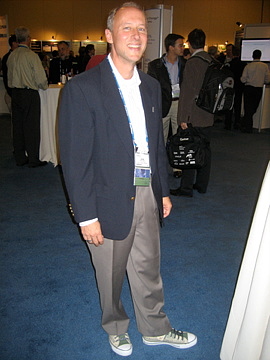
Gene Rawls models what to wear with C-note high-tops.

A vendor presentation that’s not a sales pitch!?

Lombardi was a Platinum sponsor of the event and we had a booth, a couple of talks and a great Hospitality Suite on Thursday night.  Ill have to admit that when I heard we were doing a vendor presentation, given my experience with other vendors at other conferences, I was expecting a Lombardi roadmap presentation and sales pitch.  I was therefor completely taken by surprise when Toby, our VP of Professional Services got up and didn’t talk about Lombardi at all but instead took the audience through the 10 things needed for a successful BPM project.

For the second half of the hour, Toby turned the platform over to Gene Rawls, VP of Continuous Improvement at Wells Fargo and Lombardi customer.  Gene, in his soft-spoken manner did a great job of telling the audience how he and his team went through their implementation and what to expect.

Come On Down!

One of the high lights of the conference were the hospitality suites on Thursday night.  Three other vendors hosted a suite and the themes they chose were football, James Bond/Casino Royale and rockstar/Guitar Hero.  We chose “The Price is Right.”  While it was a cool concept, the execution was very cool.  We held actual 10 contests and gave such amazing items as a Toaster Oven, an iPod Speaker Dock, a luggage set and a NEW CAR (ok it was a remote control toy Hummer).

Lombardi marketing VP Jim Rudden channels his inner Bob Barker.

Pau for now…


Google out, Zoho in — to the tune of 400,000 desktops at GE

September 23, 2008

Who doesn’t love a David and Goliath story?  Looks like General Electric has chosen India-based Zoho over Google to supply its cloud-based desktop suite on 400,000 desktops.  Zoho is a 600 person company that has never taken venture funding and currently generates $40 million a year.

According to Daya Baran’s blog “A GE spokesperson who did not want to be identified said their decision was based around issues of personal and corporate privacy, functionality, support, features and Zoho won hands down.”

Hmmm, GE might be a great candidate for Blueprint 🙂

Zoho landing page.  Look familiar?

Pau for now…
