Turning 100 years of “tribal knowledge” into documented processes

December 4, 2008

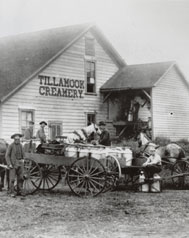
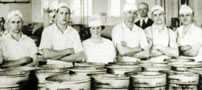
tillamookartisansA while back I posted a podcast with Steve Burge of Tillamook where he talked about how Tillamook, a cooperative, made up of over 150 dairies, took on a process mapping effort to turn 100 years of “tribal knowledge” into documented processes.

Since the story was a great example of tackling a process documentation effort that involved the whole org, rather than just IT, we decided to turn it into a webinar.  We worked with ModernAnalyst.com and created a 35 minute webinar which you can check out here (you can also check out the slides below).

What the webinar’s about

Steve talks through the slides for about 25 minutes and then fields questions for about 10.  Here are some of the topics he discusses:

  • How he built a core team where IT was in the minority and the majority of the members came from the business side.
  • How the team decided where to begin
  • How they involved over 150 people, from all over the company, to help detail the processes and how by doing so it helped eliminate silos and highlight “white spaces.”
  • How this effort led to a “new” view of BPM.

Pau for now…


Morphis: Accidental Process Consultants

November 17, 2008

Morphis is a company that provides currency supply chain management software and counts among its customers the U.S. Federal reserve as well as central banks, ATMs and armored car companies around the world.  Process mapping was the furthest thing from their minds when they started in business but they quickly found out that if they didn’t start leading their customers in process mapping sessions they wouldn’t be able to sell their product.

Last week I chatted with Gary Faulkner of Morphis about how they found themselves unexpectedly leading process mapping sessions for customers or, as Gary likes to describe the turn of events, “A funny thing happened on the way to the software business.”

Take a listen:

>> My talk with Gary (6:59):  Listen (mp3) Listen (ogg)

pair-o-dime_shiftsmallarrow3

Blueprint enabled a pair-o-dime shift for this currency manager. (sources: my fingers and my dimes)

Some of the Topics we tackle:

  • Conundrum: Morphis is meant to be customized to fit a customer’s process but if a customer can’t describe their process how can Morphis be customized?
  • Being new to process mapping they were looking for something that was intuitive and easy to use.
  • The power of seeing the process laid out visually and the importance of working on the exercise collaboratively.
  • How Morphis’s implementations are all done virtually over Webex around the globe

Pau for now…


The Tillamook Podcast — 99 yr old Dairy Cooperative embraces Process Mapping

November 3, 2008

If you’re not familiar with the name, Tillamook is a 99 year-old cooperative made up of over 150 dairies that produces high-end dairy products.  The award-winning cooperative, officially named the Tillamook County Creamery Association, is located up in the north west corner of Oregon.

Until recently, processes were passed down from artisan to artisan in the form of what Steve Burge, who runs TIllamooks’ Business Process Management Office, jokingly refers to as “tribal knowledge.”

There’s a new Sheriff in town and he’s a fan of BPM

When Tillamook’s new CEO came on board he realized that he needed to get a handle on the company’s processes in order to move forward and compete in today’s market.  It was Steve’s job to put together a Process Management Model to lead the collection and documentation of the company’s processes.

>> My Interview with Steve (7:06) : Listen (mp3) Listen (ogg)

Some of the topics we tackle:

  • How Steve built a core team where IT was in the minority and the majority of the members came from the business side.
  • How the team decided where to begin.
  • Why they decided to abandon Visio and cocktail napkins for Blueprint and the value they saw in a hosted application.
  • How they involved over 150 people, from all over the company, to help detail the processes
  • How they got process owners from the business to own execution after the initial documentation effort.

Pau for now…


“Poison:” Blueprint October ’08 is live

October 27, 2008

As product manager Dave Marquard announced this weekend, the October release of Blueprint is now out.

In keeping with the project naming schema of an alphabetical list of “bands-from-the-70’s-and-80’s-that-are-at-least-somewhat-cheesy” we are up to “P” and “Poison” (check-out the whole list here).  Poison is the 11th public Blueprint release and the 16th overall (releases usually come out every 6-7 weeks).

What’s new to Poison:

  • User Management: Thanks to the magical properties of SaaS and improvements to Blueprint, the project leader, or whomever has the admin rights, can add users on the fly and reassign user accounts depending on activity level.  If someone isn’t utilizing their account it can be reassigned to a new individual at the click of the mouse.
  • Invitations: Just like a social networking app like LinkedIn or Facebook, you can now send  invites to colleagues to join Blueprint and collaborate on process discovery and documentation.
  • Instant Upgrades: If you have signed up for a Free account and want to upgrade to the Professional Edition, all you have to do is hit the “Upgrade Now!” button and you are good to go!
  • Printing Big and Small: Whereas before you printed out your process flow diagrams to plotter-sized sheets of paper, you now have the option of printing the full image as a composite across as many pages as needed, or even scale it to fit on one sheet.
  • Word Export of Process Documentation: We’ve improved the print out capability to Microsoft Word Documents.  Now when you print from Documentation View all your inputs, outputs, problems and stakeholders are included.

Stay tuned for cool features the next release which is due in 6-7 weeks.  And what is the code name of the next release you may ask?  “Q” is the letter so it could only be “Quiet Riot.”

Pau for now…


Introducing, Process Mapping 101 – An online course

October 24, 2008

Yesterday we launched Lombardi’s first on-demand training course, Process Mapping 101.  Appropriately, it features our on-demand product, Blueprint.

Rather than putting together a how-to-use-Blueprint course, we wanted to go broader and create a how-to-get-started with Process Mapping.  What we’ve been hearing from a lot of our customers is that, while the Blueprint product is fairly straight forward, they are looking for a methodology on how to approach and drive process modeling project.   They know it involves getting group of folks together in room and capturing the info but who do you invite? How  do you run a session so you get what you want out of it and capture and come away with useful info?  Whats the best way to communicate your progress and get buy-in from senior management?

With a Little Help from Our Friends

To put this together we teamed up with BPM heavy-weight Bruce Silver and Shelley Sweet of I4Process. Here’s how Bruce describes the course:

Broken out into 5 segments of Flash video, the [2  hour] training provides a step by step approach to getting started with mapping your as-is process: the team members needed at each step, roles and responsibilities, how to facilitate the mapping sessions, how to drive the Blueprint tool, and how to organize the generated process diagram for maximum effectiveness.  Much of it takes the form of simulated team mapping sessions.  Most of the rest is hands-on for the student.  We’ll describe a scenario of information gathered from the team session, and you’ll put it into Blueprint – training video in one browser window and Blueprint open in another, so you can compare your result with what it should look like.  Hands-on exercises are the only way to learn it.

Who’s it targeted at?

Like Blueprint itselft, rather than process-jocks, this course is designed for Business Owners, Subject Matter Experts, Project Managers, and Business Analysts who are looking to get started with process mapping from a real-world perspective.

To get a flavor for the course, you can watch a few short snippets from the training here. Check it out!

Pau for now…


Pics and Notes from Rackspace’s Cloud Event

October 23, 2008

Yesterday a little before noon I jumped in my car and headed to UT to attend the Rackspace Cloud Event.  It was held on campus in the same building that “hosts” (bad pun intended) the local NPR station as well as the studio that Austin City Limits is filmed in.  It was this studio that Rackspace used for their event.

Others who’ve used the studio besides Rackspace, The Buena Vista Social Club and Robert Plant (notice the reflected PBS logo artfully captured in the upper left)

The Big News

The big news of the day were the two acquisitions that the recently IPO’d Rackspace announced, Jungle Disk and Slicehost.  Jungle Disk provides storage back-up for the cloud and until the acquisition, was solely supporting Amazon S3.  Going forward, Jungle disk will support both Rackspace’s cloud offering as well as S3.  The other company, Slicehost is “a leader in Xen-based virtual hosting.”

One of the most tangible benefits these acquisitions give Rackspace right off the bat is a whole bunch more “active, paying customers”:

It would be interesting to see this same chart done by revenue.  I have a sneaking feeling the managed hosting side would go shooting off the chart. Of course once you have new customers you can always look to up-sell them.

Mosso aka Rackspace’s Cloud Hosting Divsion

Mosso is now refered to as “Rackspace’s Cloud Hosting Division, powered by Mosso.”  It will be interesting to see how they handle the branding transition going forward and if they drop the Mosso name completely.  Speaking of Mosso, I didn’t realize it, but in chatting with Emil Sayegh, formerly Rackspace’s VP of product management and Marketing and now the Mosso GM, Mosso was originally an incubator project of Rackspace’s, funded a couple of years ago.

As of yesterday, this division is now organized into three buckets:

  • Cloud Sites (formerly “The Hosting cloud”): “a scalable platform for [web sites] for handling huge traffic spikes and a pay as-you-grow pricing model.”
  • Cloud Files (formerly “CloudFS”):  Rackspace’s cloud-based storage.  This is where Jungle Disk will fit.  Lombardi Blueprint will be making use of this when we add file attachment capability to the product in our December release.
  • Cloud Servers:

Slicehost founders Jason Seats and Matt Tanase.

The Bigger Picture

Zooming out to high-level view of Rackspace’s portfolio, its grouped into three main bubbles:

  • Cloud Hosting: Which yesterday’s event focused on.
  • Cloud Applications: Apps that Rackspace provides like email
  • Managed Hosting: “an advanced type of dedicated hosting… Unlike basic dedicated hosting, managed hosting offers system level administration and support, comprehensive Internet infrastructure and extensive services that relieve IT departments of many critical, but costly responsibilities.”  (We use this service to host Lombardi Blueprint).

Looks like Cloud hosting has bubbled to the top.

Rackspace Customer Event

I’m  psyched for next week’s customer conference down in San Antonio and learning more about what Rackspace is up to.  I met a few of the execs yesterday and warned them that I would come armed with a recorder to do some podcasting.  I will be posting those here on the blog so stay tuned.

Extra-credit reading

I ran into Red Monk Pundit Michael Cote yesterday, sporting a very sharp shirt,  and had a quick chat after the event.  Here’s his take and pics from the event.

Pau for now…


What’s in an internal name? A cheesy band?

October 16, 2008

Just because your product is serious, it doesn’t mean your internal release names have to be dull.

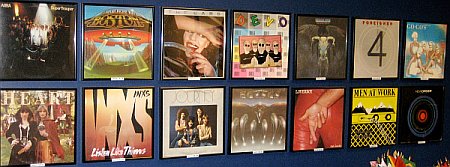
In the case of Blueprint, given the frequent release cycle that its hosted nature allows for, the team looked for a naming schema that would allow for a large set of possibilities.  The answer? An alphabetical list of “bands-from-the-70’s-and-80’s-that-are-at-least-somewhat-cheesy.” Behold…

The first 14 releases on the wall of Lombardi HQ.  With each new release a new album is purchased, framed and hung on the wall.  All with great ceremony.

One man’s (or woman’s) cheese…

Now “somewhat cheesy” is obviously subjective and if you look at the list below I’m sure you’ll find one or two that one could argue were legitimate bands.  I would also be willing to wager that which of these were considered “legitimate bands” would vary widely depending on who you are. Party on Wayne!

The List of Internal Release names and release dates:

Pau for now…


Blueprint: Built of Java thanks to Google Web Toolkit

October 14, 2008

The great thing about cloud-based applications is that it doesn’t matter what they’re written in or how they’re constructed, all that matters is that they do what you need them to.  What’s the back-end of your phone system written in?  Odds are you don’t know and don’t care.

That being said, there are group of folks, lets call them “developers” who are interested in what goes on behind the curtain.  For that group of people and others who find this kind of thing interesting and informative, read on.

What to build Blueprint out of?

When the team first started developing Lombardi Blueprint, they began with Java on the back-end and a combination of HTML and Flash on the front end.  When, due to plug-in issues, this didn’t work they moved to pure HTML and JavaScript using Dojo.  This too had its issues, namely performance and a lack of visibility.

Around this time Google Web Toolkit (GWT) 1.3 was released and the team decided to give it go.  This turned out to be the right choice.  GWT, which compiles Java code into JavaScript as you go,  enabled the team to write both the back and front ends in 100% Java.

GWT, which was originally released in May of ’06, is 100% open source licensed under the Apache License 2.0.

Here’s a good entry posted by Olivier Modica, the Blueprint engineering manager that simply lays out the advantages that GWT provides the Blueprint team: How GWT is enabling Blueprint’s agility.

Gory Detail and Extra-credit reading

If you really want to dive into what the team did with GWT and Blueprint, check out the video of the talk Alex Moffat, lead architect on Blueprint, and Damon Lundin gave at Google I/O back in May.

Also if you want to learn more about the performance of the recently released GWT 1.5, check this out:  Blueprint and the Performance of the GWT 1.5 Hash Map

Pau for now…


Watch Blueprint in Action

October 13, 2008

If a pictures is worth a 1,000 words, how many words is a 1 minute and 39 second-you tube video worth?

See for yourself.  Below is a clip that introduces the viewer to Lombardi Blueprint, the cloud-based process modeling solution (everything you see is taking place within a browser) that I’m working on.

Initial Project Goals

To give you some context for viewing, here’s how Blueprint’s lead architect Alex Moffat described the team’s initial challenge last year:

The challenge handed to us was to create a tool that the average business user could use to document and manage their business processes. It had to be easy to use, encourage collaboration between team members, and provide a shared repository for all of a company’s process documentation. Workflow functionality had to be on par with our competitors: Microsoft Visio, IDS Scheer’s ARIS, IBM’s WebSphere Business Modeler, and other desktop modeling tools. But we also wanted wiki & shared whiteboard capabilities to store information. Editing should use the drag and drop interaction users of desktop apps are familiar with. We ended up with some additional features that really set us apart:

  • An intuitive map view as a high level visualization of a process
  • Automatic workflow diagram generation
  • PowerPoint generation for easily presenting the process
  • Online chat functionality

If you’d like to actually test out Blueprint for yourself, you can get your hands on a free copy here.

Pau for now…


Ellison and Stallman Rain on Cloud Computing

September 30, 2008

Like all “new” things, if its hot and catches on everyone and his brother will jump on the band wagon and want to spread some of its magic pixie dust on their offerings — witness the overuse of the term “Web 2.0.”  Such is the current case with “Cloud Computing” a re-branding of an evolution of technology that includes utility computing and software as a service concepts.

(Note: One of the many great things about Cloud Computing is the amount bad puns that it allows for e.g. see title.)

Richard Stallman’s alter-ego “Saint IGNUcius.” (photo taken in Hawaii where we presented).

Everything tastes better with Cloud Computing on it

As Forrester analyst Frank Gillet explains on Beet.tv, this current overuse of the phrase is being referred to as “Cloud Washing” or the application of “Cloud Spray.”  It is this misapplication of the term that Oracle’s Larry Ellison railed against at the Oracle financial analyst meeting, “I can’t think of anything that isn’t cloud computing with all of these announcements.”  Still others are concerned that this willy-nilly application of the phrase will only serve to cloud the meaning of the term (remember what I said about bad puns).

Richard Stallman of the Free Software Foundation, whom I respect but don’t always agree with, tells the Gaurdian that he sees cloud mania as “worse than stupidity.  It’s a marketing hype campaign.”  Being no dummy however, Stallman has used this trend to do a little marketing of his own and grab valuable virtual ink in promotion of Free Software.

The Silver Lining

All this misappropriation aside, Cloud Computing is hot and represents a legitimate trend in computing that is occurring (and has been occurring for sometime now as an evolution rather than a revolution).

It is both this current buzz as well the legitimacy of this trend that led me to my current job, Marketing Director for Lombardi Blueprint process documentation solution.  Blueprint is a cloud-based offering that is available now (in fact you can even get a free trial).  But more on Blueprint in a future post.

Pau for now…


The Gartner BPM Summit: Cool High-Tops, TLAs and The Price is Right

September 25, 2008

A couple of weeks ago, my second day on the job, I was on a flight to our Nation’s capital to take in the Gartner BPM Summit.  It was a great way to dive into the wild and wacky world of Business Process Management.  It also enabled me to meet a lot of the members of the Lombardi team who aren’t based here in Austin.

To say it was different from the last tech event I attended (Debconf08) would be an understatement.  Out the 600 odd attendees, I don’t think I saw one t-shirted hacker. While I did see a cool pair of high-tops (see below), it was mostly a blazer-clad crowd (moi included).
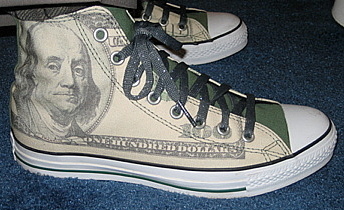
These shoes are so money!

According to Gartner, the assembly was pretty evenly split between Business (51%) and IT (49%), roughly 60% of which identified themselves as currently being involved in a BPM project of some sort.

Some of the things I learned

The three days of the Summit I hit a whole bunch of talks to try to get up to speed in this industry which is new to me.  I learned a ton, met and talked with a lot of great people (including a buddy from high school that I hadn’t seen in 15 years and who is now at IBM) and soaked up a whole bunch of new TLAs.

Here are a few of the notes that I took:

  • BPM is a journey that affects culture, skills and the way that work gets done
  • BPM objectives: Agility, speed to market, compliance, customer satisfaction, efficiency and cost savings.
  • Whoever best describes the problem is the one most likely to solve it (I want to remember this one)
  • SaaS: Two of its biggest benefits are: 1)  its pricing model allows it to fit within an operational budget (no need to get your manager’s manger’s manager to sign-off) and 2) the web-based nature allows for nearly instantaneous implementation.
  • During the Thursday morning SaaS session Michele, Cantera of Gartner and conference co-chair, positioned Lombardi Blueprint well by saying that it targets the business person and not the business analyst and thereby opens up BPM to a much wider audience (the “accesible pricing” doesn’t hurt either).  I also liked her phrase “Modeling in the Cloud” that she used to describe the space that Blueprint plays in.
  • In Michael Blechar’s talk on Business Process Analysis (aka BPA) tools he offered up a great quote appropriate to the space of process modeling.  Everyone knows the first part of Muhammad Ali’s famous quote, “Float like a butterfly, sting like a bee” but Michael provided the rest of the quote, “Your hands can’t hit what your eyes can’t see.”
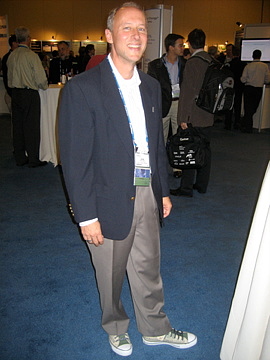
Gene Rawls models what to wear with C-note high-tops.

A vendor presentation that’s not a sales pitch!?

Lombardi was a Platinum sponsor of the event and we had a booth, a couple of talks and a great Hospitality Suite on Thursday night.  Ill have to admit that when I heard we were doing a vendor presentation, given my experience with other vendors at other conferences, I was expecting a Lombardi roadmap presentation and sales pitch.  I was therefor completely taken by surprise when Toby, our VP of Professional Services got up and didn’t talk about Lombardi at all but instead took the audience through the 10 things needed for a successful BPM project.

For the second half of the hour, Toby turned the platform over to Gene Rawls, VP of Continuous Improvement at Wells Fargo and Lombardi customer.  Gene, in his soft-spoken manner did a great job of telling the audience how he and his team went through their implementation and what to expect.

Come On Down!

One of the high lights of the conference were the hospitality suites on Thursday night.  Three other vendors hosted a suite and the themes they chose were football, James Bond/Casino Royale and rockstar/Guitar Hero.  We chose “The Price is Right.”  While it was a cool concept, the execution was very cool.  We held actual 10 contests and gave such amazing items as a Toaster Oven, an iPod Speaker Dock, a luggage set and a NEW CAR (ok it was a remote control toy Hummer).

Lombardi marketing VP Jim Rudden channels his inner Bob Barker.

Pau for now…

Google out, Zoho in — to the tune of 400,000 desktops at GE

September 23, 2008

Who doesn’t love a David and Goliath story?  Looks like General Electric has chosen India-based Zoho over Google to supply its cloud-based desktop suite on 400,000 desktops.  Zoho is a 600 person company that has never taken venture funding and currently generates $40 million a year.

According to Daya Baran’s blog “A GE spokesperson who did not want to be identified said their decision was based around issues of personal and corporate privacy, functionality, support, features and Zoho won hands down.”

Hmmm, GE might be a great candidate for Blueprint 🙂

Zoho landing page.  Look familiar?

Pau for now…


Wrapping up my second Week at Lombardi

September 19, 2008

My last day at Sun was two weeks ago and, trite as it may sound, it seems like another lifetime.

I started at Lombardi last week but spent the majority of that week attending the Gartner BPM Summit in DC (pictures to be found in an upcoming post).  During my 13 year career at Sun I had carefully engineered it so that I stayed on the periphery of enterprise software apps, now however I find myself smack-dab in the middle of the segment and being excited about the whole adventure.

This week was my first real week in the office at my new gig and I spent a bunch of time getting my desk set up, trying to pick a mail client that worked best with the new environment, learning where the bathroom was etc.  I was expecting a big culture shock going from a company of 35,000 employees to one of 200 but so far its been pretty smooth.  Maybe the big freak out comes in the second month.

One of the things I’ve noticed which I’ve enjoyed is how quick the feedback loop is in a small company and how much easier it is to attack opportunities in a holistic way with cross-functional partners (pls excuse the buzz-words).  This observation Im sure comes as a shock to few people, but after being at a large company for 13 years its something new to me.  The other thing I’ve noticed is how awesome it is to have a kitchen packed with drinks and food.  No on-site masseuse but you cant have everything.

I’m looking forward to week number three.

Pau for now…