As part of the Cloud ISV partner program we announced last month, we are working with “big data” player Aster Data. When I was out for our launch a few weeks back, I met up with Mayank Bawa, CEO and co-founder of Aster Data. We got together in my hotel lobby and talked about Aster Data, how it came to be, how they tackle Big Data analysis and how Dell and Aster are working together. Check it out:
Some of the topics Mayank tackles.
How Aster came to be: came out of the research Mayank and his co-founders were doing at Standford. They even got seed funding from their professor who had also Google and VMware get their starts when they were projects at Stanford.
Aster’s approach: build a data infrastructure that can not only store large amounts of data but also has enough compute power to analyze that data.
Tying Map Reduce closely to SQL to produce a language called SQL map reduce. This allows apps to be run right where the data is stored and managed. The Map Reduce framework allows to apps to be expressed in a variety of languages e.g. Java, Perl, Python, C++.
How Aster and Dell are working together: Bringing a MPP (massive parallel processing) data warehouse infrastructure to their customers. Building one blueprint so customers can create a self service data warehouse and another to set up infrastructure for big data analytics.
Last but not least in our tour of the first flight of servers in Dell’s PowerEdge C line is the C2100. This was filmed last month at our launch right after we closed down our whisper suite. Click below and join solutions architect Rafael Zamora as he leads you through the thrills, chills and spills of this cool new machine.
Spoiler Alert! A few Highlights
This machine is a great high performance data analytics and cloud optimized storage server. It’s perfect for use in conjunction with software from our Cloud ISV partners Joyent, Aster Data, Canonical or Greenplum.
The entire front can be jam-packed with disk drives for mega storage. You can get up to 24TB by loading twelve 3.5inch 2TB drives.
While the C2100 has same system board as the C1100, it comes with twice the real estate in a 2U form factor.
There’s even a platform for two additional drives that you can use for a bunch of different purposes such as separating production and non-production traffic.
Last month when I was out in the Bay Area for our launch, I was able to catch up with Rich Wolski, founder and CTO of Eucalyptus. Eucalyptus is one of the key ingredients in the Ubuntu Enterprise Cloud that is being certified to run on Dell’s PowerEdge C systems as part of our cloud ISV program. Here is what Rich had to say:
Some of the topics Rich tackles:
How Eucalyptus started at the University of California at Santa Barbara. They wanted to show how old-style large scale computing (NSF super computer centers) could be combined with new large-scale computing (in the form of Amazon) in the service of science. Wanted to also include 4-6 university data centers.
They put the code out as open source and got deluged by science and commercial industry about potential applications. Grew too big to continue as a research project so they brought it outside.
Working with Canonical and Ubuntu and how the relationship began. UEC and what part Eucalyptus makes up.
How NASA is offering a production Eucalyptus cloud to NASA researchers and other governmental agencies.
Where Rich sees Eucalyptus going in the next two years. The importance of the open source community and their continued focus on private clouds in the enterprise.
As part of the CIO series we are doing with Information Week, I did a webinar on Wednesday called The Journey to the Cloud. If you want to get a feel for some of the big issues and ideas addressed during the webinar, check out moderator Fred Paul’s entertaining blog entry. Here is the deck I used:
If you’re interested in listening to the webinar you can get access to it here (you will need to register). I spent about 20 minutes on the presentation and 30 minutes fielding questions from the audience. One question submitted that we didn’t have time to answer was why Fred Paul and I both have first names for last names. That will have to wait for another webinar.
Our first Cloud white paper is now available and I’m really happy with the way it turned out. Being relatively new to Dell I didn’t know if I would be “compelled” to mention product in it or not but I’m happy to say that the paper focuses solely on the trends behind, and characteristics, of cloud computing . I want to give a big shout out to Intel who helped to fund this and also didn’t insist that we mention their products. 🙂
This first paper is a short and basic introduction to cloud computing. We are working on a follow-up that will pick up where this leaves off and dives deeper. Stay tuned.
If you’re wondering about the funky game show-like setting, I shot this after hours on the day of our launch in the whisper suite. Your guide, as before, is the incomparable Dell Solutions Architect, Rafael Zamora.
A few highlights
The C1100 is a high memory, cluster optimized, compute node
Dont let its slim pizza box looks fool you, upfront you can pack either four 3.5 inch drives or ten 2.5 inch drives.
For high memory optimized compute you can get 18 DIMM sticks for 144GB of RAM.
Comes with your choice of either Intel’s Nehalem or Westmere processors.
Raf also gives a couple of examples of recent customers and how they’ve decide to configure their units.
As a follow on to last week’s PowerEdge C line overview, here is the first individual system overview: the C6100. Click below and let Dell Solutions Architect Rafael Zamora guide your thru the design and features of this densely packed machine targeted at HPC and cloud workloads.
Some of the highlights:
The PowerEdgeC 6100 holds the equivalent of 4 systems which have been packaged into “sleds,” each containing boards, RAM and microprocessors.
Upfront you can put a ton o’ disk drives, either 24 x 2.5″ drives or 12 x 3.5″ drives.
Great for markets like HPC clustering and search engines where compute density is key. (This is not intended for running general purpose apps like Exchange, SQL or Oracle).
It will serve as the compute node in the Ubuntu Enterprise Cloud solution from our partner Canonical.
I recorded this interview with David Lang earlier this year and have been meaning to post it for the longest time. David is Dell’s program manager for federal security which means he is charge of the team that supports the security requirements for all Dell’s businesses that faces the federal government. He’s based in DC but I was able to grab a bit of his time when he was out visiting Austin.
David’s interesting background: he spent many years as a special agent in the air force doing computer and espionage investigations and how this lead him to the cloud.
How David addresses questions around cloud security and what type of environments you find in federal space.
The balancing act between availability, security and cost and where Homeland Security would want to use the public cloud.
Last week I arrived a day before our launch to record videos with some of our cloud partners. My first stop was Greenplum to interview co-founder and president, Scott Yara (look for that video here in the near distant future).
Given that turnaround is fair play they asked me to appear in a short promo video that they were putting together for Chorus. Chorus will be officially announced on April 12 and is intended to marry the power of cloud computing and social collaboration with data warehousing and analytics.
I had no idea the illustrious company I would end up being edited-in alongside including my former uber-boss, Scott McNealy (who will be keynoting Greenplum’s Nov 12 event) and UC Berkeley Comp Sci Prof Joseph Hellerstein.
At last week’s Dell Launch, “Solutions for the Virtual Era,” we unveiled the first three systems in our new PowerEdge C line. These “hyper-scale inspired” systems are based on designs that we have built for our largest scaled-out customers such as Windows Azure, Facebook, Ask.com and Tencent.
The PowerEdge C line is targeted at both Public and Private cloud builders as well as HPC, Web 2.0, gaming and large scaled out web farms. In the video below, Dell solutions architect Rafael Zamora walks us through the PowerEdge C6100, C1100 and C2100.
Upcoming posts
In the days to come I will be posting individual walk-thrus of each of the three systems. I will also be posting interviews I did with executives from our cloud partners Joyent, Aster Data, Greenplum and Eucalyptus (who’s not a partner but provides a key component of our partner Canonical’s Ubuntu Enterprise Cloud).
Today is the big day. The one we’ve been working towards for a long time. As a part of Dell’s quarterly launch “Solutions for the Virtual Era,” we are announcing the introduction of:
Dell Cloud Solution for Web Applications, our first Revolutionary cloud solution. Partnering with enterprise-class cloud pioneer Joyent, we are offering a turnkey private PaaS solution comprised of pre-tested, pre-assembled and fully-supported hardware, software and services — all sold and supported by Dell. This integrated solution is targeted at enterprise app developers who are looking to develop “new world” applications in the cloud to be deployed in the cloud.
The Cloud Partner Program Working with cloud ISVs we will be offering easy-to-buy and deploy cloud solutions and blueprints optimized for and validated on Dell platforms. The first three partners we are announcing are Aster Data (providing web analytics), Canonical (offering an open source Infrastructure-as-a-Service private cloud) and Greenplum (self-service data warehousing). (On the Evolutionary cloud side we will continue to work with VMware and Microsoft and stay tuned for news on what’s happening on the Windows Azure front :).
A new line of hyperscale-inspired PowerEdge C servers including the PowerEdge C1100, C2100 and C6100 targeting HPC, data analytics, gaming and cloud builders. These are based on the designs we have created for the some of the worlds largest internet companies and cloud providers.
A suite of cloud professional services to help customers assess, deploy, design and manage dedicated solutions.
This is just a quick overview of what we are announcing today. Stay tuned for more details and info in the coming days and weeks.
Extra credit reading: Our Cloud solutions press release
Yesterday I wrote about how IT’s portfolio of compute models will shift over the next 3-5 years. I ended by saying that the line between virtualization and private cloud will blur and that there are two ways of getting to private cloud: Evolutionary and Revolutionary. Intrigued? Well then press on dear reader…
The Evolutionary Approach
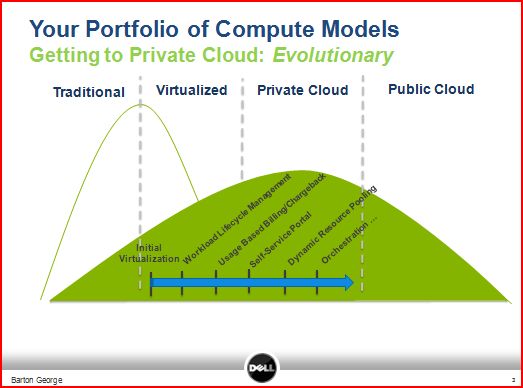
The evolutionary approach starts with virtualization and is appropriate where large investments in that area have been made and when you are talking about traditional enterprise applications. With virtualization serving as the foundation (see the graph below), additional capabilities are then layered on, such as usage-based-billing/chargeback, workload lifecycle management, dynamic resource pooling, a self-service portal for users etc.
One of the key aspects of the Evolutionary approach is that every step along the way, every capability added, brings greater efficiencies and agility. You do not need to wait until you meet the full definition of a private cloud to derive value and you can stop anywhere along the way.
You say you want a Revolution?
The other way to get to private cloud is the Revolutionary approach. This is appropriate for Greenfield opportunities within organizations, and is targeted at non-traditional, web 2.0 applications that are “cloud-native” (i.e. applications written in the cloud for deployment in the cloud). These revolutionary solutions will often be delivered as an integrated, turnkey unit (see graph below).
You don’t need to choose
Rather than adopting one or the other, most organizations will use both approaches to get to private cloud. While at this stage the evolutionary approach will be the predominate way of getting to private cloud, as more and more “new world” applications are developed in the cloud for the cloud, the balance will begin tip in favor of the revolutionary approach.
Tune in tomorrow for a specific example of a revolutionary cloud solution (and a whole lot more 🙂
Whether you believe in the Cloud or not, it’s coming. That being said it’s not a phenomenon that will fill skies of IT departments tomorrow, but rather it is starting out as another tool in IT’s bag of tricks. As time passes, cloud computing will increasingly become a greater part of the portfolio of compute models that IT departments manage, sitting alongside Traditional computing and Virtualization.
Cloud Computing Today
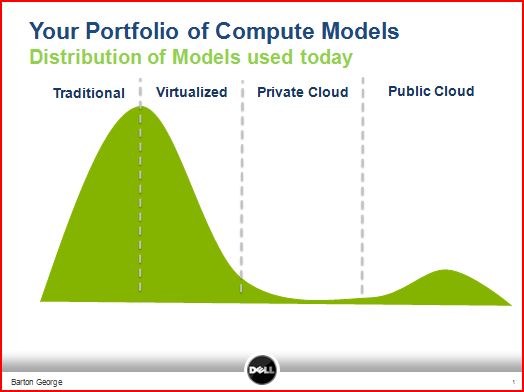
If you were to graph the distribution of compute models being used today by IT departments in large enterprises, it would look something like the chart below. Today, traditional computing and virtualization are where most of the distribution lies with a little bit of flirting with the Public Cloud in the case of SaaS applications for areas like HR, CRM, email etc. Private cloud is presently negligible.
Over the next three to five years
Over the next three to five years the above distribution will flatten out and shift to the right and will resemble the graph below. Private cloud will represent the largest compute model utilized but it will be equally flanked by virtualization and public cloud. You’ll notice there will still be a decent amount of resources that remain in the traditional compute bucket representing applications that are not worth the effort of rewriting or converting to a cloud platform.
Evolutionary Vs. Revolutionary
One of the things to note with this new distribution is that the lines between Virtualization and Private Cloud will start to blur (there will also be a blurring between Private and Public clouds as hybrid clouds become more of a reality in the future, but that’s another story for another time). There are two ways to go about setting up private clouds, evolutionary and revolutionary.
Tune in tomorrow and learn more about these two approaches and how they differ. 🙂
My favorite cosmonaut-coder Mark Shuttleworth stopped by our offices this morning for a visit. Mark is the founder of both the Linux distribution Ubuntu and its commercial sponsor Canonical. Mark and I sat down in the lobby and caught up. Here is a short interview we recorded.
The 10.4 Ubuntu release Lucid Lynx and what to expect: a strong cloud focus on the enterprise side and a lot of shiny new bling on the desktop as well as making the desktop “social” (e.g. Tweet straight from your desktop)
What Ubuntu is doing in the Netbook space
What excites Mark the most in technology today and why cloud is like HTTP in the early 90’s
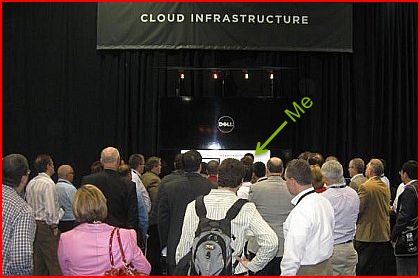
I was recently in Las Vegas for Dell’s annual kick off where the sales force learns all about the cool products we have on tap. Not only were there tons of presentation sessions, there was a full expo area with both Dell and partner booths.
In the Cloud Infrastructure Solutions booth I got to act as the official “ShamWow” guy, giving our pitch (over and over and over).
I must have done the spiel literally 50 times over the three days. But the crowds were great so I wasn’t complaining (much 🙂 ).
The Friday before last my boss Andy and I had a call with James Niccolai of IDG. We chatted about what we’ve been up to at Dell as well as teed up what we have in store for the near distant future.
To get the full scoop you should read the articles but here are some summary bits from the PCworld article:
The DCS [Data Center Solutions] unit was formed about three years ago to help Dell get more business from large Internet firms. Its engineers often spend several weeks on-site with those companies to design low-cost, low-power systems that meet the special requirements of their search, social networking and other Web applications.
That hands-on role means the DCS group designs servers only for large companies, such as Ask.com and Microsoft’s Azure division, which order tens of thousands of servers per year. But that’s about to change, Dell executives said in an interview.
Later this year Dell will turn some of those custom servers into standardized products and sell them to companies that order lower volumes of systems, including enterprises building “private cloud” environments in their data centers, and a second tier of smaller Internet companies.
“What we’ve found is, there are a whole bunch of other customers who want access to those designs but who are not buying in those types of quantities,” said Andy Rhodes, a director with Dell’s DCS group. “So the big thing we’re solving now, and we’ll talk more publically about over the next couple of months, is how to provide more of that capability to many, many more customers.”
Coincidentally, the acquisitions of the last two companies I worked at both closed this week. The first is Sun Microsystems where I worked from 1995 to 2008 and which was purchased by Oracle. The second is Lombardi which I left at the end of last summer and which was acquired by IBM.
Two very different acquisitions. One a Silicon Valley trailblazer whose acquisition took 9 torturous months to close, the other a star in the focused field of business process management which closed in less than six weeks. One company on the way up, one an icon on the way down.
Farewell Sun
While I wish the employees of both the best of luck, I particularly mourn the loss of Sun. It was an amazing company to have worked at. I joined the month that Java was introduced and rode it through its dot.com dominance and then down the other side. Even when its economic dominance waned, its willingness to take risk such as its refocusing on open source made it a fascinating place to be. The tech industry will be a less interesting place now that it is gone.
I take heart in the fact that the Sun diaspora now outweighs those still employed there. Sun alums can be found across the industry at companies big and small around the world (in fact there is a hearty band of us here at Dell). While there is no more Sun “the company” there are thousands of bits of it scattered throughout the high-tech landscape.
One of the trickiest parts for SMB’s (or organizations of any size) who are utilizing cloud-based applications is integrating these apps with exisiting on-premise applications. That’s where Cast Iron Systems, comes in.
Last month Chandar Pattabhiram, VP of Product & Channel marketing at Cast Iron visited Dell. I met up with him to chat about the company and learn what they are up to.
Some of the topics Chandar tackles:
Cast Iron is the leader in connecting cloud-based applications with on premise enterprise apps (eg Oracle, SAP).
The company began by offering a pre-configured integration appliance. They have since expand and now also offer a virtual integration appliance as well as the Cast Iron Cloud (integration as a service).
While their focus is on SaaS, they are partnering with leaders in each layer of the cloud to integrate cloud offerings with on premise apps:
SaaS: SalesForce, ADP
PaaS: Google, Force.com, Azure
IaaS: Dell
Cast Iron’s goal is to evolve to be the enterprise cloud integration platform, bridging the world of public, private and on premise applications.
Cast Iron provides the software underpinning Dell Integration Services. These services allow SalesForce.com customers to extract data that has been locked in on premise apps and provides centralized visibility within SalesForce.com.
There was a good article in Information Week last week with our GM, Forrest Norrod. Forrest talked to Charlie Babcock about the success that Dell’s Data Center Systems unit has had in the cloud space.
You should check out the whole article but here are a few bits I’ve pulled out for your reading pleasure:
Dell’s Data Center Solutions unit, has only 20 customers, but would be the third largest supplier of x86 servers in the U.S. if it were split out from Dell, said Forrest Norrod, the unit’s VP and general manager, in an interview. The only companies ahead it in shipping Intel or AMD servers would be HP and Dell itself.
This foray into cloud computing is somewhat contrary to Dell’s previous pattern of applying sophisticated supply chain logistics to well-worn grooves in the business and consumer computing markets. For one thing, Dell, until recently, hasn’t talked about it. For another, it’s built a business unit that refuses to address the mass market at all.
Norrod acknowledged what other Dell officials said as well: the lessons learned in producing servers for the big Internet service providers will be used when enterprise customers knock on Dell’s door to discuss how to build out their private clouds. “Dell will bring the capabilities from DCS to the mass market,” he said
“Interest [in private cloud computing] is spiking through the roof,” [Norrod] said, and he predicted most new enterprise applications will be designed to run in the cloud, whether public or private. Such applications are built with scalability in mind and can take advantage of the ability of the cloud to generate more virtual machines on demand.
Here is the second in my three part series on Virtualization and the cloud. Today’s entry focuses on the 800 pound gorilla in the virtualization space, VMware.
What VMware is seeing customers actually doing to take advantage of the cloud today both with regards to public and private clouds.
Some polling data he collected during his talk based on the ~300 folks who attended: 90-95% were virtualizing, 15% had an active private cloud project, 5-10% had a public cloud project. (This is pretty representative of what Dan’s generally seeing.)
The three phases of cloud:
Phase I: Standardizing and virtualizing an environment.
Phase II: Adopting private cloud from a management stand point: getting to self service and automation in terms of provisioning a new service/collapsing the time it takes to get a new image out to an end user or developer from weeks to minutes/ implementing charge back, dynamic capacity planning and management.
Phase III: Thinking about or planning how to leverage the public cloud in a fully compatible way.
A short history of VMware: how they’ve moved from desktop and server virtualization to VM management and optimization to enabling their platform for private clouds and public cloud providers.
Their “recent” acquisition of Spring Source and how it fits in.
Stay tuned next time for a summary of Gartner’s virtualization presentation from their data center conference.


 Posted by Barton George





 Barton's Blog