Talking APIs with ProgrammableWeb Founder: John Musser

September 16, 2013

Last week I was out in San Francisco for VentureBeat’s CloudBeat conference.  One of the panels I sat in on was “API’s the Key that Unlocks the Cloud.”  After it ended I grabbed some time with panelist  John Musser, founder of the web’s API directory ProgrammableWeb.  John shared his views on APIs past, present and future.

Take a listen.

Some of the ground John covers:

  • What is ProgrammableWeb and how did John get into the world of APIs
  • How would John describe the modern API and how is different from integration technology of the past?
  • What makes a good API and how do you make sure it flourishes? (Time to first “Hello world”)
  • Who are doing the best jobs with APIs (spoiler alert: Twilio and Stripe)
  • What does the future of APIs hold?
  • What’s John’s new gig, “API Science” about?

But wait, there’s more…

Stay tuned for the next week or so as I roll out the rest of the interviews I conducted at CloudBeat.  On deck are Linkedin’s use of Dell Boomi and Salesforce, Luke Kanies — Puppet CEO,  Joe Arnold – CEO of SwiftStack and Anand Iyengar – Founder of CloudVelocity.

Extra-credit reading

Pau for now…


Its all about AWS compatibility – talking to Eucalyptus CEO Marten Mickos

September 13, 2013

Earlier this week I was out in San Francisco for Venture Beat’s CloudBeat conference.  I was asked to moderate a couple of panels and got to talk with a lot of great people doing some pretty cool things.

One person I checked in with was Marten Mickos, CEO of Eucalyptus Systems, who, along with Randy Bias provided the most entertaining session at the conference.   If you’re not familiar with it, Eucalyptus provides software for building AWS-compatible private and hybrid clouds.  I grabbed Marten before he went on stage and caught up with what Eucalyptus has been up to and what’s next.

Some of the ground Marten covers:

  • Its all about AWS compatibility
  • They’ve found “Coke” now they’re looking for “Pepsi”, who’s number two?
  • The characteristics of the companies that adopt Eucalyptus
  • Support Netflix’s open source tools e.g. Chaos Monkey, and Asgard
  • What’s up ahead for Eucalyptus, on beyond Walrus with Ceph and Riak CS support

Extra-credit reading

  • The Amazon Web Services API debate shows no sign of cooling – VentureBeat
  • Technology Trumps Dogma, And Other Open Source Insights – An interview with Marten Mickos – ReadWrite
  • The Elastic Cloud: Leading Cloud Stacks Shape API Conversations – Data Center Knowledge

Pau for now…


Talking to the Docker Dudes

September 12, 2013

This morning a group of us here at Dell met with Ben Golub, Jerome Petazzoni and Nick Stinemates of dotCloud, the company behind the wildly popular open source project, Docker, “the Linux container engine.”  They came to sample the great barbecue and to chat about how Docker might potentially work with Project Sputnik, the Crowbar Project and a few other efforts.

Docker, which went live in March already has 150 contributors, 60,000+ downloads and 1000s of applications containerized and uploaded to their registry.   Given the fact that the company only has 18 employees, quite a bit of this work has been done by the passionate community that has formed in the first six months.

Overview and Tech talk

I did two interviews with the gents from Docker, a higher level overview with Ben their CEO and a more technical talk with SRE manager Jerome and Nick, their sales and deployment engineer.  Enjoy!

Some of the ground Ben covers:

  • What is Docker?
  • How it developed out of dotCloud’s PaaS efforts
  • How Ben got involved with the project and his background
  • What are dotCloud’s plans for Docker and who is integrating with it?

Some of the ground Jerome and Nick cover:

  • How long they’ve been involved and what they focus on
  • How Docker works with LXC and how it might work without LXC
  • Ubuntu is recommended but all you need is AUFS support
  • In next release they plan to offer official support beyond Ubuntu
  • Holy DevOps batman, Docker has something to offer Devs, QA Engineers, Continuos  integration and Sys Ops.

Extra-credit reading

Pau for now…


My O’Reilly Video — Telling the Project Sputnik story

August 29, 2013

While I interviewed a bunch of folks at OSCON, I also got the chance to be on the other end of the camera.  On Thursday of the event I sat down with Meghan Blanchette, editor at O’Reilly media and we talked about Project Sputnik, where it’s been and where it’s going.  Check it out:

Some of the ground I cover:

  • How Sputnik came to be and our biggest challenge
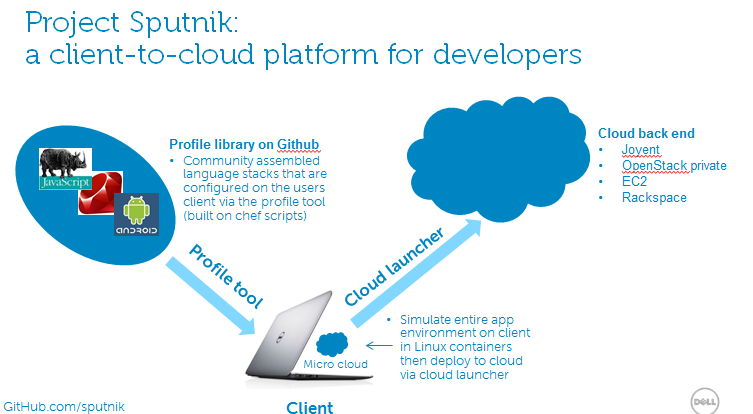
  • The three main components: XPS 13 developer edition, the Profile Tool, the cloud launcher
  • Our recently announced 3-free months on the Joyent Cloud
  • Getting some help from an internal development team

Update re Profile tool help

The internal team that I mentioned in the video is gearing up to get cracking on the profile tool.  The idea is first to gather requirements and user stories and then get jammin’ with design and development sprints.  It looks like after a bunch of false starts we are ready to push this in to high gear.  Look for an update next week.

Extra-credit reading

  • Will Developers Move to Sputnik?  The past, present, and future of Dell’s project – O’Reilly programming
  • Connecting the client to the cloud, The Sputnik Story – Slideshare

Pau for now…


OSCON: Talking OpenShift, RedHat’s Platform as a Service

August 22, 2013

Last but not least in my series of video from last month’s OSCON is an interview I did with Steve Citron-Pousty, Developer Evangelist for Red Hat’s OpenShift PaaS.

Take a listen to what the ever-entertaining Steve CP has to say:

Note: As with my interview with Neil of Inktank, I used Youtube’s feature that is supposed to fix an unsteady camera and the result gives the video a hallucinogenic feel (witness the slightly undulating stairs).

Some of the ground Steve covers:

  • What is OpenShift and Platform as a Service?  How is OpenShift different from other PaaSs?
  • OpenShift is “polyglottal:” it supports PHP, Perl, Python, Ruby, Node js and Java (with Java you get JBoss and Tomcat).  It also supports MySQL, Postgres and MongoDB right out of the box.
  • How they work with APIs and how APIs allow devs to create “situational apps.”
  • Steve’s Crystal Ball time:  in 3-5 years all developers will be using a PaaS (witness their wins with Ebay/PayPal, Accenture and DoD) + Git + a NoSQL data store.

Reference —  The rest of my OSCON interviews:

 Extra-credit reading

  • Blog:  Krishnan Subramanian: Making the Move to OpenShift
  • ZDnet: Red Hat opens OpenShift PaaS cloud for business

Pau for now…


OSCON: Talking to Andrew Parker of Puppet labs

August 19, 2013

Im now at the penultimate interview in my video series from OSCON 13.  Today’s installment features Puppet LabsAndrew Parker, team lead for the core platform team.  Check out what Andrew has to say:

Some of the ground Andrew covers

  • What is Puppet and how does it work?
  • DevOps:  How does Puppet help bridge the divide between Dev and Ops?
  • Puppet’s key crowd is hands-on operation types but business and devs play big roles as well.
  • As we get further into a cloudy world, what implications does that have for the Puppet platform?

For more Puppet goodness, check out PuppetConf this week in San Francisco.  If you cant make it there is also a live stream set up.

Extra-Credit reading


OSCON: AppDynamics and application performance management

August 15, 2013

Today’s OSCON interview takes us into the land of application performance modeling and features Dustin Whittle, Technical Evangelist at AppDynamics.   AppDynamics provides performance management for Java, .Net and PHP applications.  Check out what Dustin has to say about the wild and wacky world of APM:

Some of the ground Dustin covers

  • What does AppDynamics do?  Spoiler alert: It helps you figure out what “healthy” looks like for your application and gives you line of code visibility into your production app from the client to multiple tiers of your server and then down into the database.
  • Who looks at/uses the data AppDynamics generates?
  • How does the cloud change application development?  And what about those “noisey neighbors”?
  • APIs, SDKs and the recently launched AppDynamics X.

Tune in next time to see the next in my OSCON interview series.  Still left are RedHat’s OpenShift and Puppet.

Extra-credit reading


OSCON: Neil Levine of Inktank, sponsor of Ceph

August 12, 2013

The next in my series of interviews from last month’s OSCON features the ever affable Neil Levine of Inktank.   Neil, who has been with the company nearly a year, heads up product management and we talked about Ceph, the company and where its going.

Warning:  I used Youtube’s feature that is supposed to fix shaking and the result gives the video a hallucinogenic feel (Timothy Leary would approve).

Some of the ground that Neil covers:

  • Inktank as the primary sponsor of Ceph, a scale-out open source software defined storage solution
  • Other similar solutions
  • Selling to cloud devops teams rather than traditional storage teams
  • What’s next?  tiering, deeper integration with OpenStack, pushing out more APIs to build up their dev community etc.

Extra-credit reading/viewing:

  • Press Release:  University of Hawaii at Manoa Deploys Ceph Storage With OpenStack
  • OSCON 2013 – My video playlist: Enstratius, Dasein, Citrix, Mark Hinkle’s keynote, Apigee, Inktank, OpenShift, AppDynamics and Puppet

Pau for now….


OSCON: Mark Hinkle on his keynote + Citrix and Open Source

August 9, 2013

Last month at OSCON, after his keynote “Creating communities of Inclusion,” I caught up with Mark Hinkle, Senior Director of Open Source Solutions at Citrix.  We chatted about about the talk he delivered and what he and Citrix are up to in the world of Open Source.

Some of the ground Mark covers:

  • Getting in ruts in the open source community and how we can refactor
  • Open source is not a zero sum game
  • Open source developers are not always the best at asking for help
  • Mass collaboration like that seen in open source can benefit other industries as well

Some of the ground Mark covers:

Extra-credit reading/viewing:

Pau for now…


OSCON: Apigee and APIs

August 5, 2013

The week before last when I was out at OSCON I caught up with Sam Ramji VP of Strategy at Apigee.  I got Sam to tell me about his company and the future of APIs.   Here’s what he had to say:

Some of the ground Sam covers:

  • What does Apigee do.
  • How well is the importance of APIs understood in enterprises today
  • Using business people as their entry point into the enterprise but also catering to the developer.
  • Whats the big thing in the world of APIs in the next year

Extra-credit reading

Pau for now…


OSCON: Dell Multi-cloud manager & Dasein Cloud

August 1, 2013

Last week at OSCON.I grabbed some time with my new Dell co-worker, James Urquhart.  James became a Dell employee not too long ago when Dell acquired Enstratius.   I wanted to hear straight from the horses mouth about the Dell Multi-Cloud manager and the Open Source project, Dasein Cloud.  Here’s what James had to say:

Some of the ground James covers — Dell Multi-cloud Manager

  • James initial impressions of Dell
  • Where does the Multi-cloud manager fit within the Dell cloud portfolio
  • This is used by both developers and ops so how do they position it to each of those audiences.

Some of the ground James covers — Dasein:

  • What is Dasein Cloud and does it work (hint: its more than API mapping)
  • Hows the community and which companies are supporting it
  • What are the project’s goals for the next year

Extra-credit reading

Pau for now….


OSCON: The Project Sputnik story & giveaway

July 29, 2013

Last week, Dell was out in force in Portland, Oregon, representing at OSCON.   We had a booth and gave a few talks.

The talk that Cote and I delivered covered the story behind the Project Sputnik: Connecting the client to the cloud  – The Sputnik Story :

Give it away, give it away, give it away now

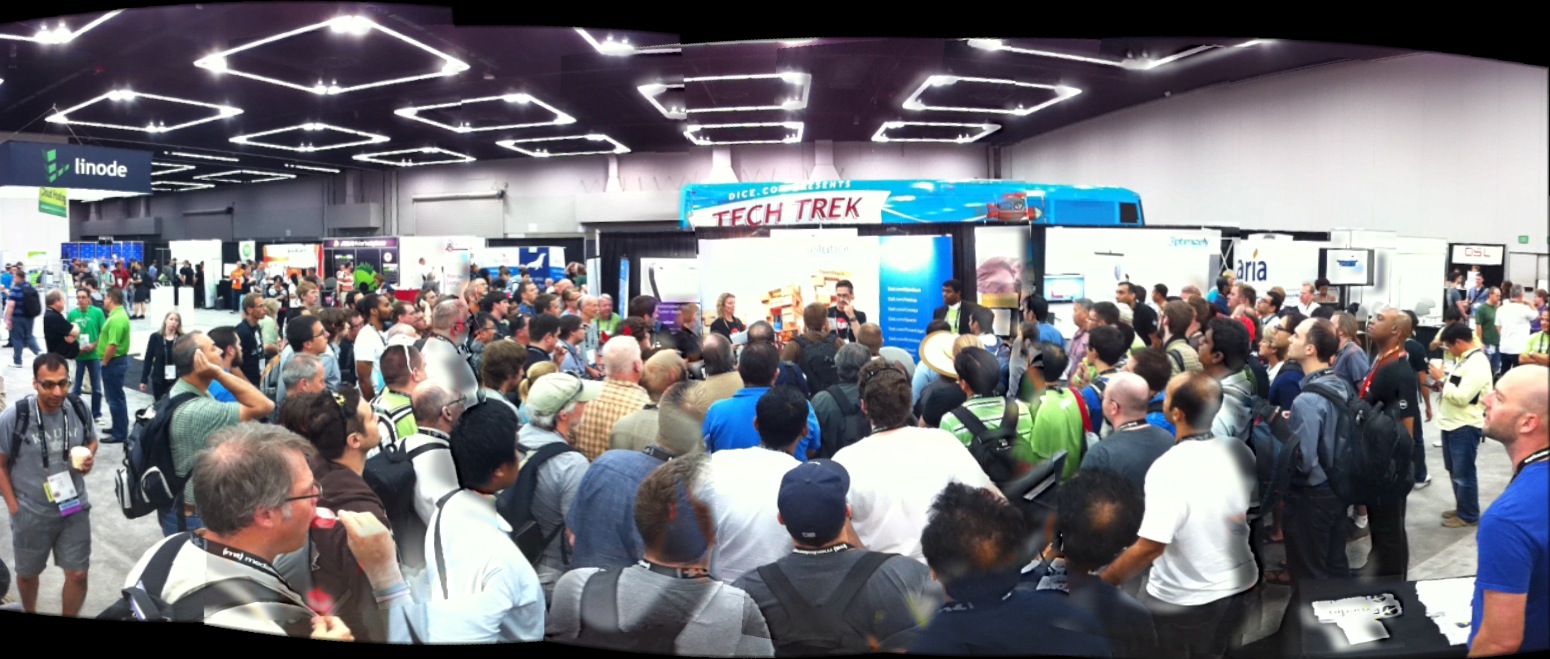
In addition to talking about Project Sputnik, we gave away three of the XPS 13 developer edition systems.  Here is the crowd waiting for us to draw the winner at the Dell booth:

The Sputnik drawing at the Dell booth.

The Sputnik drawing at the Dell booth.

And here is the lucky winner, Katrina Prosise, a comp sci student in Portland.

Barton George (Dell), the lucky winner, Joseph George (Dell)

L->R: Barton George (Dell), Katrina Prosise (the lucky winner), Joseph George (Dell)

Stay tuned to this blog over the next week or so as I will be sharing a bunch of the video interviews I conducted while at OSCON.

Extra-credit reading

Pau for now..


Project Sputnik now comes with 3 month free trial on Joyent cloud

July 23, 2013

Joyent logoAs of today we are making available three months of free use of the Joyent Cloud to owners of the XPS 13 developer edition.

The idea behind Project Sputnik, has always been to provide a client-to-cloud platform for developers and today we are offering access to the Joyent Cloud to complete the solution.

What you get and how you get it

With the trial you get either two g3-standard-0.625-kvm instances running Ubuntu for 3 months or one g3-standard-1.75-kvm instance running Ubuntu for 3 months.

We will be setting up a landing page in the next day or two provide elegant access to the Joyent Cloud but for those who want to get started right away you can simply follow the “How do I get Started” instructions below.  We are kicking this off to begin with with 500 free accounts, first come first served.

3 components wJoyentProfile Tool and Cloud Launcher

Also available now are the Project Sputnik Cloud Launcher and profile tool.   The profile tool is designed to provide access to a library of community-created profiles, and to configure and quickly set up development environments and tool chains.  Today we have three sample profiles available: Emacs, Ruby and JavaScript.  Documentation on how to create a profile will be coming soon so stay tuned.

The cloud launcher creates a seamless link from the client to the cloud, to facilitate ongoing development of application environments.  There is a Juju version of the launcher that currently comes with Sputnik and today we are announcing a version that Opscode has developed which uses spiceweasel as its underlying library.  You can check out a demo of it here.  We are also working to connect the chef version of the cloud launcher to the Joyent trial, more to come on that soon.

But wait, there’s more

In related Dell Open Source news we’ve got a whole lot of momentum going on.  You can check out all the news in today’s press release but here are the highlights:

Dell OpenStack-Powered Cloud Solution

Now available with: OpenStack Grizzly support, support for Dell Multi-Cloud Manager (formerly Enstratius), and extended reference architecture support, including the Dell PowerEdge C8000

Dell Cloud Transformation Services

The new consulting services provide assistance with assessing, building, operating and running cloud environments, and enable and accelerate enterprise OpenStack adoption.

Dell Cloudera Hadoop Solution

Now supports the newest version of Cloudera Enterprise. Updates allow customers to perform real-time SQL interactive queries and Hadoop-based batch processing, simplifying the process of querying data in Hadoop environments.

Intel Distribution for Apache Hadoop

Dell has tested and certified the Intel Distribution for Apache Hadoop on Dell PowerEdge servers. Additionally Dell Solution Centers validated the reference architecture and developed a technical whitepaper that simplifies the deployment of Intel Distribution on the Dell platform

 Crowbar

Dell has released RAID and BIOS configuration capabilities to the Crowbar open source community.  SUSE has integrated Crowbar functionality as part of SUSE Cloud to make OpenStack-based private cloud deployments seamless.

Dasein open source project

Dell confirmed its commitment to further develop and support the Dasein open source project, as pioneered by recently acquired Enstratius.

Phew, a whole lot of shaking going on! 🙂

===========================================

How do I get Started with Joyent Cloud trial

Step 1:

Open a terminal window press Ctrl + Alt +T

1.1. $ wget https://us-east.manta.joyent.com/jens/public/sputnik.tar

1.2. $ sudo tar -C / -xvf sputnik.tar

Step 2:

Find and run the “Install Joyent Public Could” in the launcher.

Look for the big Joyent LOGO.

Step 3:

Signup for a free trial account on the Joyent Public Cloud.

Open Firefox, goto http://www.joyent.com

Step 4:

Back in the terminal window, type the following command:

$ /usr/share/applications/joyentInstaller.sh

Step 5:

5.1. $ wget -O key-generator.sh https://us-east.manta.joyent.com/jens/public/key-generator.sh

5.2. $ chmod 755 key-generator.sh

5.3. $ ./key-generator.sh (enter you username and password for the jpc)

To source your new environment variables run the following commands

5.4. source ~/.bash_profile

Step 6:

6.1   To Confirm that the Joyent cloud SDK is installed:   $ sdc-listdatacenters

6.2   To confirm that the Joyent Manta SDK is installed:   $ mls /manta/public/sdks

How do I provision a new instance?

Sign in to the Joyent portal and click the  in the upper right portion of the screen. Once you’re there, the tool will walk you through the choice of datacenters, images, and instance types and sizes. You’ll have a chance to review the hourly and monthly cost of the instance, and provide a memorable name for the instance. Once you’ve decided on the type of instance that fits your project, click the  button and the system will ask to confirm your request. The provisioning will start immediately, but may take a few seconds to complete. Clicking on the new named instance will show its assigned public IP address when provisioning is complete. You may SSH into the instance with ssh -l root <ip address>.

How do I stop, resize or reboot instances?

Shutting down, resizing or rebooting your instance can all be executed through the customer portal of Joyent. In addition, we’ve provided a script you can use to perform these steps within your instance.

How do I install software on my instance?

To install or update software on your instance, you’ll need to run commands as either the administrative or root user of your instance. For tips on how to run commands and installation processes, check out the pages on how to install software on your instance.

How do I secure my instance?

Joyent take cloud security very seriously and we have refined many processes to reduce risk and preserve the integrity of data managed in your instance. For a full list of security checks and processes, please visit the security center in our documentation.

How do you manage your instance resource usage?

One of strengths of Joyent is the ability to have full and detailed transparency of every aspect of your infrastructure and application. You can use Cloud Analytics to provide you real-time, diagnostic heatmaps of system behavior. In addition, using these tips here can provide you better control over optimizing the performance of your instance.

How do you manage a database on your instance?

Instances on Joyent can be pre-configured to run a wide range of databases and database services. Joyent supports: MySQL, Percona, Riak, MongoDB, as well as integration to database services from companies like, Cloudant or MongoLab. For big data projects, Joyent is an ideal platform for configuring and running a Hadoop cluster. Check out these guides on how to set up a database or configure your Hadoop cluster.

How do you analyze performance of my instances?

Joyent is the best cloud in the industry for monitoring the entire health of your stack. Using Cloud Analytics, you have the ability to examine, in real-time, the performance characteristics of every level of your application, and network. If you just want to perform server level monitoring, we’ve built integration with leading monitoring tools from New Relic and Nodefly as well.

Where can I learn more?

Our documentation center and engineering blogs are terrific resources for you to learn more about Joyent and participate in the Joyent community. The Dev Center resources we’ve built for you will hopefully get you started on a path to success with Joyent. For additional help or training, please visit:

Pau for now…


Dell and Sputnik go to OSCON

July 18, 2013

Next week, myself, Michael Cote and a whole other bunch of Dell folk will be heading out to Portland for the 15th annual OSCON-ana-polooza.  We will have two talks that you might want to check out:

Cote and I will be giving the first and the second will be lead by Joseph George and James Urquhart.

Sputnik Shirt

And speaking of Project Sputnik, we will be giving away three of our XPS 13 developer editions:  one as a door prize at the OpenStack birthday party, one as a drawing at our booth and one to be given away at James and Joseph’s talk listed above.

We will also have a limited amount of the shirt to the right so stop by the booth.

But wait, there’s more….

To learn firsthand about Dell’s open source solutions be sure to swing by booth #719 where we will have experts on hand to talk to you about our wide array of solutions:

  • OpenStack cloud solutions
  • Hadoop big data solutions
  • Crowbar
  • Project Sputnik (the client to cloud developer platform)
  • Dell Multi-Cloud Manager (the platform formerly known as “Enstratius”)
  • Hyperscale computing systems

Hope to see you there.

Pau for now…


Developers + IT ops = cloud innovation

June 27, 2013

A couple weeks ago Dell put on a half-day Cloud summit on BrightTALK.  The event, led out of our services group, was made up of six hour-long presentations that ranged from Cloud security to compliance to HPC.

John Willis, who recently joined Dell via the Enstratius acquisition, and I presented the deck below.  We began with the rise of the developer and their key role in cloud.  From there we talk about how IT can best work with developers to drive innovation, while at the same time maintaining stability (spoiler alert: the answer is DevOps).

If you want to listen to recordings of any of the six presentations that made up the cloud summit, check out the links below:

Extra-Credit reading

Pau for now…


Project Sputnik: Rave reviews, 13.04 and OSCON

June 25, 2013

Wow, I cant believe its been over a month since I last blogged.  Things have been busy but I also got to take some time off with the fam, which was well needed :).  Here are a few quick updates:

Reviews

TechCrunch: Laptop Week Review: The Dell XPS 13 Developers Edition With Ubuntu

Dude, you got a Linux-powered Dell! In all the years I’ve reviewed laptops I’ve never been as pleasantly surprised by an Ultrabook as I was with the Dell XPS 13 Developers Edition. This ultrathin, ultralight SSD laptop originally came in Windows flavor but, much to my surprise, I far prefer the Ubuntu edition of this device. It is solidly built, acceptably priced given the solid state drive, and surprisingly powerful.

GoSaBe blog: Dell XPS 13 FHD Developer Edition

Well, I did something I never thought I would: I bought a brand-new, high-end Dell laptop. For full price. Me.  Hell will be freezing over shortly…So, so far, two thumbs up. Way to go Dell. (There, I said it.)

ISO features now in 13.04

Kamal Mostafa, Canonical kernel meister for project Sputnik, recently pointed out on the forums:

…the Sputnik ISO is now over a year old and all of the kernel features it supplies have since been integrated into standard the Ubuntu kernel, making Ubuntu 13.04 a good choice if you’re planning to install Ubuntu yourself on an XPS 13.

OSCON

If you are interested in Sputnik and are heading to OSCON next month, you may want to check out the session Cote and I are doing:

Connecting the client to the cloud  – The Sputnik Story

07/24/2013 11:30am – 12:10pm PDT (40 minutes); Room: F150 (capacity: 95)

Pau for now…


Shuttleworth raves about Dell XPS13 developer edition

May 24, 2013

At the OpenStack summit last month we caught up with Ubuntu and Canonical founder Mark Shuttleworth.

Below is a quick snippet taken from our chat with Mark where he talks about the Dell XPS 13 developer edition aka Project Sputnik.  Mark dubs the system “freakin’ awesome” and the “environment of choice for anyone doing web or cloud development.”  🙂

Extra-credit reading

  • Laptop Week Review: The Dell XPS 13 Developers Edition With Ubuntu – TechCrunch
  •  It just works: Dell XPS 13 Developer Edition Linux Ultrabook review – Ars Technica

Dell to go Partner route for public cloud

May 20, 2013

As you may be aware Dell has been offering and hosting a public, multi-tentant IaaS cloud offering.  After getting that business off the ground and many customer conversations,  we’ve come to realize that the greatest way we can provide value for our customers is to focus our investments on more strategic components of the cloud and provide our customers with maximum choice and flexibility.

As a result, rather than building out and supporting our own multi-tenant public cloud, we will partner with companies in order to provide customers access to the cloud(s) of their choice.

Enter Enstratius

A sampling of some of the public clouds Enstratius provides access to.

A sampling of some of the public clouds Enstratius provides access to.

With our recent acquisition of Enstratius not only are we are able to provide our customers with the ability to manage and govern a multi-cloud environment but we are now able to offer access to over 20 prominent clouds from Amazon to Rackspace, to Google, to AT&T.

A new Partner Program

Beyond the partners that Enstratius provides access to, today we are also kicking off today a partner program to provide access to IaaS through an ecosystem of options.  The first three partners we are announcing are:  Joyent, Scale Matrix, Zero Lag:

  • Joyent: An IaaS provider for real-time web and mobile applications. Joyent has out-of-the-box compatibility with Enstratius’ multi-cloud management.
  • ScaleMatrix: Cloud hosting platform, Services are offered from proprietary world-class data centers, and leverage enterprise hardware, storage and cutting-edge security and Distributed Denial of Service (DDoS) mitigation services.
  • ZeroLag: Combines VMware-powered on-demand cloud infrastructure with professional services and custom-designed solutions.

Customers will be able to purchase products from these partners through their Dell sales representatives and you can find out more information at dell.com/cloud-partner-program.

Private Cloud and Project Sputnik

On the Private Cloud front nothing has changed.   We are still huge supporters of OpenStack OpenStack_200.jpg-2f65a9098a7b1dd1and will continue offering our Open Stack-based private clouds.  Additionally  we will continue to provide cloud-to-on-premise connectivity via Boomi.

On the Project Sputnik front the cloud launcher that we continue to work on is being designed to provide access to a host of clouds.

Extra-credit reading

  • Dell to Deliver Public Cloud through Partner Ecosystem – Press Release

Pau for now..


Update: Project Sputnik Profile Tool and Cloud Launcher

May 6, 2013

During last week’s DevOps Days here in Austin, Matt Ray of Opscode and Charles Lowell of the Frontside did a demo showing the status of the Project Sputnik profile tool and the cloud launcher.  The profile tool is still at a very early stage, and while the Cloud Launcher exists today in the form of LXC + JuJu, we are working on a version that works using Chef.

After Matt and Charles’ talk I grabbed sometime with them as well as Chris McClimans of Opscode to talk about where we’re at, where we’re going and what’s a spice weasel.

Profile Tool & Cloud Launcher Tool Slide

Extra-credit reading

Pau for now…


Dell Acquires Enstratius — So what do they do?

May 6, 2013

Last week at DevOps Days Austin, I did a couple of interviews with John Willis (aka @botchagalupe), VP Client Services and Enablement at Enstratius.  The first video dealt with devops and the idea of culture as a secret weapon in the war of hiring.  The second one was about Enstratius the company, which coincidentally today Dell announced it was acquiring.

I’m very excited about the move because, besides the great technology, with Enstratius we are getting some top talent like John, James Urquhart, George Reese, Bernard Golden, David Bagley and many more.

Take a listen as John explains what exactly it is that Enstratius does:

Some of the topics John covers:

  • Enstratius’ common open API structure
  • Governance: e.g. Role based access, a federated view of resources, encrypted key management storage yadda, yadda
  • Direct integration with Chef and Puppet
  • Integration points with APM companies like AppDynamics and New Relic

Extra-credit reading

Pau for now…