Earlier today at Cloud Computing Expo here in New York, Boomi CTO Rick Nucci conducted a session entitled “Cloud Integration: Best practices for IT Executives.” Rick did a great job sketching out the issues to consider and what to take into account with regards to integration. The most compelling part of the talk, however came from Pradip Sitaram, CIO of Enterprise Business Partners and Boomi customer. Enterprise is a not-for-profit that builds affordable housing across the U.S.
After Pradip got off stage I sat down with him and got him to give a condensed version of his talk:
Some of the ground Pradip covers:
Enterprise homes house over 1 million people and every 55 minutes somebody moves into an enterprise home.
Dealing with the financial and occupancy reports that come from over 1600 properties, on a daily, monthly and yearly basis. How Boomi provided a solution to dealing with and managing these reports that was a fraction of the quote from the other vendor, and could be implemented in weeks instead of months.
Their longer term issue of dealing with over 70 databases that are out dated and need to be modernized. The answer is to go to the cloud and Boomi will act as their strategic integration platform making sure that all the pieces old and new work together.
Today, day one of the Cloud Computing Expo kicked off here at the Javits center in New York city. The event began with a keynote delivered by Steve Schuckenbrock, president of Dell Services. Dell is the Diamond sponsor at the event and Steve talked about finding the real business value in cloud computing and the business of “Yes, now“.
Another of today’s speaker was the founder and CTO of Boomi, Rick Nucci. Boomi provides a SaaS-based cloud integration offering and was acquired by Dell about six months ago. After Rick finished his session I grabbed some time with him to learn more Boomi.
Some of the ground Rick covers:
What Boomi is and how it got started in the integration space back in 2000.
[01:05] How Boomi’s integration offering evolved from a traditional middleware approach to cloud-based.
[02:51] How being acquired by Dell has changed how Boomi run’s its business and serves its customers.
Today at Citrix Synergy, Citrix announced “Project Olympus,” their up coming OpenStack distribution. In case you’re not familiar with it, OpenStack is an open source cloud platform based on the code from NASA’s Nebula cloud as well as Rackspace’s storage code. The OpenStack project kicked of last summer and already has gathered support from over 60 commercial hardware and software vendors.
Mt. Olympus and the Cloud
Citrix’s OpenStack Distro
Citrix’s Project Olympus will produce a commercial distribution of the OpenStack infrastructure-as-a-service platform. This “Olympian” distribution will be made up of two main components: a Citrix-certified version of OpenStack and a cloud-optimized version of XenServer. While Citrix will lead with their Xen technology, thanks to OpenStack the distro will support all leading hypervisors.
Project Olympus is targeted at both public cloud providers as well as enterprise customers looking to build out private clouds. The distribution will be available later this year.
But I want it now — The Citrix/Rackspace/Dell Early Access Program
For those who don’t want to wait until the official distribution is ready, don’t fret you can get started today through the Early Access Program (EAP). The EAP is designed to help customers kick-off pilots and proof-of-concept deployments. The program provides access to a beta version of the Citrix distro plus Dell hardware and deployment software as well as deployment services, training and on going customer support for customer clouds via Rackspace’s Cloud Builders program.
Dell’s above-mentioned deployment software, aka “crowbar,” was a big hit at the last OpenStack Design summit. The software which leverages Opscode’s Chef, allows folks to get an Openstack cloud up in running in less than four hours (instead of days). In addition to the deployment software and systems, to support the project Olympus EAP, Dell will also be providing reference architectures so keep your eyes peeled for those.
If you have any questions about what Dell is doing with OpenStack or want to get started, email us at OpenStack@Dell.com.
As a run up to next months Structure conference, GigaOm has put together a list of the top 50 companies “that are influencing how the cloud and infrastructure evolves.” Those who made the list, entitled The Structure 50, are described as follows
These are the ones to watch — at least in 2011. You’ve heard of some – such as Amazon or Dell. Others – such as Nicira or Boundary – are probably not yet on your radar. But they should be. All of these companies, big or small, have people, technology or strategies that will help shape the way the cloud market is developing and where it will eventually end up.
Dell’s Bio
For each of the 50, GigaOm has put together a short “bio.” Here is the entry for Dell:
Founded
1984
Investors
Public Company
Structure50 Topic
Data Center
Description
Dell is among the world’s biggest server, storage and PC vendors, although the company has turned much of its focus to cloud computing software.
GigaOM’s Take
Dell has made heavy investments in cloud computing, ranging from dense, low-power servers for cloud data centers to software acquisitions and OEM deals that provide cutting-edge management capabilities. Going forward, Dell has plans to provide both Windows Azure- and OpenStack-based cloud services.
Looking forward to Structure 11
Members of the Dell cloud team, including myself, will be out in force at Structure 11. We will have a booth and Forrest Norrod, the GM of Dell’s Next Generation Computing Solutions division will be speaking on a panel. Forrest’s panel, entitled “The Economics of Open Everything,” will focus on OpenStack and Cloud Foundry as two specific initiatives built around open source.
If you find yourself at Structure swing by the booth or seek one of us out. Its a pretty intimate conference and we shouldn’t be too hard to find.
There is only one magazine over the last couple of decades that I have read religiously, The New Yorker. Every week a new edition appears, often much later than it hits the stands, in my mailbox and I get vaguely giddy cracking open the slim edition to see what treasures lie inside. As a lapsed English major I have long given up reading novels due to time constraints but thanks to the weekly fiction in the New Yorker I am able to stay relatively current with whats happening in the world of literature particularly since the short stories that appear in the magazine are often developed into novels.
This venerable publication is now available electronically and has gotten me thinking.
A fantastic blog by Jason Biggs, appeared today in CrunchGear — It Is Finished: The New Yorker iPad App Is The Beginning Of The End Of Print. The entry details one paperphile’s descent into the world of printed bits and bytes, a journey that reaches a moment of intense reflection and rumination with the availability of the New Yorker on the iPad:
There is something in our core that loves a book. We love the paper, the smell, the visual cues and dog-eared bookmarking techniques. But I wonder if this is a learned response, handed down to us in a long line that began with Gutenberg and ended with Mom, Pop, and our favorite English teacher. I wonder if my kids will care about books as much as I did – the physical objects, not the stuff inside – and whether their kids will even know books exist. There are generational overlaps that happen all the time. My father’s old records, once wildly important to him in the 1960s and 70s ended up in my hands in the 90s and taught me to love Bob Dylan, the Beatles, and the Stones. But will I ever fire them up again? No. Those records were the last gasp of a discovery engine that stopped when the last mass-market LP was sold in the last Tower Records store. That engine can’t start again, but I suspect my own son will find my old CDs, become curious, and then go off on a journey of his own. I wonder how his son, years from now, will find my son’s discarded bits and reconstitute them into music but that’s a sad and metaphysical thing – the passing of bits from parent to child – that I don’t even want to ponder it.
To paraphrase Mark Twain (and Im pretty sure he did say this one), until now the reports of the death of print have been greatly exaggerated. Now I’m no longer sure.
As a part of Intel’s Cloud Builder program, of which Dell is a member, Intel is hosting a podcast series appropriately entitled, Intel Conversations in the Cloud. The first vendor they featured in the series was Dell and, back in March, I had the honor of representing us.
Yesterday was day two of Dell’s two-day industry analyst summit which was held at the W hotel in Austin Texas. The event brought together over 100 analysts from around the world to hear to about the company’s strategy and vision from Dell’s top execs.
The second day kicked off with a presentation by the President of Dell Services, Steve Schuckenbrock which was then followed by a panel moderated by Michael Dell himself. The panel that Michael moderated was made up of the heads of four software companies Dell has recently acquired: Boomi, SecureWorks, KACE and Compellent. The general sessions then concluded with a tag-team presentation by Dell’s CMO Karen Quintos and Andy Lark, VP of global marketing for Public and Large Enterprise. Karen and Andy’s presentation covered Dell’s brand efforts and marketing initiatives in 2011.
Beyond the general sessions
After the general sessions, the rest of the afternoon featured a series of smaller breakout sessions as well as packed agenda of 1:1’s with analysts and Dell execs. Between his one one-on-one’s I was able to grab some time with analyst Ray Boggs, VP of IDC‘s SMB and Home office research and get his take on the event:
Some of the ground Ray covers:
What were Ray’s expectations coming into the event and to what extent did Dell meet or miss those expectations
The key role the medium sized company plays in Dell’s strategy
Dell doubling down on acquisitions and R&D
What are Ray’s clients asking him about Dell
What would Ray like to see from Dell going forward
Today at the W hotel in Austin, Dell held its bi-annual analyst summit. Today’s event is the third in a series of analyst functions organized around the theme “Services and Solutions for the Virtual Era.” The first event was held in San Francisco in March of last year and the second came six months later in Boston.
Today’s program
Today’s event was broken into three sections. The first section featured presentations by
Karen Quintos, SVP and CMO
Dave Johnston, SVP Corporate Strategy
Brian Gladden, CFO
Steve Felice, President, Consumer, Small and Medium Business
Paul Bell, President, Public and Large enterprise
In the case of Steve and Paul they also each featured a couple of customers on stage.
The second section was a solutions panel moderated by Brad Anderson, SVP of Enterprise solutions and featured members of his team who manage strategy, storage, networking and computing platforms. The final section of the day was also a panel. This featured the GM of Dell China, the head of Dell’s OEM business, Dell’s GM of Public and Large Enterprise in Europe, Middle East and Africa, the head of Dell Channels and the GM of Dell Small and Medium business solutions.
How did we do?
To see how the event came across, I grabbed some time with Redmonk analyst Michael Cote and we sat down for a chat (I’m hoping to grab more analyst feedback at day two tomorrow):
Some of the ground Michael covers:
What his clients ask him about Dell and what, as a result was he looking for today
Dell’s focus on solutions and de-emphasis on technology
Is Dell putting on its big boy pants?
The value of expanding on Dell’s success in select verticals
Last week at the OpenStack Design Summit I met up with Erica Brescia, CEO of BitRock who was accompanied by BitRock’s founder and CTO Daniel Lopez Ridruejo. Although BitRock’s recently announcedBitNami Cloud Hosting currently runs solely on Amazon’s EC2, Erica and Daniel were at the OpenStack event to see if OpenStack might make sense as a second platform.
I grabbed some time with Erica and we did a quick interview and demo:
Some of the ground Erica covers:
BitRock, facilitating the installation of software. Who are the big open source players that BitRock makes easy to deploy.
Bitnami.org providing end users with completely free native installers, virtual appliances or cloud templates
Who are the targets users for BitNami cloud hosting
The demo covers:
Creating a server on Amazon EC2 in minutes, with apps added
Earlier this week, I attended the first two days of the OpenStack Design Summit out in Santa Clara, CA. Before I took off I grabbed sometime with Jim Curry, GM of Rackspace Cloud Builders and the leader of Rackpace’s OpenStack efforts.
I got Jim’s thoughts on how the summit was going, how the project was going as well as some breaking news.
Some of the ground Jim covers:
Jim’s areas of responsibility
How this week’s Design summit is different from the first two? (how its grown and changed)
Some of the hot topics at this summit
Breaking news re. the next release, Diablo, milestones and a regular cadence
Note: I had a brain cramp and said Ubuntu follows the Mozilla schedule, I meant GNOME (go figure)
At the last OpenStack design summit, I sat down with Eucalyptus co-founder Graziano Obertelli and got his thoughts on the effort. This morning I bumped into a now clean-shaven Graziano and thought Id get his input on this week’s summit.
Some of the ground Graziano covers:
What Graziano’s goals are for this weeks OpenStack summit
Earlier today the OpenStack Design Summit kicked off here at the Hyatt in Santa Clara. This four day event is bringing together developers, users and business people to discuss OpenStack and design its future.
Among this morning’s attendees was James Staten Forrester Research’s cloud guru. I grabbed James at the first break and got his thoughts on the event’s kick-off and OpenStack in general.
Some of the ground James covers:
Why he chose to attend and what he’s looking for
What he thought of the opening presentations and how something like an OpenStack could alleviate some of the pain of outages like Amazon had last week.
What type of outcomes he would like to see from this weeks summit.
How important are programs like Rackspace’s cloud builder effort.
When it comes to latency in financial trading, the name of the game is how low can you go. According to an industry analyst, a millisecond of latency in trading can translate into $100 million of lost revenue for a major brokerage firm.
In a quest to quash latency while at the same time providing flexibility and agility, TIBCO has banded together with Dell, Arista Networks and Mellanox Technologies to deliver a complete Extreme-Low-Latency Messaging solution based on TIBCO FTL.
This solution, which was announced earlier today, is made up of the following:
Mellanox ConnectX-2 EN 10GigE NICs with RDMA over Converged Ethernet
This end-to-end solution enables financial trading market customers to rapidly turn millions of messages per second into actionable information on the trading room floor. Faster access to information means faster time to analysis and faster time to profitability. And in today’s global financial markets, speed is king.
Press release: TIBCO, Arista Networks, Dell, and Mellanox Technologies Team Up to Provide Financial Markets with Extreme Low-Latency Messaging Solution
Savtira Corporation, who provides outsourced Cloud Commerce solutions, has chosen Dell DCS’s PowerEdge C line of servers and solutions to deliver streamed media and apps from the cloud. Dell’s gear will help power the Savtira Cloud Commerce platform and Entertainment Distribution Network (EDN).
With a little help from PowerEdge C, businesses will now be able to use EDN to stream all digital media (business apps, games, music, movies audio/ebooks) from the cloud to any device. One of the particularly cool features is, since the state and configuration are cloud-based, consumers can switch between devices and pick up exactly where they pushed pause on the last device.
Talk about supercharging
To power Savtira’s EDN data center, the company picked PowerEdge C410xs packed with NVidia Tesla M2070 GPUs and driven by PowerEdge C6145s. If you think GPUs are just for rendering first-person shooters, think again. GPUs can also cost-effectively supercharge your compute-intensive solution by offloading a lot of the processing from the main CPUs. According to NVidia, for 1/10 the cost and with only 1/20 of the power consumption, GPUs deliver the same performance as CPUs.
To help you get an idea of the muscle behind this solution, the PowerEdge C410x PCIe expansion chassis holds up to 16 of the Tesla M2070s GPUs, each of which exceeds over 400 cores. Two fully populated C410xs are in turn powered by one PowerEdge C6145 for a combined total of 33 Teraflops in just 7U.
Talk about a lot of power in a little space 🙂
Extra-credit reading
PowerEdge C6145 — Dell DCS unveils its 4th HPC offering in 12 months, and its a beefy one
PowerEdge C410x — Say hello to my little friend — packing up to 16 GPGPUs
NVIDIA: from gaming graphics to High Performance Computing
A whitepaper came out a little while ago from the management consulting firm, PRTM, that gives a perspective on the server industry. The paper, which Dell was one of the contributors to, specifically focuses on something near and dear to our hearts, hyperscale data centers.
The paper, entitled Hyperscale Data Centers: Value of a Server Brand, talks about what organizations who are looking to build out these ginormous data centers should consider when selecting a system vendor.
In particular, PRTM offer their points to consider in light of the decision of working with a system OEM (Original Equipment Manufacturer) like a Dell or HP, or going directly to an ODM (Original Design Manufacturers) like a Foxconn or Quanta.
The five main areas PRTM recommends focusing on when choosing a server vendor are:
Providing total solution reliability
Ability to accommodate future capacity swings
Ability to guarantee supply of components and sub-systems
Accountability
Ability to manage the entire spectrum of a large-scale deployment
Check out the whitepaper and see where you land (I know which I would choose :))
Update:
Dave Ohara of Green Data Center blog fame did a post about choosing between OEMS and ODMs building on this entry. He provides a lot of great detail and factoids, check it out:
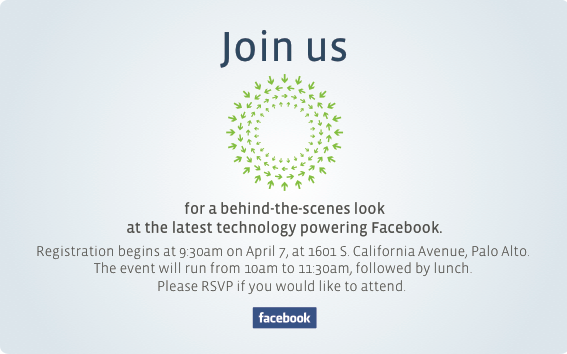
Last Thursday a group of us from Dell attended and participated in the unveiling of Facebook’s Open Compute project.
Much the way open source software shares the code behind the software, the Open Compute project has been created to provide the specifications behind the servers and the data center. By releasing these specs, Facebook is looking to promote the sharing of data center and server technology best practices across the industry.
Pre-Event
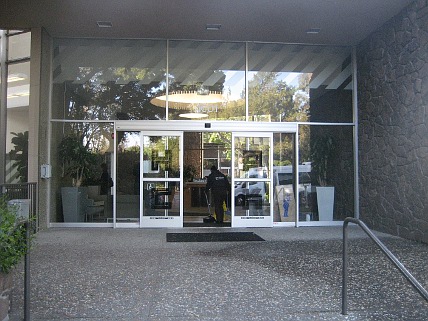
The unassuming entrance to Facebook's Palo Alto headquarters.
The Facebook wall.
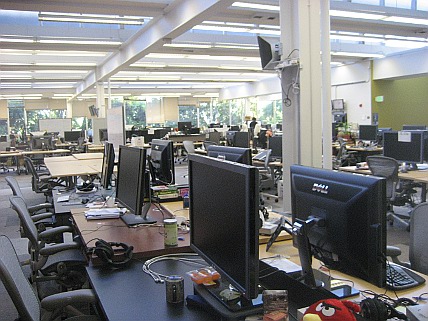
Facebook headquarters at 8am. (nice monitors! 🙂
Words of wisdom on the wall.
The Event
Founder and CEO Mark Zuckerburg kicks off the Open Compute event.
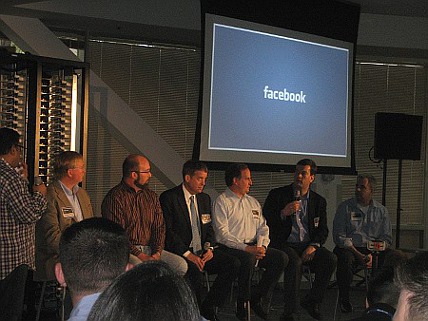
The panel moderated by Om Malik that closed the event. Left to right: Om, Graham Weston of Rackspace, Frank Frankovsky of Facebook, Michael Locatis of the DOE, Alan Leinwand of Zynga, Forrest Norrod of Dell (with the mic) and Jason Waxman of Intel.
Post-event show & tell: Drew Schulke of Dell's DCS team being interviewed for the nightly news and showing off a Dell DCS server that incorporates elements of Open Compute.
This morning at Facebook’s headquarters in Palo Alto the company announced their Open Compute project Partners and kindred spirits were there to tell the story behind Open Compute and explain what they think it means to the industry. One group of kindred spirits were the individuals from Rackspace. I got some time with Jim Curry who heads up OpenStack at Rackspace after the event officially ended.
Here is what Jim had to say:
Some of the topics Jim covers:
Driving efficiencies in data center design requires looking at the issue holistically.
Learning from Facebook’s successes and failures.
Looking forward to collaboration in an area that hasn’t historically had a lot of collaboration.
Engagement with Facebook engineers on how to run OpenStack on their hardware.
Former Dell DCS dude Frank Frankovsky has been at Facebook for about 18 months. Frank is Facebook’s Director, Hardware Design and Supply Chain and since he arrived, he has been heavily involved in the Open Compute project. Today was the big day when Open Compute made its worldwide debut.
Frank represented Facebook on the panel discussion which was moderated by GigaOM’s Om Malik. After the panel I was able to grab a few minutes with Frank, between press interviews, and learn first hand about the project.
Some of the topics Frank covers:
What he and his team do at Facebook
Their brand new data center which is running open compute infrastructure
Opening up the details and specs of their data center and the systems they are running
The genesis of the open compute project
What are the next steps for the open compute project
This morning, at Facebook’s headquarters in Palo Alto, the company unveiled the Open Compute project. Also on hand to support the announcement were partners such as Dell and Intel, who served on a panel alongside representatives from Rackspace, the Department of Energy, Zynga and Facebook. Forrest Norrod, GM of Dell’s server platform division represented Dell on the panel.
I caught up with Forrest after the event to get his take on the Open Compute project and what it means for Dell.
Today at its headquarters in Palo Alto, Facebook and a collection of partners such as Dell, Intel and AMD — as well as kindred spirits like RackSpace’s founder (the company behind OpenStack) and the CIO of the Department of Energy — are on hand to reveal the details behind Facebook’s first custom-built data center and to announce the Open Compute project.
Efficiency: saving energy and cost
The big message behind Facebook’s new data center, located in Prineville Oregon, is one of efficiency and openness. The facility will use servers and technology that deliver a 38 percent gain ìn energy efficiency. To bring the knowledge that the company and its partners have gained in constructing this hyper-efficient hyper-scale data center Facebook is announcing the Open Compute project.
Much the way open source software shares the code behind the software, the Open Compute project has been created to provide the specifications behind the hardware. As a result, Facebook will be publishing the specs for the technology used in their data center’s servers, power supplies, racks, battery backup systems and building design. By releasing these specs, Facebook is looking to promote the sharing of data center and server technology best practices across the industry.
How does Dell fit in?
Dell, which has a long relationship with Facebook, has been collaborating on the Open Compute project. Dell’s Data Center Solutions group has designed and built a data center solution using components from the Open Compute project and the server portion of that solution will be on display today at Facebook’s event. Additionally Forrest Norrod, Dell’s GM of server platforms will be a member of the panel at the event talking about the two companies’ common goal of designing the next generation of hyper efficient data centers.
A bit of history
Dell first started working with Facebook back in 2008 when they had a “mere” 62 million active users. At that time the three primary areas of focus in with regards to the Facebook IT infrastructure were:
Decreasing power usage
Creating purpose-built servers to match Facebook’s tiered infrastructure needs
Having tier 1 dedicated engineering resources to meet custom product and service needs
Over the last three-plus years, as Facebook has grown to over 500 million active users, Dell has spefically helped out to address these challenges by:
Building custom solutions to meet Facebook’s evolving needs, from custom-designed servers for their web cache, to memcache systems to systems supporting their database tiers.
Delivering these unique servers quickly and cost effectively via Dell’s global supply chain. Our motto is “arrive and live in five”, so within five hours of the racks of servers arriving at the dock doors, they’re live and helping to support Facebook’s 500 million users.
Achieving the greatest performance with the highest possible efficiency. Within one year, as the result of Dell’s turnkey rack integration and deployment services, we were able to save Facebook 84,000 pounds of corrugated cardboard and 39,000 pounds of polystyrene during that same year.
Congratulations Facebook! And thank you for focusing on both open sharing and on energy efficiency from the very beginning!


 Posted by Barton George






 Barton's Blog