OpenStack Compute – talking to the chief architect

July 18, 2010

Rick Clark used to be the engineering manager at Canonical for Ubuntu server and security as well as lead on their virtualization for their cloud efforts.  He’s now at Rackspace and is applying much of what he learned while at Canonical to his new gig as project lead and chief architect of the just announced OpenStack Compute.

Rick talked to me about what he brought with him from Canonical as well as the details behind OpenStack Compute.

Some of the topics Rick tackles:

  • What is the OpenStack Compute project (hint its a fully open sourced IaaS project)
  • Leveraging what Rick learned from the Ubuntu community, including a regular six month cadence.
  • Rick’s goals for design summit: develop a roadmap for the first release, spec out the software and spend the last two days prototyping and hacking.
  • Why they went with the Apache 2 license and why not AGPL?
  • The Rackspace API (NASA had already started to switch from the Amazon API before combing
  • The project’s core principles: open, open, open

Extra-credit reading:

Pau for now…


The Cloud is a marathon — Marten Mickos, Eucalyptus CEO

June 24, 2010

Yesterday at the GigaOM Structure conference here in San Francisco, I ran into Marten Mickos, the recently appointed CEO of Eucalyptus systems.  Eucalyptus is one of the key ingredients in the Ubuntu Enterprise Cloud that is being certified to run on Dell’s PowerEdge C systems as part of our cloud ISV program.

Marten, the former CEO of MySQL took the helm of Eucalyptus about three months ago, and was at Structure both as an attendee and participant, sitting on two panels at this two-day cloud-a-polooza.  At the end of the day-one I got some time with Marten and asked him about his new gig.

Some of the topics Marten tackles:

  • How he made the decision to go to Eucalyptus. (Hint: he asked the question, what’s bigger than Open Source)
  • What is Eucalyptus and whats it based on?
  • How will Marten’s experience at MySQL and Sun help him in his new role at Eucalyptus?
    • MySQL was a disrupter of the old whereas Eucalyptus is an innovator of the new.
    • Sun’s company culture was phenomenal, the technology was phenomenal, the business…um…
  • What Eucalyptus is doing with Canonical and the Ubuntu Enterprise Cloud.
  • What Eucalyptus is focusing on for the next year.

Extra-credit reading:

Pau for now…


NetworkWorld Review of Ubuntu Enterprise Cloud

May 18, 2010

Tom Henderson and Brendan Allen of ExtremeLabs published a great walk-thru of the Ubuntu Enterprise Cloud (UEC) last week in NetworkWorld.  Canonical, the commercial sponsor behind Ubuntu, is one the first members of our Cloud Partner Program and we will soon be offering UEC running on top of our PowerEdge C line accompanied by reference architectures.

If you’re not familiar with UEC, which leverages the open source Eucalyptus private cloud platform, here is a quick backgrounder:

Basically, Ubuntu Enterprise Cloud can be deployed on internal hardware to run job/batch applications. The idea is to initially allocate storage, then rapidly build multiple virtual machines to process data, collect the data, then tear down the infrastructure for re-use by a subsequent purpose.

Ubuntu Enterprise Cloud provides internal cloud control methods that closely mime what can be done on Amazon’s public cloud infrastructure. Its tools can be used to process recurring jobs or one-shot distributed applications, like DNA analysis, video rendering, or database table reformatting/reindexing.

Walk this way

The Review, which is a concise 3 and a half pages, steps you through:

  • Getting started
  • Installation*
  • Setup/configuration
  • Image Bundles
  • Usage/Monitoring

*My favorite line from this section is: “Installation was very simple; we inserted the Ubuntu Server CD, selected Ubuntu Enterprise Cloud, and drank energy drinks.”

If you’re interested in learning about UEC this article is a great place to start.

Extra-credit reading

If the above whets your appetite, you may want to dig into the following:

(The last 3 items I grabbed from Dustin’s Blog)

Pau for now…


Dell’s New High Performance Analytics & Cloud Server

April 21, 2010

Last but not least in our tour of the first flight of servers in Dell’s PowerEdge C line is the C2100.  This was filmed last month at our launch right after we closed down our whisper suite.  Click below and join solutions architect Rafael Zamora as he leads you through the thrills, chills and spills of this cool new machine.

Spoiler Alert! A few Highlights

  • This machine is a great high performance data analytics and cloud optimized storage server.  It’s perfect for use in conjunction with software from our Cloud ISV partners Joyent, Aster Data, Canonical or Greenplum.
  • The entire front can be jam-packed with disk drives for mega storage.  You can get up to 24TB by loading twelve 3.5inch 2TB drives.
  • While the C2100 has same system board as the  C1100, it comes with twice the real estate in a 2U form factor.
  • There’s even a platform for two additional drives that you can use for a bunch of different purposes such as separating production and non-production traffic.

Pau for now….


Talkin’ to Eucalyptus Founder & CTO — Rich Wolski

April 19, 2010

Last month when I was out in the Bay Area for our launch, I was able to catch up with Rich Wolski, founder and CTO of Eucalyptus.  Eucalyptus is one of the key ingredients in the Ubuntu Enterprise Cloud that is being certified to run on Dell’s PowerEdge C systems as part of our cloud ISV program.  Here is what Rich had to say:

Some of the topics Rich tackles:

  • How Eucalyptus started at the University of California at Santa Barbara.  They wanted to show how old-style large scale computing (NSF super computer centers) could be combined with new large-scale computing (in the form of Amazon)  in the service of science.  Wanted to also include 4-6 university data centers.
  • They put the code out as open source and got deluged by science and commercial industry about potential applications.  Grew too big to continue as a research project so they brought it outside.
  • Marten Mickos coming on board as CEO.  How it came about.
  • Working with Canonical and Ubuntu and how the relationship began.   UEC and what part Eucalyptus makes up.
  • How NASA is offering a production Eucalyptus cloud to NASA researchers and other governmental agencies.
  • Where Rich sees Eucalyptus going in the next two years.  The importance of the open source community and their continued focus on private clouds in the enterprise.

Pau for now…


PowerEdge C1100 – Skinny & Dense

April 13, 2010

Here is the third in my series of four videos exploring the new Dell PowerEdge C server line.  Today’s feature, the PowerEdge C1100.

If you’re wondering about the funky game show-like setting, I shot this after hours on the day of our launch in the whisper suite.  Your guide, as before, is the incomparable Dell Solutions Architect, Rafael Zamora.

A few highlights

  • The C1100 is a high memory, cluster optimized, compute node
  • Dont let its slim pizza box looks fool you, upfront you can pack either four 3.5 inch drives or ten 2.5 inch drives.
  • For high memory optimized compute you can get 18 DIMM sticks for 144GB of RAM.
  • Comes with your choice of either Intel’s Nehalem or Westmere processors.
  • Raf also gives a couple of examples of recent customers and how they’ve decide to configure their units.
  • The C1100 will also serve as the cloud management server for the upcoming Joyent solution and the Ubuntu Enterprise Cloud.

Tune in next week when Rafael will take us through the PowerEdge C2100.

Pau for now…


PowerEdge C6100 – HPC & Cloud machine

April 8, 2010

As a follow on to last week’s PowerEdge C line overview, here is the first individual system overview:  the C6100.   Click below and let Dell Solutions Architect Rafael Zamora guide your thru the design and features of this densely packed machine targeted at HPC and cloud workloads.

Some of the highlights:

  • The PowerEdgeC 6100 holds the equivalent of 4 systems which have been packaged into “sleds,” each containing boards, RAM and microprocessors.
  • Upfront you can put a ton o’ disk drives, either 24 x 2.5″ drives or 12 x 3.5″ drives.
  • Great for markets like HPC clustering and search engines where compute density is key.  (This is not intended for running general purpose apps like Exchange, SQL or Oracle).
  • It will serve as the compute node in the Ubuntu Enterprise Cloud solution from our partner Canonical.

Still to come, overviews of the C2100 and C1100.

Extra-Credit Reading:

Pau for now…


Dell’s New Cloud Server line – An Overview

March 30, 2010

At last week’s Dell Launch, “Solutions for the Virtual Era,” we unveiled the first three systems in our new PowerEdge C line.  These “hyper-scale inspired” systems are based on designs that we have built for our largest scaled-out customers such as Windows Azure, Facebook, Ask.com and Tencent.

The PowerEdge C line is targeted at both Public and Private cloud builders as well as HPC, Web 2.0, gaming and large scaled out web farms.  In the video below, Dell solutions architect Rafael Zamora walks us through the PowerEdge C6100, C1100 and C2100.

Upcoming posts

In the days to come I will be posting individual walk-thrus of each of the three systems.  I will also be posting interviews I did with executives from our cloud partners Joyent, Aster Data, Greenplum and Eucalyptus (who’s not a partner but provides a key component of our partner Canonical’s Ubuntu Enterprise Cloud).

Extra-Credit reading

Pau for now…


Ubuntu founder stops by Round Rock

February 19, 2010

My favorite cosmonaut-coder Mark Shuttleworth stopped by our offices this morning for a visit.  Mark is the founder of both the Linux distribution Ubuntu and its commercial sponsor Canonical.   Mark and I sat down in the lobby and caught up.  Here is a short interview we recorded.

Some of the topics Mark tackles:

  • Where Canonical is currently working with Dell
  • Ubuntu Enterprise Cloud (to build your “own little EC2”)  and how its doing
  • Passing the CEO mantle to Jane Silber in March
  • The 10.4 Ubuntu release Lucid Lynx and what to expect: a strong cloud focus on the enterprise side and a lot of shiny new bling on the desktop as well as making the desktop “social” (e.g. Tweet straight from your desktop)
  • What Ubuntu is doing in the Netbook space
  • What excites Mark the most in technology today and why cloud is like HTTP in the early 90’s

Extra-credit reading

Pau for now…


Mark Shuttleworth on the Cloud, Ubuntu on Dell and more

September 24, 2009

Mark Shuttleworth, founder of Ubuntu and the head of Canonical, the commercial entity behind the popular linux distribution, is currently making his rounds in the States.  Yesterday he was quite busy,  taking the stage at both the Intel Developer Forum in San Francisco as well as at  LinuxCon up in Portland Oregon.

Today he popped by Dell here in Austin to chat.  I grabbed him for a few minutes right before lunch. Here is the result:

Some of the topics Mark tackles:

  • The release yesterday of Dell’s Mini netbook with Ubuntu Moblin Remix – Developer Edition. (More details on the release from the Dell blog.)
  • Mark’s keynote yesterday at Linuxcon and the themes of cadence, quality and design.
  • His kerfluffle with the Debian community around release schedules.
  • The cloud-related goals for next month’s Ubuntu 9.10 release, Karmic Koala:
    • To be able to deploy your own cloud across 5-10 servers in 15 mins to an hour
    • Be able to enable private clouds that are completely EC2 compatible
    • Ability to create a library of virtual appliances that will deploy on EC2 or private clouds
  • The announcement earlier this week of the 10.04 Long Term Support (LTS) release named “Lucid Lynx.”
  • Mark’s thoughts on Windows 7 or as he calls it, “the wonderful Service Pack for Vista.”
  • How long until profitability.

Pau for now…


RightScale Part 2: Why the cloud? Apple Fanboys and Server Suffrage

June 18, 2009

Tuesday I listened in on the RighScale webinar: How to Build Scalable Websites in the Cloud.  This is part two of my thoughts and notes from the event.  (Note: it doesn’t look like it’s been posted yet but it should be available here soon).
The clouds providers that Right Scale works with.

The clouds providers that Right Scale works with.

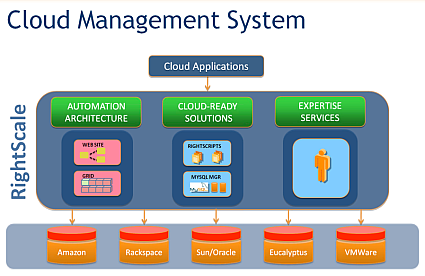
As I discussed last time, RightScale acts as a management platform between cloud providers and Apps.

Which Cloud Providers do they work with?

If you double click on the IAAS bit in the yesterday’s slide you get something like the above.  Right Scale works on top of Amazon, coming soon to Rackspace’s Slicehost, Sun/Oracle’s cloud), Eucalyptus theEC2-compatible open source alternative that allows you to set up “private clouds” (BTW as anyone who attended Austin Cloud camp knows I’m using “private cloud” under duress, Gordon Haff does a good job explaining my heartburn) and VMWare.

Linux more robust than Windows

When asked about OS’s supported the answer was Windows as well as Ubuntu and CentOS.  Their CEO did admit that currently Windows support is not as robust as Linux.  They actually began with CentOS and according to one of their team have recently begun supporting Ubuntu more fully.   When I asked about other Linux flavors, Debian, SuSE etc. they said that there were “licensing issues” standing in the way.  I should have asked about OpenSolaris 🙂

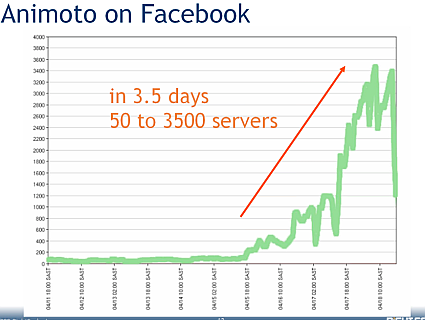
Animoto, the well used example of how server demand can explode.

Animoto, the well used example of how server demand can explode.

Why do you look to the clouds?

During the webinar they polled the 200 odd attendees: “what’s driving you to the cloud?”  The results (as you’ll notice, you were allowed to vote for more than one):

  • 80% Scalability
  • 73% Cost Savings
  • 59% On Demand access
  • 28% Back-up and recovery
  • 06% Other

Not surprisingly Scalability came in number 1.  As if to underscore the point they brought out everbody’s favorite case study of exploding demand, Animoto.  Thankfully they had another example of uneven demand, iFixit (see below).  As an aside, one example I’d like to see charted is the attendee who mentioned that their agency is responsible for posting election results and were “not prepared for the interest worldwide, for Proposition 8.”

It was interesting to see that cost savings came in a close second, its always hard to measure particularly over the long haul but the perceived cost benefit is definitely strong in most folks mind.

iFixit's traffic could be said to be a tad "spikey."

iFixit's traffic could be said to be a tad "spikey."

Right Scale fighting for Server voting rights

And in conclusion…I’m always intrigued with the way English language morphs and evolves so I thought it was really interesting how the word “vote” is being used in the cloud (or at least by RightScale).  Basically they use a “voting process” when scaling.  Here’s how one of their team explained it.

Once a machine hits the scale up threshold  it places a vote to scale up.  When enough machines vote to scale up i.e. 51% if that that is what the decision threshold is set at, then new servers are provisioned and configured.  The same goes for scaling down.

Don’t know if this usage is new or a throw back from mainframes or from some other industry but I like it.

Pau for now…


RightScale part 1: Mickos joins and control moves up the stack

June 17, 2009

Yesterday I attended a webinar that RightScale put on entitled: How to Build Scalable Websites in the Cloud.  It was basically a welcome to RightScale, welcome to the cloud presentation but overall interesting and credible.

The presenters were their CEO, their head of marketing and a mini team of techies.  Below is part one of some of my thoughts and takeaways.  But first a slight digression…

Enter the Dolphin Master

One thing I noticed during the presentation and which warmed my heart was that MySQL played prominently in a bunch of the slides.  It was only today when I was poking around the RightScale site that I saw the press release from a few weeks ago announcing that Marten Mickos, former MySQL CEO and Sun employee joined the RightScale board of directors.  Its interesting but not surprising to note in the release that Marten calls out Sun and Canonical (the commercial sponsor behind Ubuntu) as two strategic partners helping to expand the RightScale ecosystem.

Where Right Scale fits within the tri-sected cloud.

Where Right Scale fits within the tri-sected cloud.

Where they play in the Cloud(s)

RightScale positions themselves as a cloud management platform or as I like to think of it “a cloud tamer.”  If you split the cloud in three — software as a service, platform as a service and infrastructure as a service — they play in the last space. Basically Right Scale sits on top of Infrastructure as a Service (IAAS) and can handle all the tricky bits so you don’t have to.

Choose or choose not to choose

For those who want more control over their infrastructure RightScale will allow you to “choose among a variety of development languages, software stacks, data stores and cloud providers.” For those less intrepid in the cloud they have server templates that you can start off with.

One of the key benefits they stressed was getting rid of vendor lock-in, “so that you never get locked in to a single provider.”  You’ll notice on the X axis above they show lock-in decreasing and portability increasing as you move to the right.  My question however is that with Right Scale aren’t you simply locked in to a different layer of the cloud?  Doesn’t the control point simply move up the stack?  Just wondering…

Tune in tomorrow for part deux!

Extra Credit Reading/Listening

  • What is MySQL founder Monty Widenius up to post MySQL/post Sun? The Open Database Alliance and his MariaDB – May ’09
  • An interview with Marten Mickos, the day the MySQL deal with Sun closed — Feb ’08.
  • An interview with Marten Mickos after he keynoted Canonical’s first (and last) Ubuntu Live — Aug ’07.

Pau for now…


Talking to Canonical’s KVM Kid — Dustin Kirkland

April 28, 2009

At Austin Cloud Camp on Saturday I ran into Ubuntu linux developer and Canonical employee, Dustin Kirkland.  Dustin is on the server developer team at Canonical and, as he explains it, focuses on various aspects of virtualization, the plumbing layer below cloud computing.  I grabbed Dustin for a few minutes and chatted with him about last week’s release and what he’s been working on.

Some of the topics Dustin Tackles:

  • KVM, Canonical’s hypervisor of choice
  • Ubuntu’s next release and its focus on Eucalyptus to enable companies to set-up their own EC2 compatible “private clouds” based on Ubuntu servers.
  • What Dustin likes most about cloud computing (hint: think green)
  • What he likes most about working at Canonical

Update: And on a related note — Eucalyptus goes commercial with $5.5M funding round

Pau for now…


Mark Shuttleworth dicusses the Cloud and Ubuntu

March 30, 2009

Last month Mark Shuttleworth, founder of Ubuntu Linux, CEO of Cannonical Ltd and First African in Space, announced that Ubuntu was going to be making a big push into cloud computing with their release slated for October.  This will add to early cloud support that’s debuting in next month’s release, Ubuntu 9.04.  (BTW, For a good backgrounder on Mark and Ubuntu, check out Ashlee Vance’s story in the New York Times from January).

I  was interested to get some more details so I reached out to Mark to find out his master Cloud plan, his thoughts on Cloud Computing today and where he thought it was going.  This is what he had to say:

My interview with Mark (9:51)  Listen (Mp3) Listen (ogg)


Mark and myself at the Ubuntu Developer Summit in Boston at the end of ’07 (Mark’s the one without the “Barton” name tag.)

Some of the topics Mark Tackles:

  • Ubuntu has picked two anchor points for its cloud strategy: Amazon EC2 and UCSB‘s (go Gauchos!) Eucalyptus.  Eucalyptus is for those looking to create “private clouds” on their own and on the Amazon side they are making it easy for users to plug into EC2 as well as offering folks the ability to run Ubuntu-based machines on their cloud.
  • Why they went with EC2 and Eucalyptus.  On the Eucalyptus side it has to with it being Java-based, which meshes nicely with the work Ubuntu did with Sun to get the Java stack “straightened out” on Ubuntu for  app servers.
  • The constraints that EC2 imposes actually make it more interesting by providing discipline, much in the same way that http applied the discipline of being completely connectionless.
  • We haven’t yet seen the “definitive cloud” in  the way that Google came along and captured the spirit (and revenues) of the web.  It will still be 5 -10 years before the cloud computing is nailed.
  • Portability in the Cloud is key if we want to avoid gross lock-in issues.  People are trying to tackle this in a variety of ways but it makes sense to look at the way http came to dominance.
  • Any truth to the rumor that Google is planning on using Ubuntu as a Netbook OS? (listen how Mark deftly responds 🙂
  • Last time we spoke, back in August, Mark said he was looking at profitability in 18 months to two years, is he still on track?

Pau for now…

Update: Here is the Register article based on the above podcast.


It takes a Community (and they could use a Marketing Guide) — Mozilla Debut’s theirs

February 26, 2009

It’s 2009 and most of us appreciate the power of the community.  It has been what has driven the ascendancy of free and open source software.  It is what helped propel our current President to the White House.

obamacommunity

Obama community in action. Source: Huffington Post

“I’m in charge here” doesn’t work for a community

Although it may be obvious to some, the most important thing to know about a community is that its about influence and not control.  You can’t direct a community to do anything.  What you can do is provide great products, ideas etc that your community can get behind, promote and help make better.  Its about acknowledging their help and providing the tools and resources to help them help you.  As Max Spevack, the former Community Manager for Fedora Linux once told me, “It’s about the power of persuasion and ‘thank you.'”  Or as the motto of Obama’s field campaign states: “Respect. Empower. Include.”

debianhackers

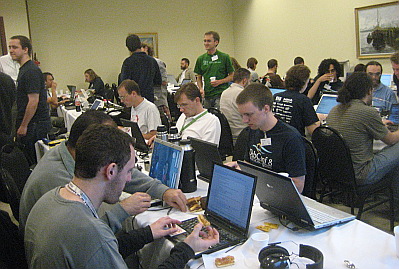
Hackers working on Debian GNU/Linux, an entirely community built distro. (Source: My pic from Debconf8 in Argentina).

Does it work elsewhere?

So the power of community is now recognized in the development of open source software as well as in the marketing of a presidential candidate.  What about in the marketing of open source software?

Various software communities do look to members to help with many aspects of marketing, just ask Jono Bacon community leader for Ubuntu Linux or Zonker Brockmeier of OpenSUSE.  What I haven’t seen however is an actual marketing guide developed with and for the community.  That is until yesterday (there must be another community that has such a guide, I just cant think of any).

A Guide is Born

Back in November, my former Sun compadre, Patrick Finch now of Mozilla posted a blog entry imaginatively entitled, Wanted: A Guide To Community Marketing At Mozilla that discussed “the need to help the community do as much of its own marketing as possible.”  Yesterday Patrick blogged the arrival of the Mozilla Community Marketing Guide.

The guide’s brief intro explains “We hope the guide helps Mozillians identify activities they wish to undertake and point them to the resources that are already available to the community.”  Those resources are then categorized into 14 topics  such as, Public Speaking , Blogging, Tagging and Social Networking, Promoting the Mozilla Mission and  Guerrilla Marketing Activities. It also has a section that talks about what is community marketing and show cases some of Mozilla’s most famous grass roots campaigns like the Firefox crop circle and the New York Times ad.

firefox_crop_circle

Strange things happen up in Oregon.  (Read how OSU students did this.)

Gettin’ better all the time

The guide like many resources for the community, and following the Web 2.0 tenant of the “eternal beta,” is positioned as work in a progress that will be added to and updated.

I think this is guide is a great idea to help the community help Mozilla.  One of the the greatest value I see in this is, by show casing the efforts of community members it helps to give others ideas and motivate them.  I will be very interested to see how this grows and is used going forward.

Although the power of the community is now recognized it is fascinating to see the tools and tactics that are being developed to further support its members and harness their energy.   This is a space is one to keep an eye on and watch develop as it becomes more and more mainstream.

Pau for now…