Today Dell is announcing that it is continuing to put its money where its mouth is when it comes to its transformation into a solutions provider, this time to the tune of $1 Billion. The goal of this investment, which is being made this year, is to provide customers with a complete set of resources and services to enable business agility, efficiencies and competitive advantage.
Specifically Dell is announcing:
Cloud Data Centers: The building of multiple cloud data centers around the world that will allow customers to take advantage of such offerings as Infrastructure as a Service, Desktop as a Service, Storage as a Service and IT outsourcing.
Global Solutions Centers: The creation of a network of global solutions centers to help customers architect, validate and build the efficient enterprise from the data center to the edge of the network.
New Solutions: New open, capable and affordable solutions for data management, client virtualization and data center virtualization:
Dell vStart: a single unit infrastructure solution that runs 100 to 200 vm’s and comes racked and cabled from the Dell factory.
Dell|Microsoft management and virtualization solutions partnership to deliver integrated management solutions made up of Dell’s Virtual Integrated System, our Advanced Infrastructure Manager and Microsoft’s System Center.
Dell Email and File Archive Solutions
Dell Desktop Virtualization Solutions
A little more detail:
Next generation cloud data centers
Over the next 24 months Dell is building out a host of cloud data centers around the world. Rather than old-school, giant raised-floor data centers these cloud data centers will be much smaller (approximately 10,000 square feet), more efficient and designed to take advantage of modular, hyper-scale and high-density principles. Dell’s modular strategy will let the company quickly expand capabilities as demand grows.
These data centers will feature private, public and hybrid cloud options. They will provide the foundation for Dell’s next generation services and solutions and offer IaaS, and SaaS capabilities as well as IT outsourcing for customers.
Global solutions center network
This year Dell will open 12 Global Solutions centers and is planning ten more over the next 18 months. These centers are customer facing facilities that will act as a “living lab” providing an environment and the support for customers to architect, build and test proof of concepts involving Dell products, services and solutions. The centers will also support solution integration, technical briefings and validation and ISV certification to meet regional requirements.
Starting with the upgrading of the existing Austin, Limerick and Frankfurt centers, further facilities will be opened this year in the Americas (Washington DC, Chicago, Northern California and Brazil), APJ (Shanghai, Singapore, Tokyo and Sydney) and EMEA (Paris).
With today’s announcement Dell his taken its evolution into a services and solutions company and kicked it up a notch. In the “Virtual Era” technology is rapidly changing and it along with new delivery models such as cloud are changing the way businesses operate and create advantage. Through its cloud and solution centers and new solution offerings Dell is bringing new ways to help customers harness and leverage these changes.
OpenStack, the open source cloud platform based on code donated by NASA and Rackspace, has gained considerable traction since it was launched eight months ago. The community has rapidly grown and there have been several releases. Now its time to get potential customers trying it out and kicking the tires.
With the idea of removing friction to adoption and make the testing out of the platform as easy as possible, Dell, Equinix and Rackspace are announcing today the availability of a free OpenStack cloud demonstration and test environment.
The idea of the demo environment is to allow organizations to easily evaluate OpenStack and assess application performance on the platform in a low risk environment for free. The next step after a successful demo would be a proof of concept.
Movin workloads around the country
This demo environment is initially available in three U.S. data centers and in Q2 of this year this offering will also be available in Equinix data centers in Europe and Asia. The initial data centers are:
Equinix Silicon Valley
Equinix Asburn, VA
Rackspace Chicago
By having geographically dispersed facilities customers are able to test out the moving of applications and workloads between them.
The various parts
The OpenStack demo environment is made up of the following components
Platform Equinix, a global delivery platform of 92 network neutral data centers in 35 metro markets
Widening the circle
The name of the game here is making the trying out of OpenStack as easy as possible. There are a lot of community members and open source aficionados who are already testing out OpenStack. The idea with OpenStack cloud demonstration environment is to provide a set up where a greater number of organizations feel comfortable evaluating the platform for themselves.
Dell’s Data Center Solutions group (DCS) is no longer a toddler. Over the weekend we turned four!
Four years ago on March 27, 2007 Dell announced the formation of the Data Center Solutions group, a special crack team designed to service the needs of hyperscale customers. On that day eWeek announced the event in their article Dell Takes On Data Centers with New Services Unit and within the first week Forrest Norrod, founding DCS GM and currently the GM of Dell’s server platform division, spelled out to the world our goals and mission (in re-watching the video its amazing to see how true to that mission we have been):
The DCS Story
If you’re not familiar with the DCS story, here is how it all began. Four years ago Dell’s Data Center Solutions team was formed to directly address a new segment that begin developing in the marketplace, the “hyperscale” segment. This segment was characterized by customers who were deploying 1,000s if not 10,000s of servers at a time.
These customers saw their data center as their factory and technology as a competitive weapon. Along with the huge scale they were deploying at, they had a unique architecture and approach specifically, resiliency and availability were built into the software rather than the hardware. As a result they were looking for system designs that focused less on redundancy and availability and more on TCO, density and energy efficiency. DCS was formed to address these needs.
Working directly with a small group of customers
From the very beginning DCS took the Dell direct customer model and drove it even closer to the customer. DCS architects and engineers sit down with the customer and before talking about system specs they learn about the customer’s environment, what problem they are looking to solve and what type of application(s) they will be running. From there the DCS team designs and creates a system to match the customer’s needs.
In addition to major internet players, DCS’s customers include financial services organizations, national government agencies, institutional universities, laboratory environments and energy producers. Given the extreme high-touch nature of this segment, the DCS group handles only 20-30 customers worldwide but these customers such as Facebook, Lawrence Livermore National Labs and Microsoft Azure are buying at such volumes that the system numbers are ginormous.
Expanding to the “next 1000”
Ironically because it was so high-touch, Dell’s scale out business didn’t scale beyond our group of 20-30 custom customers. This meant considerable pent up demand from organizations one tier below. After thinking about it for a while we came up with a different model to address their needs. Leveraging the knowledge and experience we had gained working with the largest hyperscale players, a year ago we launched a portfolio of specialized products and solutions to address “the next 1000.”
The foundation for this portfolio is a line of specialized PowerEdge C systems derived from the custom systems we have been designing for the “biggest of the big.” Along with these systems we have launched a set of complete solutions that we have put together with the help of a set of key partners:
Dell Cloud Solution for Web Applications: A turnkey platform-as-a-service offering targeted at IT service providers, hosting companies and telcos. This private cloud offering combines Dell’s specialized cloud servers with fully integrated software from Joyent.
Dell Cloud Solution for Data Analytics: A combination of Dell’s PowerEdge C servers with Aster Data’s nCluster, a massively parallel processing database with an integrated analytics engine.
Dell | Canonical Enterprise Cloud, Standard Edition: A “cloud-in-a-box” that allows the setting up of an affordable Infrastructure-as-a-Service (Iaas)-style private clouds in computer labs or data centers.
OpenStack: We are working with Rackspace to deliver an OpenStack solution later this year. OpenStack is the open source cloud platform built on top of code donated by Rackspace and NASA and is now being further developed by the community.
These first four years have been a wild ride. Here’s hoping the next four will be just as crazy!
World Hosting Days is going on right now outside of Frankfurt and our group is using this event to debut our new PowerEdge C microservers. These new microservers, which come in both Intel and AMD flavors, are right-sized for dedicated hosting applications and provide extreme density and efficiency.
Yesterday, we got a shout out during AMD’s session and today Jason Waxman of Intel had kind words for our PowerEdge C5220 microserver during his talk. Jason is Intel’s General Manager, High Density Computing, Data Center Group and this morning he delivered the session, “Driving efficiency, security and simplicity across next generation cloud data centers.”
In the short segment above from Jason’s talk, he spends the first couple of minutes on Intel’s power efficient processors such as the Sandy Bridge Xeon and Atom chips. At the 2:20 mark he switches gears and talks about our new PowerEdge C5220 and how it has been designed with hosters in mind.
Jason stops by our booth
After he got through speaking, Jason stopped by the Dell booth and did a quick video talking specifically about the PowerEdge C5220 and what he really likes about it.
This week, outside of Frankfurt, WorldHostingDays is taking place. A whole delegation of folks from the Data Center Solutions group is there to support the announcement of our new microserver line. A lot of our key partners are there as well. One such partner is AMD.
Earlier today, AMD director of product marketing John Fruehe held a session entitled “Core Scalability in a cloud environment.” Above is a three minute section where John talks about the three AMD-based systems that are part of the PowerEdge C line:
The PowerEdge C5125 microserver which we announced yesterday
The PowerEdge C6105 optimized for performance per watt per dollar.
Earlier this morning at WorldHostingDays outside of Frankfurt, we announced our new line of PowerEdge C microservers. While this is our third generation of microservers, its the first that are available beyond the custom designed systems we’ve been building for a small group of hyperscale web hosters.
If you’re not familiar with microservers, their big appeal is that they are right-sized for many dedicated hosting applications and provide extreme density and efficiency, all of which drive up a data center’s revenue per square foot. As an example, our first generation allowed one of France’s largest hosters, Online.net to efficiently enter a new market and gain double digit market share.
To see exactly what these systems are all about, check out this short walk thru by Product Manager Deania Davidson. The system that Deania is showing off is the AMD-based PowerEdge C5125 which will be available next month. Also announced today is the Intel-based PowerEdge C5220 which will be out in May.
Over the past three years Dell’s Data Center Solutions group has been designing custom microservers for a select group of web hosters. The first generation allowed one of France’s largest hosters, Online.net to enter a new market and gain double digit market share. The second generation brought additional capabilities to the original design along with greater performance.
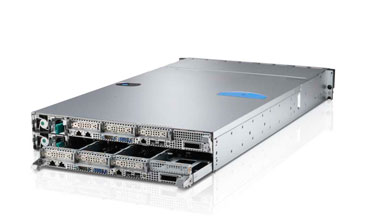
Today we are announcing that we are taking our microserver designs beyond our custom clients and are making these systems available to a wider audience through our PowerEdge C line of systems. The PowerEdge C5125 and C5220 are ultra-dense 3U systems that pack up to twelve individual servers into one enclosure. The C5125, which is AMD based, will be available next month and the Intel-based C5220 will be available in May.
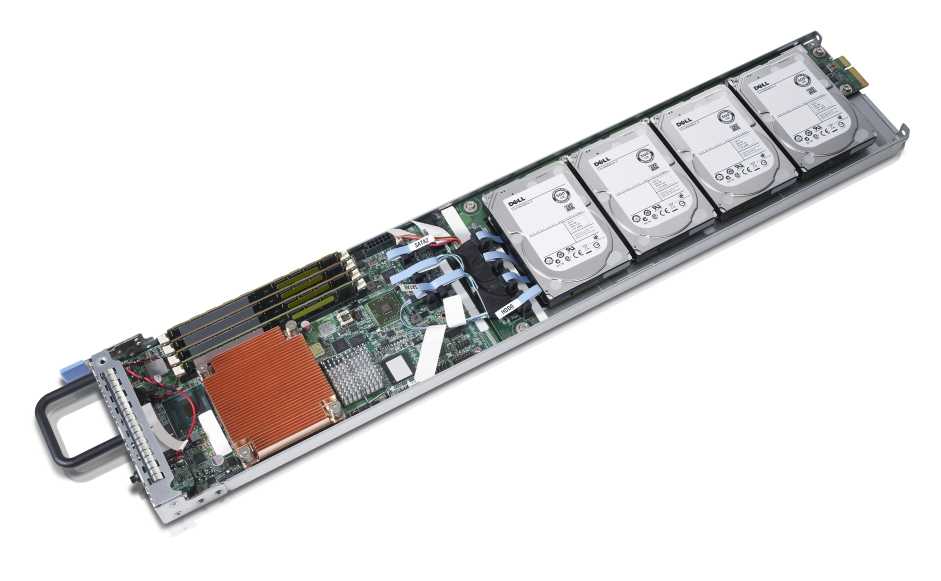
The PowerEdge C5125 with one of the 12 server sleds pulled out.
So what the heck is a “microserver”
Microservers are a new class of systems specifically designed for those use cases where multi-core CPU architecture and extensive virtualization are overkill. What they provide instead are multiple low-cost dedicated servers, each featuring a single-socket CPU, where one CPU is perfect for running single applications.
The general idea behind these lighter weight systems is that they are right-sized for a particular set of applications such as serving up Web pages, streaming video and certain online gaming services.
DCS’s third generation of microservers
One of the most important attributes of the PowerEdge C5125 and C5220 is their density. By packing 12 one-socket servers in a 3U form factor these systems deliver four times the density of more conventional 1U servers. This translates to four times less floor space, cabling and racks all of which means greater revenue per square foot for web hosters and data center operators.
These systems further save on power and cooling by leveraging shared infrastructure. The server nodes in the chassis share mechanicals, high-efficiency fans and redundant power supplies all of which helps it save up to 75% in cooling costs compared to typical 1U servers.
One of the server sleds from the C5125. This is a four 2.5-inch HDD version, there is also a two 3.5-inch HDD version.
So if power, cooling and revenue per square foot are somethings you are concerned with or you are looking to provide dedicated hosting to your customers of lighter weight applications you just might find the PowerEdge C microserver systems something you want to take a closer look at :).
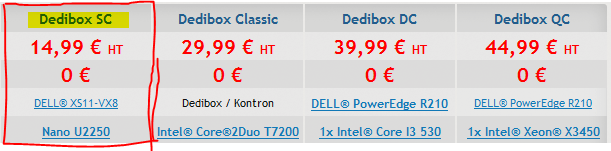
Online.net, owned by the Iliad group, is the second largest hoster in the French market. The company had traditionally been focused on the higher end of the dedicated hosting market with services starting at 29.99 euro/month and predominantly based on Dell’s rack mounted servers. About three years ago they began exploring the possibility of providing a lighter weight entry-level offering targeted at SMBs.
Online engaged Dell’s Data Center Solutions (DCS) group and the two teams began brainstorming around system designs to meet the needs of this new segment. The design that DCS came up with was the Via processor-based microserver the Dell X511-VX8, code name“Fortuna” (please note I had nothing to do with the official naming of this product :)). The system handles one OS and app per server, has one 1 CPU per server and features 12 servers per chassis.
Online.net's "START" line of offerings, beginning with the microserver enabled, Dedibox SC.
Thanks to these ultra cost-efficient systems, Online was able to provide SMB customers with an entry-level offering at half the price of their next lowest product. Not only that but this new offering allowed Online to grab significant share in the French market.
Tres tres cool et tres tres (geek) chic
If you want to see the Dell X511-VX8 in action or take a tour of Online’s datacenter and operations, all set to chill house music, check out the video below. (The rows and rows of X511s appear at the 1:40 mark and go until 2:40. You can also see a quick overview of one of the microservers themselves at the 4:36 mark).
Beyond the Dell X511-VX8
The success that Online had with the X511 gave DCS insight into the potential of the microserver market. Based on the concepts that came from the work with Online.net, DCS created a follow-on offering, code-named “Viking,” for our custom accounts.
This too was a big success, so much so that we will soon be taking this experience even broader as we look to announce our third generation microserver.
Microservers are a class of scaled-out systems that Dell’s Data Center Solutions group has been designing for customers for the last several years. These ultra-dense systems are made up of up to twelve discrete servers within one enclosure and are perfect for dedicated web hosting and telco customers.
With a little help from our friends
Take a listen to Intel’s director of cloud marketing, Raejeanne Skillern as she talks about how Intel’s been involved in this space and how the two companies have worked together in the microserver space in the past and what we may have up our sleeves.
Some of the ground Raejeanne covers
How, over the last few years, Intel has been investigating customer requirements in this space and investing in technology.
Working on delivering standards
How Dell and Intel have worked together
Keep your eyes peeled for something coming in the PowerEdge C space
One of the trickiest things to get right in an open source project is the governance model. Who makes up the various boards and gets what authority is something struggled over and something that virtually no one gets right straight out of the gate. Its particularly interesting if you are a commercial entity sponsoring a project and want to maintain a certain amount of influence over the endeavor but also want it to grow and flourish.
Two weeks ago Jonathan Bryce, Rackspace cloud co-founder and one of the leads of the OpenStack project policy board, announced the changes that were being made to OpenStack’s governance.
I ran into Jonathan on Monday during South by Southwest and sat down with him to get some more insight into what the changes were and why they were being made.
Some of the ground Jonathan covers:
From Mosso to Rackspace cloud to OpenStack
How they’ve been surprised by the great uptake by the community and how this has led them to evolve the governance structure.
What the various boards are and what their make up will be
Last week and this, Austin’s downtown has been taken over by the South by Southwest festival (SXSW). What started out nearly 25 years ago as a music festival/conference has grown to include parallel film and interactive events as well. During the event every bar and venue downtown is occupied with bands, films or tech companies showing their stuff.
Check out the mini montage below that includes a quick interview I did with Dell solutions engineer Greg Althaus right after he finished the demo.
Don’t take our word for it
Dell is currently field testing crowbar and plans to donate the code to the OpenStack community after testing. If you are interested in testing crowbar yourself, email us at OpenStack@Dell.com.
Some of the ground the video covers
Intro montage: Welcome to the Kung Fu Saloon, setting up and a snippet of the demo
[0:40] Talking to Greg
What actually is crowbar and how does it work with OpenStack compute and storage?
How fast can you spin up a cloud using it?
Where does OpsCode’s Chef fit in?
Our plan to donate this code to the community after field testing.
One small step for OpenStack, one giant step for mankind! Ok, that may be taking it a bit far but today there is some exciting news that Dell and Rackspace have announced.
If OpenStack is new to you it’s the open source cloud platform based off of the Nebula cloud code base donated by NASA (hence all the rocket allusions) and the storage code base from Rackspace. The project is now about eight months old and its community is over 50 organizations strong including NASA, Citrix, AMD, Intel, NTT, cloud.com, RightScale, Dell, Opscode and Puppet labs.
To help the community and organizations get up and going building out their own OpenStack based clouds we are announcing the following:
Proof of Concepts: Rackspace and Dell are working together to deliver an OpenStack solution to market later this year. As the first step along the way we are currently seeking customers for OpenStack proofs of concept (POC). If you are interested in learning more about the POCs and possibly participating or getting engaged, email: OpenStack@Dell.com.
Code: Dell has developed an OpenStack installer that can be used to quickly install OpenStack on bare metal Dell PowerEdge C servers. This tool is being field tested, and Dell will contribute the code to the OpenStack community once testing is complete. To help users out further, once the OS is installed, the servers can be updated with all the latest packages and be automatically configured by Opscode’s Chef to provide their services in the OpenStack infrastructure.
Technical whitepaper: A technical whitepaper, “Bootstrapping OpenSource Clouds” which lays out the design of a hyperscale OpenStack cloud on Dell PowerEdge C servers.
But wait, there’s more, “Cloud Builders”…
To help support OpenStack deployments, Rackspace announced today that its launching a new division, “Cloud Builders.” Cloud Builders “will provide training, certification, deployment services and ongoing support and management to enterprises and service providers via the team of OpenStack experts and its partner network.”
Specifically the offerings will include (taken from the Rackspace blog):
Training & Certification – Rackspace Cloud Builders will provide training classes and certification testing for designing, developing and administering OpenStack Clouds. Rackspace also plans to empower a network of training and certification experts.
Deployment Services – Rackspace Cloud Builders, in conjunction with other experts from the OpenStack community, will help customers design and deploy OpenStack Clouds.
Support & Management – Customers will have ongoing access to remote support and escalation assistance from the OpenStack specialists, including proactive monitoring and fixes.
OpenStack is picking up momentum, stay tuned for more and in the meantime, set the controls for the heart of the sun! 🙂
A couple of weeks ago, we announced the PowerEdge C6145 system made up of two servers crammed into a 2U enclosure with a total of 96 cores. Today that system officially became available for purchase.
Dell (NSDQ:Dell) has really outdone itself. On Tuesday, the company begins shipping a machine that the CRN Test Center can only describe as 2010 Server of the Year squared.
Officially called the PowerEdge C6145, Dell’s latest monster server more than doubled the Geekbench score of the reigning champ, the Dell R815.
This is from the article that SearchDataCenter.com did:
Talk about dense. Dell’s new PowerEdge C6145 server stuffs eight AMD Opteron processors in a single 2U enclosure, making it a standout for high-performance computing (HPC) and, potentially, virtualization…By way of comparison, Dell called out Hewlett-Packard’s eight-way ProLiant DL 980 G7, which has 8U and takes up four times as much space as the Dell box. This is especially important in HPC environments, which, in their scope, tend to put a premium on footprint.
This will be extremely useful for companies that want to attach lots of storage or networking to server nodes in dense configurations, or those who want to cram in a lot of cores into a box and lash them to lots of external GPU co-processors.
The C6145 is Dell Data Center Solutions group’s fourth HPC system in 12 months. Looks like we’re picking up some momentum 🙂
Earlier this month when the Bexar release for OpenStack went live, a meet up was held in Santa Clara. As a part of the event, a series of lightening talks were given by various OpenStack community members. One of the speakers was Dell’s very own Rob Hirschfeld, a senior cloud solutions architect, who has been actively involved with the OpenStack project from the get-go.
Here is the short presentation that Rob gave where he talks about some of the key characteristics of a hyperscale environment and how it differs from a traditional enterprise data center.
Monday I wrote about the announcement of our mega-beefy, 96-core PowerEdge C6145 server, specifically geared to customers solving big problems involving huge and complex data sets in mapping, visualization, simulations and rendering.
At the other end of the spectrum however are customers, such as those offering low-end dedicated hosting solutions, who are looking for systems with only enough processing and storage to serve up straight-forward, focused applications such as those for serving up webpages, streaming video etc. These “right-sized” systems are referred to as “micro” or “light weight” servers.
Take a listen to Data Center Solutions marketing director Drew Schulke below as he explains the origin of the microserver and walks you through our second generation offering in this space.
Some of the area Drew covers:
How did Dell get into the microserver market 2-3 years ago
How the progression of Moore’s law caused processing power to out strip the needs of many applications.
A walk through of our second generation microserver which packs 12 single socket servers into one 3Uenclosure.
We will continue to be making noise in this space. Be sure to tune in next time as our topic will be a mini “case study” on Dell’s first generation microserver deployed at a large hoster in France.
Today Dell Data Center Solutions (DCS) is announcing the PowerEdge C6145, number four in our line of offerings targeted specifically at High Performance Computing. This AMD-based system, which contains two four-socket servers for a total of 96 cores, ranked as the highest performing x86 2U shared infrastructure server on the market based on SPECfp_rate2006 results. In addition, the PowerEdge C6145 can deliver up to a 534% better price performance at 1/5 the cost and 1/4 of the rack space when compared to HP’s ProLiant DL980 G71.
The HPC beat goes on
When we in DCS launched our PowerEdge C line almost a year ago, our first HPC-focused machine was the Intel-based C6100. We followed it three months later with our C410x expansion chassis to supercharge it and then, three months after that, we came out with the AMD version of the C6100, the PowerEdge C6105. Now three months after that system debuted we are unveiling the C6145. All three servers come in the same 2U package but with differing chips and architectures targeted at different HPC application types.
Check out the video below and let the C6145 architect, John Stuewe take you on a quick tour of this new muscle machine.
Hairy problem solver
The PowerEdge C6145 with its 755FLOPS and up to 1T of memory is specifically geared to solving big problems involving huge and complex data sets in mapping, visualization, simulations and rendering, and solving them faster. With regards to efficiency, the shared infrastructure design of the system can reduce the number of individual fans by 1/4 compared to traditional 2U systems with less power needed to cool and resulting in higher performance per watt, per dollar.
Super charge it
As if 96 cores packed into 2U wasn’t powerful enough, you can take your workloads “to 11” with the help of the PowerEdge C410x. The C410x PCIe expansion chassis allows you to double the server to graphics processing unit (GPU) ratio to 1:8 to create a number-crunching uber powerhouse.
Dell DCS has been listening to their HPC customers and rolling out systems to meet their needs, today we’ve announced the latest in our line up, the PowerEdge C6145.
1 Based on testing by Dell Labs. Dell PowerEdge C6145: SPECfp_rate2006 of 1310 in 2U as compared to HP ProLiant DL980 G7: SPECfp_rate2006 of 1080 in 8U. SPEC® and the benchmark name SPECfp® are registered trademarks of the Standard Performance Evaluation Corporation. Competitive benchmarks stated above reflect results published or submitted to www.spec.org as of Feb 14, 2011. The comparison presented above is based on the best performing 8-chip x86 servers. For the latest SPECfp_rate2006 benchmark results, visit http://www.spec.org/cpu2006. Actual performance will vary based on configuration, usage and manufacturing variability.
In case you’re not familiar with it, Dell’s Data Center Solutions (DCS) group has been around for nearly four years, acting as a “custom tailor” to some of the largest internet superstars and scale-out leaders, organizations like Facebook, Microsoft Azure and Lawrence Livermore national labs. A year ago DCS added to this custom capability by bringing out a line of specialized servers paired with software solutions targeted at the tier of customers right below these “biggest of the big.”
A changing of the guard
Last March, Roy Guillen took over the helm as the General Manager of the DCS group when the then current GM, Forrest Norrod was promoted to run all of servers at Dell. Near the end of the year I sat down with Roy to get his thoughts on what made DCS, DCS and learn what success looked like for him.
Some of the ground Roy covers:
His Background
[0:49] What makes DCS unique within Dell and the industry
[2:01] The customer story that best sums up DCS
[3:25] The one thing that isn’t well known about DCS
Last November, Dell announced the Dell Cloud Solution for Web Applications. This turnkey offering is composed of Dell systems and Joyent Software along with a reference architecture all supported by Dell services. This solution enables a private Platform as a Service (PaaS) environment to support the development and testing of languages such as PHP, Perl, Python, Ruby and Java.
This solution is designed for hosters and telcos who are looking to provide public PaaS offerings. An example of this is Uniserve, a Canadian Internet services provider. Uniserve has adopted the Dell Cloud Solution for Web Applications to offer on-demand access to a high-performance Internet application and consumer delivery platform, for customers to develop iPhone apps to commercial storefronts, to hosting and delivering Software-as-a-Service.
Check out the short video above where Dell Data Center Solutions architect Brian Harris provides a high level overview of the Dell Cloud Solution for Web Applications architecture.
A while ago, as a follow-up to our white paper “Laying the Groundwork for Private and Public Clouds” Dell and Intel worked with CIO magazine to put together a Tech Dossier that picked up where our previous paper left off.
Here are a few paragraphs from the white paper to whet your appetite:
For many enterprises, building a private cloud is simply the next step on an evolutionary path that began with data center consolidation. When a company has established a strong virtualization underpinning and is working with traditional enterprise applications, an evolutionary approach to the private cloud makes perfect sense…
In some instances, however, taking what Dell refers to as a “revolutionary” approach to private clouds will be more efficient and much more appropriate. The revolutionary approach makes use of “new world” applications that are written for and deployed in the cloud. These cloud-native applications are designed from the ground up for greater scalability and use across a multitude of servers…
The revolutionary approach requires a new way of thinking about the cloud, but one that Van Mondfrans says enterprise IT executives should undertake sooner rather than later. “This is where the application paradigm is going,” he says…
You can access the document here (no registration required :).
Dell’s Data Center Solutions (DCS) group has some pretty colorful folks. One of the more interesting members is Jimmy Pike, the man IDG New’s James Niccolai refered to as the “Willy Wonka of servers.” Jimmy, the self-proclaimed “chief geek” of the DCS team is the consummate tinkerer whether that involves constructing a data center in a brief case or thinking of new ways of driving down data center power consumption by leveraging alternative forms energy.
Last Spring I visited Jimmy’s home to check out what he was working on in his “free time.” Here’s what I saw (he keeps telling me he’s got much cooler stuff since I shot this so I may have to do a “geekquel”)
Some of the things Jimmy show us:
The low-power chips he’s playing with
His experimentation with user interfaces and superman glasses
His mini rack of servers
The various forms of desktop virtualization and OS’s he uses


 Posted by Barton George

 Barton's Blog