Sputnik 3 — Great Reviews from the Blog-o-sphere

January 29, 2014

At the end of last year we launched the third generation of the Dell XPS 13 Developer Edition, aka Sputnik 3, which features the 4th generation Intel processors.  This Ubuntu-based laptop is the third in a line of developer focused systems which began life as the internal skunk works effort, “Project Sputnik.”  Thanks to strong community input and support the project became a product a little over a year ago.

Over this past month there have been three great reviews that have come out that I wanted to share.

1) Dell XPS 13 Developer Edition review (Haswell, late 2013 model)

This first review, from J’s blog, is quite detailed and comprehensive.   It has great photos and got nice traction on Hacker News.  Here is the opening paragraph

The XPS 13 Developer Edition, aka “Project Sputnik”, is a laptop with a FullHD 13-inch screen, backlit keyboard, SSD, 4th gen intel CPU and comes pre-installed with Ubuntu 12.04 LTS.

What makes this machine so interesting is not so much that Ubuntu comes pre-installed on it (it would be easy for anybody to install it him/herself, after all), but rather that Dell put some extra-work in making sure everything works right out of the box and supports running Ubuntu on it. WiFi, keyboard backlight, screen brightness control, sleepmode, etc. are guaranteed to work. [read more]

2) Guide to Leaving Your Mac Laptop

Carin Meier not only reviewed the XPS 13 developer edition but walks folks who may be interested in leaving their Macs behind how she set up her programs that she uses on a daily basis.  This blog too has great pics.  Carin’s blog starts,

I felt like I was in a controlling relationship headed downhill. After two custom laptops returned for defective hardware, I wanted to leave. But leaving didn’t seem so easy after living in the walled garden of Apple all those years.

This blog post is about how to leave your Mac and return to OSS.

There are quite a few nice alternatives to the Mac Air out there. I decided to go with the new Sputnik 3. Some of my reasons:

  • Powerful – New Haswell processor
  • 13.3 inch touch display with 1920 x 1080 resolution
  • Ships with Ubuntu 12.04 (64 bit)
  • Nice design (yes looks are important) [Read more]

3) Got me a Dell XPS 13 Developer Edition

The third review, by David Pollack, is actually a twofer in that he posted a follow on entry,  Still Liking the XPS 13 Developer Edition, two weeks after the first.  David’s posts are succinct and well laid out and I love his concluding paragraph 🙂

Just buy one

If you’re doing development like Clojure and Java, then the XPS 13 Developer Edition is a better choice than the MacBook Pro. It’s less expensive and just as impressive hardware-wise. And I like Linux a lot more than OS X. [Read more]

Extra-credit reading

Pau for now…


Consumerization: setting the bar for IT

January 28, 2014

Mark Stouse of BMC has asked various people in the industry to answer seven short questions for his series Marking Predictions for 14.  The questions are around Cloud Computing, Big Data and Consumerization.

To give you a taste of what I was thinking about, here is my response to the second question and why I think Consumerization is a big deal:

Cloud Computing, Big Data or Consumerization: which trend do you feel is having the most impact on IT today and why?

Consumerization, because it sets the bar for how technology should look and be designed.  Workers want technology in the workplace that is as easy to use and intuitive as the consumer applications and tech products they use at home.  Consumerization has set a high bar for IT but one that I believe will ultimately benefit all involved through greater adoption, satisfaction and productivity.

You can see my complete responses on Mark’s blog and learn, among other things, why I think Tony Stark is like big data.

Pau for now…


“New Age of Apps” Think Tank to be streamed Live

January 21, 2014

On Thursday, January 23 Dell services will be hosting a think tank in Silicon Valley at the venture capital firm NEA.  While hosted in the Bay Area, the event will be streamed live for viewing around the world.

The title of the Think Tank is “The new age of apps and delivery gaps” and we have put together a group of 10 panelist that we feel represents a cross-section of technology and IT today:

  • Barry Libenson-SVP and CIO,  Safeway
  • Jay Ferro – CIO, American Cancer Society
  • Ranga Jayaraman- Associate Dean & CIO,  Stanford GSB
  • Luke Kanies – Founder & CEO, Puppet Labs
  • Alex Salazar – Co-Founder & CEO, Stormpath
  • Alex Williams – Blogger & Journalist, TechCrunch
  • Michael Cote – Research Director, Infrastructure Software at 451 Research
  • Sarah Novotny- Tech Evangelist, NGINX
  • Das Kamhout – IT Principal Engineer, Intel
  • Jimmy Pike – Sr. Fellow and Chief Architect, Dell

I will be acting as the moderator of the panel.

Join in

The event will begin at 9AM Pacific Time, and last for three and a half hours. The event will be divided into two main sessions and we’ll discuss such topics as the influence of application developers, the changing role of the CIO and why firms need to build API strategies  (see the session outlines below for more details)  You can follow and contribute questions and comments via Twitter at #TheAppGap.   Hope you can make it!

Session Outlines

Session 1- Welcome to the application-centric world – best practices in the ‘greenfield’    

The rise of cloud applications force companies to reevaluate their business architectures.  Leveraging new platforms, organizations can operate more efficiently, better engage with customers, and introduce innovative products and services faster than ever before.  In this session we’ll discuss and debate how to effectively leverage the best of today’s advanced (digital) technologies and capitalize on the opportunity for a ‘greenfield’ approach.

*Questions

  1. What would you do different to be ready for the digital age?  Entrepreneurs starting a company today, what are the architecture and design choices you’d recommend?
  2. What plans would you put in place to leverage cloud, big data, mobile and social media?  What would your API strategy be?
  3. How would you plan for growth over a 3-5 year horizon?

Session 2: Nexus of forces – CIOs under pressure and the rise of the enterprise developer

While CIOs are under pressure to reduce costs and improve efficiency, enterprise developers have become the new ‘kingmakers’ leading product development and customer applications.  Our experts will share experiences in managing these complex stakeholder relationships, brainstorm the way out from technical debt and examine the possibilities within existing applications.

*Questions:

  1. How do organizations evolve legacy existing environments to take advantage of emerging trends – what are the breakthrough processes and technologies?
  2. What does the CIO needs to do to re-connect with business leaders and organizational strategies? What roles do CIOs, CTOs, business and developers play?
  3. How do established companies take advantage of the changes that are happening today?   i.e. private/public cloud strategies, apps modernization, leveraging new architectures, API strategies.

Pau for now…


DevOps Days NYC — When DevOps goes wrong

January 9, 2014

One the most enlightening and entertaining presentations on Day one of DevOps Days NYC, was given by ScriptRock cofounder, Mike Baukes.

In his presentation, which is embedded below, Mike talks about a devops project he was on in Australia.  He and his team were brought in to a large trading firm to implement continuous delivery and integration, they got the code right but made a few critical mistakes.

Listen to Mike as he tells his cautionary tale.

Some of the ground Mike covers

  • Their charter and goal on the project
  • The team they created and the alienation it resulted in
  • What went wrong
  • How would he do it if he could it over again

Extra-credit reading

  • ScriptRock GuardRail, First Take: Cloud-based server monitoring and diagnostics – ZDNet

Pau for now…


DevOps Days NYC — Jonathan Reams of MongoDB

January 8, 2014

As I continue in my series of videos from DevOps days NYC a few months ago, here is an interview with Jonathan Reams of MongoDB.

Johnathan is systems engineer on Mongo’s DevOps team and is helping to make MongoDB, the NoSQL non-relational database, more appealing to operations.

Some of the ground Jonathan covers:

  • Mongo’s huMONGOus recent round of funding
  • As a NoSQL database, how is Mongo different from traditional relational databases
  • How does MongoDB compare to other non-relational databases like Couchbase or Basho’s Riak
  • Seeking to widen appeal beyond developers to operations
  • Whats next for Mongo for both developers and ops

Extra-credit reading

  • Military Supply Data Search Tool Uses MongoDB – InformationWeek
  • MongoDB grabs $150M in funding, now top NYC startup at $1.2B valuation – VentureBeat

Pau for now…


DevOps Days NYC – Mark Burgess of CFEngine

January 7, 2014

In my last entry, I featured an interview with SaltStack, the newbie in the infrastructure automation and configuration management space.  Today’s interview is with the man who started it all back in the 90’s, Mark Burgess, Founder and CTO of CFEngine.

Some of the ground Mark covers

  • How it all began a couple of decades ago at the University of Oslo
  • As scale has increased over the last twenty years, how has CFEngine kept pace
  • Inducted in JP Morgan’s Hall of Technology and how JP Morgan uses CFEngine
  • How does CFEngine differ from the other configuration management tools?  (hint: think model-based frameworks)
  • What does the next year hold for CFEngine

Pau for now…


DevOps Days NYC: Mike Ainsworth of SaltStack

January 7, 2014

Infrastructure automation and configuration management have become a hot topic as organizations, particularly those in the web and cloud space have continued to scale out. The first player, that helped define the space, was CFengine.  Heavy weights in this space now include Puppet and Chef, and at Dell we lead, Project Crowbar, an open source effort in this area.

The new kid on the block, based in Salt Lake city, is SaltStack.   Although relatively new, they count LinkedIn as one of their users.   At DevOps Days NYC back in October I grabbed some time with Salt solutions engineer, Mike Ainsworth.  Here is what Mike had to say:

Some of the ground Mike covers

  • What does SaltStack do
  • When did they get their start and how has their momentum been
  • How they differ from the other players in the space
  • How Linkedin is using SaltStack
  • The technical details re what they are focusing on going forward

Extra-credit reading

Pau for now…


Barton’s Blog — 2013 in review

January 6, 2014

A bit gratuitous, but  here is the 2013 annual report for my blog prepared by the WordPress.com stats helper monkeys.

Here’s an excerpt:

These are the posts that got the most views in 2013.

  1.  Sputnik 2 is here: Dell XPS 13 Developer Edition goes 1080p and lands in Europe 217 COMMENTS February 2013
  2. Introducing Sputnik 3 and its unofficial big brother  92 COMMENTS  November 2013
  3.  Game on! Ubuntu comes to Alienware 13 COMMENTS April 2013
  4. Available online in Europe, the Dell XPS 13 Developer Edition 106 COMMENTS  March 2013
  5.  Introducing Project Sputnik: Developer laptop 335 COMMENTS  May 2012

Click here to see the complete report.

Pau for now…


DevOps Days NYC: Mark Imbriaco of GitHub

January 6, 2014

Here is the first in a series of interviews I conducted in October at DevOps Days NYC.  My first interview is with Mark Imbriaco, ops dude extraordinaire at GitHub who previously ran ops for 37signals, Heroku, and LivingSocial.

GitHub, if you’re not familiar with it is a code hoster that boasts around 5 million users and close to 10 million individual repositories.  Through the magic of its “pull request” feature it has vastly increased participation in open source projects and accelerated innovation.  Listen to Mark and learn more.

Some of the ground Mark covers:

  • How did GitHub rise to prominence and eclipse SourceForge as the developer repository of choice
  • Success Metrics
  • GitHubs architecture
  • What are GitHubs challenges as it moves forward
  • How the “pull request,” the killer app of GitHub, work

Extra-credit reading:

Pau for now…


Cloud Beat: Talking to Founder of CloudVelocity

January 6, 2014

With the New year I’m finally getting to a backlog of cool interviews I did last quarter.   The first is the last of the interviews I conducted at Venture Beat’s CloudBeat back in September with the CTO and Founder of CloudVelocity, Anand Iyengar.  CloudVelocity provides automated cloud migration and disaster recovery software.  Take a listen to what Anand has to say.

Some of the ground Anand covers:

  • What is CloudVelocity?
  • What areas does it focus on?  (Hint: test/dev, migration, disaster recovery)
  • How Anand and the other founders came up with the idea for CloudVelocity
  • What’s on the agenda as they move forward

Extra-credit reading

  • CloudVelocity: Launch apps to cloud with no change to code – Network World

Pau for now….


Sputnik 3 online in Europe just in time for Holidays

December 20, 2013

Last month in the States we announced the availability of Sputnik 3, the XPS 13 XPS13-DEDeveloper Edition featuring the 4th generation Intel processors. This laptop, which is touch-enabled, is replacing the existing XPS 13 Developer Edition.

We had hoped to make the offering available online across Europe a couple of weeks about but a few online glitches kept us from making it so.

Various countries have been coming online recently and today I would like to announce that the XPS 13 developer edition is available (see below for the specs) in the following countries/languages:

Sputnik 3  (XPS 13 Developer Edition) Product specs :

  • Processor: 4th generation Intel i7
  • Display: 13.3″ Full High Definition touch display (1080p)
  • System memory: 8GB
  • Graphics: Intel HD graphics 4440 (HD 5000 in the case of the enterprise version)
  • Hard drive: 256GB SSD drive
  • Standard Service: 1 year Dell ProSupport and onsite service after remote diagnostics
  • Operating system: Ubuntu 12.04 LTS
  • Community projects: Cloud launcher and Profile tool (for more info see the update from last week)

Thanks for your patience and happy holidays!

Extra-credit reading

Pau for now…


Insight into the technology behind Goldman Sachs

December 17, 2013

Last week I attended the Gartner Data Center conference in Las Vegas.  I went to talk to customers, do booth duty (I talked about the app-centric world and how IT can best respond to it) and check out a few sessions.

The best session I attended was a power-point-free discussion with Don Duet, Co-head of Goldman Sach’s Technology division.  Below are a few of the things that Don talked about and comments he made which I thought were particularly interesting.  It’s not just web companies that are pushing the technology envelope.

Goldman’s Technology

  • Goldman Sachs’ has 36,000 employees, 6,000 of which are developers (10,000 people in tech overall).  They have 30 PB’s of data.  They support their employees with half a million cores.
  • Goldman builds their infrastructure around their applications
  • Goldman’s four Big Bets
    • Commodity computing
    • Software defined everything
    • Drive everything in infrastructure from an application perspective
    • Open Source and Open Standards
  • Don and team do an exercise where they talk about how they would architect Goldman if they were starting fresh today (“Goldman 2.0”)
  • “It’s harder and harder to tell where the business stops and IT begins”
  • “Most of our infrastructure should be able, over time, to migrate to the public cloud (once security gets better)”

Extra-credit reading

Pau for now…


IDC predicts fierce battle for developers in 2014

December 16, 2013

A couple of weeks ago IDC put out their predictions for 2014, saying “2014 Will Be a Year of Escalation, Consolidation, and Innovation as the Transition to IT’s “3rd Platform” Accelerates.”

The part that really caught my eye was the the second half of the following sentence:

“In 2014, we’ll see every major player make big investments to scale up cloud, mobile, and big data capabilities, and fiercely battle for the hearts and minds of the developers who will create the solutions driving the next two decades of IT spending.” —  Frank Gens, Senior Vice President and Chief Analyst at IDC

We have entered the app-centric world and companies that don’t seek to understand or serve developers will, at best,  find themselves at a severe disadvantage.

Pau for now…


Update: Project Sputnik Profile tool

December 11, 2013

About a month ago I blogged that, with renewed vigor and resources, we were tackling the Project Sputnik Profile Tool – a tool that enables a developer to quickly set up an environment without cluttering up their system. The announcement included a new collaboration with the folks from Docker and a request for feedback from the Community by December 3.

That date has now passed and Peter Owens, who is the project manager for the Profile Tool effort, has collated the feedback and mapped it against our vision for the tool and our minimum requirements.

(When not managing the profile tool effort Peter, as Director of Software Engineering in Dell Services, leads a development team responsible for the delivery of Managed-Private Clouds to global customers and expanding Dell’s OpenStack /DevOps development capability. Peter is based Dell’s Cloud Centre of Excellence in Dublin Ireland.)

Here is Peter’s  summary:

What we’ve learned

It is clear that you believe we are on the right track with the Profile Tool and that our plan to leveraging Docker will allow users to set up environments with minimum impact on system resources.

Where the feedback became very interesting was in the following areas:

1) project lifecycle

We need to define user stories for the following scenarios:

  • where the tool is re-run or a project has already been setup by a user
  • the project definition is changed
  • adding and removing packages
  • handling changes to languages or frameworks pulled into a project

2) User specific configurations

  • to avoid conflicts, profiles should not be keyed solely on username

3) Specifying language versions

  • we need to specify language versions within potentially multi-project environments
  • users should be able to specify the language version from within a project

It was generally felt that separating out usernames, packages and config definitions was the correct approach. There were also some useful comparisons with other tools such as Boxen which enables you to centralize your configs for an entire organization. This means a “template” can be created for new hires or groups of developers.

 A Big Thanks and Next Steps

We are very grateful to those who took the time to contribute, share this initiative with their respective communities and provide feedback. Based on the feedback we’ve received we have started working on user story requirements which we hope to have done by the end of the year.  After that we will start coding in January.

As you’d expect we will be using a GitHub central repository where all the code can stay in sync. Code changes will be committed to this and other developers will pull them (sync them to their local repository). To start with we will be providing read-only access to the central repository, so the community will be able to keep track of our progress!  Once we get a little further along we will open up the repository for others to jump in.

Stay tuned and thanks again!

Extra-credit reading

  • Dell aims for cloudy orbit with Sputnik Ubuntu developer project – The Register

Pau for now…


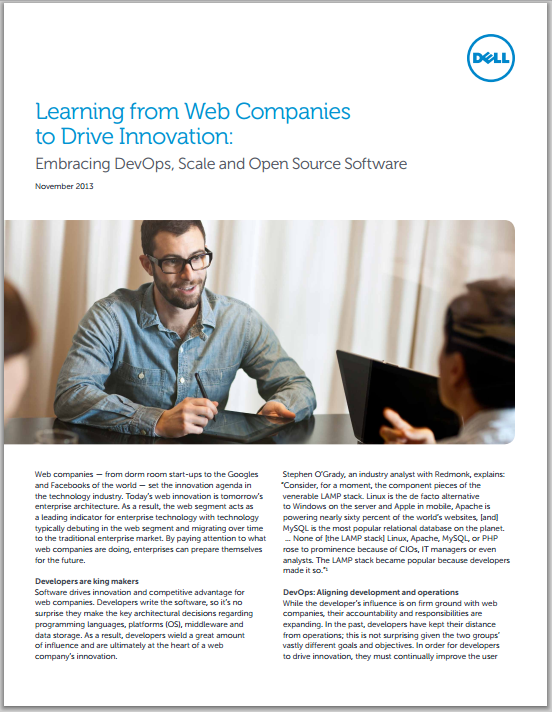
Whitepaper: Learning from Web Companies to drive Innovation

December 4, 2013

Web-WhitepapercoverToday I finally get to debut a white paper that Michael Cote, now of the 451 Research, and I started quite a while back:

Learning from Web companies to drive Innovation – Embracing DevOps, Scale and Open Source Software

The basic theme of the paper is that Web companies set the agenda for the IT industry and enterprises can benefit by understanding and following their practices

The paper’s key themes:

  • Web companies are characterized by Open Source software and a three-tiered architecture:
    • A scale out infrastructure
    • A data tier that utilizes big data
    • An application tier supported by a proliferation of development languages
  • Developers are kingmakers and must be supported and allowed to innovate
  • DevOps is a key trend that brings developers and operations together to reduce friction and increase velocity

If this looks at all interesting, please check it out.  It should be a quick read and hopefully we’ve written it in away that is accessible to a wide audience.

Extra-credit viewing

Pau for now…


Introducing Sputnik 3 and its unofficial big brother

November 15, 2013

Sputnik3

Sputnik 3

First, a little background.  Nearly a year ago today we launched the first Dell XPS 13 Developer Edition.  This Ubuntu-based client-to-cloud platform was the result of an internal skunkworks effort, Project Sputnik.  Thanks to strong community input and support the project became a product.

Within a few months of launching the initial XPS 13 Developer Edition (Sputnik 1), we introduced “Sputnik 2” solving for the biggest issue with the first release, monitor resolution.

Today we are announcing the availability of Sputnik 3, the XPS 13 Developer Edition featuring the 4th generation Intel processors. This laptop, which is touch-enabled, will replace the existing XPS 13 Developer Edition.

ubuntu_black-orange_hexAnd since we’re talking about systems and Ubuntu, in response to the continuous requests for a more powerful version of the Developer Edition, we have taken the first steps by doing some testing on the Precision M3800 and posting the results.

This system news is on the back of our announcement earlier this week about the relaunching of the Profile Tool effort and our request for input from you all.

The Sputnik 3 Product specs are as follows:

  • XPS13-DEProcessor: 4th generation Intel i7
  • Display: 13.3″ Full High Definition touch display (1080p)
  • System memory: 8GB
  • Graphics: Intel HD graphics 4440 (HD 5000 in the case of the enterprise version)
  • Hard drive: 256GB SSD drive
  • Standard Service: 1 year Dell ProSupport and onsite service after remote diagnostics
  • Operating system: Ubuntu 12.04 LTS
  • Community projects: Cloud launcher and Profile tool (for more info see Tuesday’s update)

Availability of Sputnik 3

Starting today the updated XPS 13 Developer Edition is available in the

Pricing for the system will not increase and will remain $1,549.99

Early next week the Developer Edition will be available in Canada.

For North America, the US and Canada, in addition to the i7 configuration, there will also be an i5/128GB config  that will be available on a build-to-order basis and priced at $1249.99.

By the end of November, the Developer Edition will be available in

[Update 12/20/13: Sputnik 3 now available in Europe]

  • United Kingdom
  • Ireland
  • France
  • Germany
  • Austria
  • Spain
  • Netherlands
  • Italy
  • Switzerland

Europe – Wave 2:  Available in December

  • Belgium
  • Denmark
  • Norway
  • Sweden

Testing Ubuntu on the Precision M3800 mobile workstation

While the XPS 13 has proven to be very popular with developers, since we started

Dell Precision M3800

Dell Precision M3800

project Sputnik there has been a group in the community that has been asking for a “big brother” for the XPS 13 developer edition, i.e. a system with 16GB of RAM that offered a larger screen and more horsepower.

With the above in mind, when Project Sputnik team member Jared Dominguez learned about the sleek new  Precision M3800 that was coming out, he finagled his way into getting a system to do some testing.

You can find Jared’s detailed results here but the net is “For the most part, everything [he] tested works,” the one exception being the SD card reader.   The resourceful Jared then shipped his system to Chris Ball, a buddy of his that maintains the SD/MMC/SDIO subsystem of the Linux kernel, and who graciously agreed to volunteer time debugging the Linux driver for this card reader.  We will keep you updated on the progress.

So while Jared’s testing is not official it should be enough to get most devs going running Ubuntu  on the M3800.  And like the initial project Sputnik offering, if we get enough positive feedback, we might be able to offer it as an official pre-installed offering.

Extra-credit reading

Pau for now…


Project Sputnik Profile Tool: Dell commits engineering resources, Docker joins the cause and we want your input!

November 12, 2013

Sputnik_Sticker_FinalWhen we first introduced Project Sputnik over a year ago we talked about two community projects: the profile tool and the cloud launcher.  We garnered a fair amount of attention and made some progress but unfortunately not as much as I would have liked.  I am very happy to report therefore that recently we have put together an intrepid group of developers and architects within Dell to pick up the profile tool charge.

While we’ve had a few false starts in the past, besides the addition of committed Dell resources, there are a couple of other things that set this time apart: 1) we are starting from an internal use case and 2) we are working with and leveraging some of the work of Docker.

And just like when project Sputnik originally kicked off, we want to get your input and feedback on the Profile Tool and its direction (see a few paragraphs down for what specifically we are looking to you all for).

Internal need

Scratching your own itch is a key component to any self-respecting open source project. Read on to see where ours came in. A group within the Enstratius team, which we acquired back in the Spring, is switching to Sputniks (Dell XPS 13 developer edition) as their primary laptop. One thing that team member John Vincent was tasked with doing was getting these new systems set up quickly for the team. He was looking for a way to automate the process when his boss suggested he check out what we were hoping to do with the profile tool.  John liked what he saw so much that he joined the team.

Besides this representation from the Enstratius team, the Sputnik team also includes members from Dell Services’ office of the CTO and the Dell Cloud Services development and architecture team.

Working with the Docker crew

DockerRather than re-inventing the wheel, and to help provide perspective, we are now working with the folks from Docker.  They will be giving us their feedback, helping with integration and creating a Go profile.

As their CEO Ben Golub said, “The Dell team has delivered real benefits for the developer community through Project Sputnik and we expect same from the profile tool. We’re committed to working with their team to provide the best possible integration with Docker so those benefits continue to grow.”

Profile tool: Some details and a quick POC

The idea behind the profile tool is to enable a developer to quickly set up an environment without cluttering up their system.  This applies whether it is a “clean” computer for a new hire or a new project for an existing team member where the developer needs to use a new language or tool-chain.

A profile is basically a collection of simple YAML files, stored in a pre-determined directory structure, which specify one or more of the following:

  • Language:  a programming language e.g. Python, Ruby, JavaScript
  • Framework:  a language-specific software platform which simplifies the programming task (e.g. Django, Rails, Node.js)
  • Library:  an additional software component, such jinja2 or numpy for Python
  • Service: a software service used by the project, such as a database or message queue

To use a profile, it is downloaded to the developer’s machine, and an isolated environment (Linux container) is automatically created using Docker if it is part of the profile.

Input from the community

Here is the Profile Tool repository on Github and to give you a feel for how the profile tool might work, here is a quick POC (note that these actions aren’t actually being executed. We’re just logging them as if we were).

We would love to get your input. Some of the different ways you can contribute are as follows:

  • Open issues on this repository with suggestions on proposed definition syntax
  • Fork the repository and propose your own definition for a language
  • Share this initiative with your respective communities
  • Offer insight into how your community or company can use this
  • Be honest and tell us what works and what doesn’t

While almost everything is open to modification, we have a few small requirements.

  • The definition format MUST be YAML. YAML was chosen because it allows the appropriate data structures, is both human- and machine-readable and allows comments
  • Respect the goals of minimalism and composition defined above
  • This is based on Ubuntu 12.04 amd64 (for now) as the primary use case is for inclusion in the Sputnik laptop

We will be soliciting feedback for the next three weeks so please get us your thoughts by December 3.

What about the cloud tool?

We haven’t forgotten about the cloud tool, which allows you to deploy your applications to the cloud.  While you can currently use Linux containers and JuJu to get your apps into the clouds, we are working on a version that will provide even greater automation.  This will be phase II after we get the profile tool a bit further along, stay tuned!

But wait, there’s more…

If you’re interested in Project Sputnik you’ll want to watch this blog which will be bringing some more news in the not too distant future. 🙂

Extra-credit reading

Pau for now…


Talking SwiftStack with Founder and CEO Joe Arnold

November 11, 2013

At Venture Beat’s CloudBeat I moderated two panels, the first was with PayPal and Puppet Labs and the second was with Disney, CloudStack and SwiftStack.

After the Disney panel I grabbed some time with SwiftStack’s CEO and Founder Joe Arnold.  SwiftStack is based on the OpenStack storage project, Swift, and helps operations teams implement and manage an easy-to-use, multi-tenant and highly scalable private cloud storage platform.

Take a listen to what Joe has to say:

Some of the ground Joe covers

  • [0:20]  What is SwiftStack?
  • [0:56]  Where did Joe get the idea for SwiftStack
  • [2:15]  What additional pieces does Swift Stack add to OpenStack’s Swift project?
  • [3:26]  What is coming down the pipe? (Spoiler alert, it has to do with Erasure coding and Storage policy)

Extra-credit reading

  • Full Support for Global Clusters Now Available in OpenStack Object Storage – Syscon media
  • OpenStack Object Storage (“Swift”) – Wiki

Pau for now…


Automating the Cloud: Talking to the Puppet Master

November 7, 2013

In the cloud you can turn on 100s or 1000s of servers at the click of a mouse, but what happens when you want to configure them?  If you do it by hand it will take you months if not longer.  That’s where Puppet comes in, an automation tool that allows you to configure and manage legions of servers.

Back in September, at Venture Beat’s CloudBeat I moderated a session with Stan Hsu of Paypal and Luke Kanies, CEO and Founder of Puppet labs.  During the session Stan talked about how Paypal used Puppet to automate their processes and increase responsiveness to the business.

After the session I grabbed some time with Luke to learn more about Puppet.

As Luke explained,  as we have moved to cloud-scale the need for automation has continued to rise.  With the cloud the rate of change continues to increase and time to value is what you compete on.  As a result, shortening the amount of time between when your developers finish coding and your customers get access to those services is critical.  Anything that lengthens that time is friction and the name of the game is reducing friction and increasing velocity.  As Stan of paypal explained during our session you want to constantly examine your processes for bottle necks and then automate them.

With a tool like Puppet sysadmins can automate processes and move beyond the table stakes of providing a stable and secure environment and become more responsive to the business and ultimately the customer.

Some of the ground Luke covers in the above video:

  • How did Luke get in the automation game and where did the idea for Puppet come from?  How form the start his goal was to make a tool that the vast majority of people could use, not just the gurus.
  • 2:38 How have things changed in the eight and half years since he started Puppet?
  • 4:46 Who are the primary users of Puppet?  Why DevOps is poorly named and why it’s so important for sysadmins and operations.

Extra-credit reading

Pau for now…


LinkedIn stitches together single pane of glass with Dell Boomi

September 18, 2013

Here’s the next in my series of interviews from VentureBeat’s CloudBeat, held last week in San Francisco.

After his panel, I got a chance to chat with Andres Bang, head of global sales and operations systems at Linkedin.  I talked to Andres about how they used Dell Boomi to integrate their cloud and on premise applications, along with their CRM platform SalesForce.

Andres told me, “Dell Boomi is doing to the integration industry what SalesForce did to the CRM industry 10 years ago,” hear what else he had to say:

Some of the ground Andres covers:

  • What Andres does and the goals of his group within LinkedIn
  • Looking for a way to expand their SalesForce platform with custom applications
  • Stitching together SalesForce, databases, tools and custom apps with Dell Boomi.  “Integrations which used to take months or years are now talking days or weeks.”
  • What specific apps and data types is LinkedIn using Boomi to connect to SalesForce to provide a “single pane of glass” for sales

More Cloudbeat videos to come

Stay tuned to this blog for interviews with

  • Luke Kanies — Puppet CEO
  • Joe Arnold – CEO of SwiftStack
  • Anand Iyengar – Founder of CloudVelocity

Extra-credit reading

Pau for now…