Project Sputnik to go from Pilot to Product

July 18, 2012

A couple of weeks ago we announced a Beta program for the four-month old Project Sputnik — an effort to investigate creating a developer focused laptop based on Ubuntu and Dell’s XPS13 laptop.

Since the beta announcement we have received thousands of applications from around the world.  This tremendous response, on top of fantastic amount of input we have received on the Project Sputnik storm session, has convinced us to take this project from pilot to product.

This fall we will be offering an Ubuntu 12.04LTS-based laptop pre-loaded on Dell’s XPS13 laptop.

Going from skunk works to mainstream

Back in the Spring, project Sputnik was the first effort green-lighted by an internal incubation program at Dell.  Thanks to the incubation program we got a little bit of funding and some executive advisers.  This incubation program notwithstanding, project Sputnik  has been a pretty scrappy skunk works effort to date.

The idea behind the incubation program is to harness that scrappiness and inventiveness to explore & validate new ideas & products outside mainstream Dell processes. Thanks to the tremendous amount of support both outside (you, the community!) and inside Dell,  with today’s announcement, we will begin making our transition to an official, “mainstream” Dell product.

  I should also mention, if its not obvious, that we have not been doing the work alone. Canonical  has been “scrappin” right besides us, helping to drive the project and doing a ton of engineering on the software side.

Beta program

As I mentioned at the start we have been completely blown away by the number of applications we have received.  We’re currently working through logistics of how to handle the tons of applications, we’ll notify all applicants soon, and intend to keep that process and the future product aligned with the spirit of the program.

To make sure that we are listening to your ideas, please continue to post any thoughts about what you would like to see in a developer laptop on our Storm session.   If you have an XPS13 running Ubuntu and want to share your experience or report a bug or issue, see our forum on Dell Tech center.

For more information on the program see the Project Sputnik FAQ

Thanks everyone for all the interest and passion, stay tuned as we push forward!

Reference: current solution details

Hardware

The solution is based on the high-end configuration of the Dell XPS13 laptop.

Software

Available now

  • drivers/patches for Hardware enablement
  • basic offering of key tools and utilities

Coming soon

  • Profile tool: a software management tool to go out to a github repository to pull down various developer profiles e.g. javascript, ruby, android.
  • Cloud tool: will allow developers to create “microclouds” on their laptops, simulating a proper, at-scale environment, and then deploy that environment seamlessly to the cloud.

Extra-credit reading

  • Press release: Dell Demonstrates Commitment to Open Source Software, Developer Communities
  • Dell Tech Center: Sputnik wiki
  • PC World — Dell’s Ubuntu‬ Laptop Program Enters Beta, ‘Blows Away’ Expectations
  • Initial thoughts on Project Sputnik from O’Reilly’s Mike Hendrickson
  • Transcript from last week’s Sputnik chat on Tech Center

Pau for now…


Announcing project Sputnik Beta program

July 2, 2012

Last week project Sputnik got an official presence on dell.com.  While the project is still a skunk works effort rather than a product, we are rapidly gaining traction within the company.

If you’re not familiar with project Sputnik, its a laptop pilot targeted at developers and based on Dell’s XPS13 ultrabook and Ubuntu 12.04LTS.

The new page points you to where you can buy an XPS13 (unfortunately still pre-loaded with Windows at this time), where you can get the image to load, where you can offer suggestions, read about people’s experiences and where you can sign up for a beta unit.

Be a Beta Cosmonaut

If you are interested in getting your hands on a project Sputnik beta unit we are now recruiting volunteers for the Sputnik Beta Cosmonaut program (and yes we know the original Sputnik was unmanned, we’re taking artistic license here).  A limited number of applicants will be selected to receive a discounted, beta version solution (Dell XPS 13 Ultrabook with Ubuntu 12.04LTS pre-loaded).

If selected, all we ask is that you use the system regularly and give us your honest feedback on the project Sputnik forum.  It will be interesting to see if we get five people applying to be cosmonauts or 5,000.  Stay tuned…

To apply, please fill out this form.

Project Sputnik forum and wiki

Along with a landing page on dell.com, we recently launched a project Sputnik presence on Dell TechCenter.  On TechCenter, you can find a Sputnik wiki as well as the forum I mentioned above to share experiences with Sputnik and file bugs.

BTW both Dell and Canonical will be at OSCON and one of the things we’ll be talking up is project Sputnik.  Stop by and say hi if you’re there.

Key links

Pau for now…


Sputnik update: Touchpad driver now available!!!

June 20, 2012

If you’ve been following project Sputnik — a developer laptop pilot based on Dell’s XPS13 ultrabook and Ubuntu 12.04LTS — you’ll know that the biggest draw back in these initial weeks has been the lack of multi-touch support in the touchpad.  For some this has been annoying, for others this has been such a pain that they have put their system aside until the driver becomes available.  I’m happy to say that as of a few hours ago, a fully open source driver is now publicly available.

Here are the details from Canonical’s Kamal :

The Sputnik ISO image is pre-configured to use the PPA for updates so all systems which were previously installed with that ISO will automatically be offered the PPA update and their touchpads will just start working.  Furthermore, even systems which are installed now (or later) using that ISO will still automatically be offered the updated PPA kernel when they do their first software update.

There is also a link on the Sputnik PPA page to the Cypress driver patch (and also to the whole DellXPS patch set), so folks building their own kernels from source can get it from there.

Shout outs to…

A big thanks to Kamal from Canonical, Mario on the Dell side for driving this, and the vendor Cypress for doing the work!

Extra credit reading


Sputnik update: Profile tool and touchpad

June 18, 2012

I’ve meant to blog more frequently around Sputnik but it’s been crazy busy marshalling resources within Dell for our little skunk works project.

We have captured a lot attention within the company and are trying to leverage that attention to help beef up our core team.  One of the areas outside the company we have gotten a great deal of support from is Canonical, the commercial sponsor behind Ubuntu.

Here are a couple of the areas we’ve been working on with Canonical:

The Touchpad

Probably the area we’ve gotten the most amount of inquiries into is the status of the driver being written for the touchpad to allow multi-touch support.  Last week Dell and Canonical received two code drops from the vendor and they are looking very good.  Its only a matter of time now before we have driver in the XPS enablement PPA.  Stay tuned.

Update June 21: the driver for the touchpad is now available!

The Profile tool

Over the last couple of weeks we had a series of calls with folks from Canonical to scope out the effort around the profile tool.

The basic idea around the tool is that instead of stuffing the system with every possible tool or app a developer could possibly want, we are keeping  the actual “stuff” on the install image  pretty basic.

Instead we are working with Canonical to put together a tool that can go out to a github repository and pull down various developer profiles e.g. Android, Ruby, Javascript…

After our conversations we decided to break the effort into two phases:

Phase I – “System Configuration”:

  • The first phase will focus on installing bundles of packages with a YAML-driven approach. This will allow developers to get installable components of the toolchains they need

Phase II – “User Configuration”:

  • The second phase is focused on automating the configuration of the developer’s toolchain and environment, using a model-driven automation tool like Chef, Puppet etc.
  • The idea would be to create an open community where developers can share these profiles, extend them, etc.
  • We are still figuring out the feasibility of this phase and gauging interest.

We’d be interested in any comments or thoughts you have around the profile tool, or anything else having to do with Sputnik.

I’m hoping to start providing more updates (keep you fingers crossed)

Extra-Credit reading:


Sputnik…Wow!!

May 29, 2012

Courtesy of nasaimages.org

We knew that project Sputnik, the idea of creating a developer laptop based on Dell’s XPS13 ultrabook and Ubuntu 12.04LTS, would have appeal but we never could have anticipated the response we’ve gotten.

To put it into perspective, the most cumulative views I’ve had of a blog entry before Sputnik was 2,700.   My post introducing Sputnik, as of tonight, has had over 42,000 views!  And the news has been carried by a boatload of   pubs and blogs around the world (see a partial list below).

Silent but not sleeping

In case you’re wondering, the radio silence for the last couple of weeks  hasn’t been intentional our little team has just been crazy busy.   Not only have we gotten attention outside of Dell but our profile has raised quite a bit inside as well.  Our skunk works team has been scrambling to leverage that attention to see what we can do to put this on a faster track.  We have also had a bunch of meetings with Canonical to talk about the best way forward given the intense interest.

Whole lot of feedback

We have been deluged with comments and suggestions both on my blog and the Sputnik Storm session and while there were plenty of people who said they would  buy it now if it was available, we also received some clear direction on where people would like to see this offering go.   Some of the key areas for improving the offering are:

  • Multi gesture support for the touch pad  (more on that in a second)
  • Screen resolution
  • More memory (8GB+)
  • Matte screen
  • Pricing: don’t make it more expensive than Windows

We are making note of these suggestions as we plot our way through this six month pilot.

The track pad

Its no surprise that the number one complaint has been the lack of multi gesture support in the touchpad.  Canonical and Dell have reached out to the vendor and last week they began working on an open source driver.  The vendor is sending both Dell and Canonical intermediary versions which will allow us to iterate on them as they’re developing and provide feedback about what’s working and what isn’t with the way things are assembled.  Fingers crossed, we hope to see the completed driver by the end of June.

Update June 21: the driver for the touchpad is now available!

Thanks everyone for their amazing interest Sputnik and look for a bunch more info soon.

Extra-credit reading — some Sputnik coverage


Redmonk on Developers and Project Sputnik

May 8, 2012

Today at the Ubuntu Cloud Summit here in Oakland I grabbed sometime with Redmonk analyst Stephen O’Grady.  It was Stephen who originally brought up the idea of creating a Dell laptop running Ubuntu targeted at developers.

I talked to Stephen about how he would characterize today’s world of developers and what he feels project Sputnik needs to deliver on to be successful.

Updated March 22

Extra-credit reading

Pau for now…


Talking about Project Sputnik

May 8, 2012

Last Friday Cote and I took a break from the mad rush getting ready for today’s Sputnik announce and grabbed a conference room to record a short video.  Below we discuss the project, how it came about, what its goals are and where it could go from here.

-> Weigh in on Dell IdeaStorm: Project Sputnik

Extra-credit reading


Introducing Project Sputnik: Developer laptop

May 7, 2012

-> Update 2/18/2013: Sputnik 2 is here: Dell XPS 13 Developer Edition goes 1080p and lands in Europe

-> Update 11/29/2012: Sputnik has landed! Introducing the Dell XPS 13 Laptop, Developer Edition

Today I am very excited, I finally get to talk about project Sputnik!  In a nutshell, drumroll please, here it is:
Made possible by an internal innovation fund, project Sputnik is a 6 month effort to explore the possibility of creating an open source laptop targeted directly at developers.  It is based on Ubuntu 12.04 and Dell’s XPS13 laptop.

To put it in context, Sputnik is part of an effort by Dell to better understand and serve the needs of developers in Web companies.  We want to finds ways to make the developer experience as powerful and simple as possible.  And what better way to do that than beginning with a laptop that is both highly mobile and extremely stylish, running the 12.04 LTS release of Ubuntu Linux.

Why a developer laptop

When we first started setting up the web vertical to focus on companies who use the internet as their platform, we brought in Stephen O’Grady of Redmonk to learn as much as we could about the needs of developers.  One of the ideas that Stephen tossed out was a Dell laptop running Ubuntu, targeting developers.  We thought the idea was pretty cool and filed it away.

As we continued talking to customers and developers the topic of Ubuntu kept coming up and we came across a fair number of devs who were asking for a Dell laptop specifically based on it.  To my knowledge, no other OEM has yet made a system specifically targeted at devs and figured it was time to see what that might mean.  When the XPS13 launched we realized that we found the perfect platform to start with and when Dell’s incubation program was announced we knew I had the vehicle to get the effort kick started.

I should also add that Ubuntu was a natural choice not only because of its popularity in the Web world but Dell has quite a bit of experience with it.  In fact Dell has enabled and pre-installed out-of-the-factory Ubuntu on more computer models than any other OEM.

What’s Sputnik actually running?

The install image available for Sputnik contains

  1. drivers/patches for Hardware enablement
  2. a basic offering of key tools and utilities (see the complete list at the end of this entry)
  3. coming soon, a software management tool to go out to a github repository to pull down various developer profiles.

Hardware enablement

In putting together the project, the area that we focused on first was hardware enablement.  As Linux users are all too painfully aware, Linux drivers are not always available for various platforms.  We have been working hand in hand with Canonical, the commercial sponsor behind Ubuntu and identified three main areas on the XPS13:

  1. An issue with brightness
  2. The Wifi hotkey
  3. The touchpad and multi touch support

The first two have been resolved but the last one re the touchpad is still at large.  The issue is a bit of a pain particularly the lack of palm rejection support which can cause your cursor to jump by mistake.  We have contacted the vendor who makes the touchpad and they are sizing the effort to fix this and at the same time we are working with Canonical to find an interim solution.

Update June 21: the driver for the touchpad is now available!

Developer profile management

Hardware enablement is table stakes but where Sputnik starts to get interesting is when we talk about profiles.  No two developers are alike so instead of stuffing the system with every possible tool or app a developer could possibly want, we are trying a different approach.  As mentioned above, the actual “stuff” on the install image is pretty basic, instead we are working with a few developers to put together a tool that can go out to a github repository and pull down various developer profiles.  The first profiles we are targeting are Android, Ruby and JavaScript.

As a one of our alpha cosmonauts, Charles Lowell, explained (we have been working with three local developers in Austin, Charles, Mike Pav and Dustin Kirkland to put together our initial offering together.   And yes I know Sputnik was unmanned but its our project and we wanted to call the testers “cosmonauts.” )

What I’d like to see is not only a gold-standard configuration, but also a meta-system to manage your developer configuration… The devops revolution is about configuration as code. How cool would it be if my laptop configuration were code that I could store in a source repo somewhere?

After we build the management tool and some basic profiles to get the effort started, we are hoping that the community will take over and began creating profiles of their own.

Getting Feedback and UDS activities

The idea is to conduct project Sputnik out in the open.  There is a Storm Session that went live this morning on Dell Idea Storm for people to discuss the project and submit feedback, comments and ideas.  Later today here at the Ubuntu Developer Summit, Dustin, Mario Limonciello of Dell and I will be hosting a UDS session to discuss Sputnik.  Additionally at UDS there is a coding contest that has been kicked off.  The three people who write the best Juju charms will each get an XPS13.

The Vision: a Launchpad to the cloud

As mentioned at the start, Sputnik is currently a 6month project to investigate an Ubuntu laptop.  If successful, we have big plans for the effort. 🙂

When we initially pitched Sputnik to Ubuntu’s founder Mark Shuttleworth a couple months ago he really liked the idea.  In his eyes however, he saw something bigger.  Where it got really interesting for him was when this laptop was optimized for DevOps.  In this scenario we would have a common set of tools from client, to test, to production, thereby tying Sputnik via a common tool chain to a cloud backend powered by OpenStack.  Developers could create “micro clouds” locally and then push them to the cloud writ large.

We see a lot of potential in Sputnik to provide developers with a simple and powerful tool.  Only time will tell however so stay tuned to this blog, check out the Sputnik Storm session and weigh in on the project, what you’d like to see and how you think it can be made better.

Pau for now…

Extra-credit reading

Links and notes

Basic Install

== standard meta packages ==

ubuntu-desktop^

standard^

== scm ==

git

git-core

bzr

bzr-gtk

bzr-git

python-launchpadlib

== utilities ==

screen

byobu

tmux

meld

juju

charm-tools

charm-helper-sh

euca2ools

puppet

chef (available post install)

== editors ==

emacs

vim

vim-gnome

== browsers ==

chromium-browser

firefox

== common build tools/utilities & dependencies ==

fakeroot

build-essential

crash

kexec-tools

kvm

makedumpfile

kernel-wedge

fwts

devscripts

libncurses5

libncurses5-dev

libelf-dev

asciidoc

binutils-dev


On beyond North America — Dell’s OpenStack solution now available in Europe and Asia

March 21, 2012

Last summer at OSCON Dell announced the availability of our OpenStack solution in the US and Canada.  Today at World Hosting Days in Rust Germany we are now announcing that our OpenStack-Powered Cloud Solution is available in Europe and Asia.

If you’re not familiar with it, OpenStack is an open source cloud project built on a foundation of code initially donated by NASA and Rackspace.  The project kicked off a little over a year and a half ago here in Austin and it has gained amazing traction since then.

Dell’s offering

Dell’s OpenStack cloud offering is an open source, on premise cloud solution based on the OpenStack platform running on Ubuntu.  Its composed of:

  • The OpenStack cloud operating system
  • PowerEdgeC servers: C6100, C6105, C2100 and, coming soon, Dell’s new C6220 and R720
  • The Crowbar deployment and management software framework – developed and coded by Dell 🙂
  • Dell’s OpenStack reference architecture
  • Dell Services

Crowbar software framework

To give a little more  background on the Crowbar software framework, its an open source project developed initially at Dell and you can grab it off github.  The framework, which is under the Apache 2.0 license,  manages the OpenStack deployment from the initial server boot to the configuration of the primary OpenStack components, allowing users to complete bare metal deployment of multi-node OpenStack clouds in hours, as opposed to days.

Once the initial deployment is complete, you can use Crowbar to maintain, expand, and architect the complete solution, including BIOS configuration, network discovery, status monitoring, performance data gathering, and alerting.   Beyond Dell, companies like VMware, Dreamhost and Zenoss have built “barclamps”  that allow them to utilize Crowbar’s modular design.  Additionally, customers who buy the Dell OpenStack-Powered Cloud Solution get training, deployment, and support on Crowbar.

So as of today, customers in the UK, Germany and China can purchase the Dell OpenStack-Powered Cloud Solution.  As customer demand grows in other regions we will be adding more countries so stay tuned.  If the first 18 mos of the project are any indication of whats the pace is like to come, we are all going to be in for a lot more excitement.

For more info, email: OpenStack@Dell.com

Extra-credit reading

Pau for now…


Mark Shuttleworth part two: Developers, DevOps & the Cloud

January 13, 2012

As I mentioned in my last entry, Mark Shuttleworth of Ubuntu fame stopped by Dell this morning on his way back from CES.  Between meetings Mark and I did a couple of quick videos.  Here is the second of the two.  Whereas the first focused on the client, this one focuses on the Cloud and the back-end.

Some of the ground Mark covers

  • The cloud, Ubuntu and OpenStack involvement
  • The developer story: connecting the dots between app work on the client and testing and then deployment on the other end.
  • The world of DevOps and how JuJu fits in
  • Apple’s iOS as a developer platform and where Linux might have the edge going forward

Extra-credit reading


How to create a Basic or Advanced Crowbar build for Hadoop

November 29, 2011

As I mentioned in my previous entry, the code for the Hadoop barclamps is now available at our github repo.

To help you through the process, Crowbar lead architect Rob Hirschfeld has put together the two videos below.  The first, Crowbar Build (on cloud server), shows you how to use a cloud server to create a Crowbar ISO using the standard build process.  The second,  Advanced Crowbar Build (local) shows how to build a Crowbar v1.2 ISO using advanced techniques on a local desktop using a virtual machine.

Crowbar Build (on cloud server)

Advanced Crowbar Build (local)

Pau for now…


Hadoop World: Ubuntu, Hadoop and Juju

November 14, 2011

I’m always interested in what’s happening at Canonical and with Ubuntu.  Last week at Hadoop World I ran into a couple of folks from the company (coincidentally both named Mark but neither Mr. Shuttleworth).  Mark Mims from the server team was willing to chat so I grabbed some time with him to learn about what he was doing at Hadoop World and what in the heck is this “charming” Juju?

Some of the ground Mark covers

  • Making the next version of Ubuntu server better for Hadoop and big data
  • (0:34) What are “charms” and what do they have to do with service orchestration
  • (2:05) Charm school and learning to write Juju charms
  • (2:54)  Where does “Orchestra” fit in and how can it be used to spin up OpenStack
  • (3:40) What’s next for Juju

But wait, there’s more!

Stay tuned for more interviews from last week’s Hadoop world.  On tap are:

  • Todd Papaioannou from Battery Ventures
  • John Gray of Facebook
  • Erik Swan of Splunk
  • Nosh Petigara of 10gen/MongoDB.

Extra-credit reading

Pau for now..


An Update from Eucalyptus’s CTO and Founder

June 8, 2011

Yesterday at Cloud Expo I bumped in to Dr. Rich Wolski, CTO and co-founder of Cloud player, Eucalyptus.  It had been a while since we had last talked so I grabbed some time with him and got him to give me the skinny:

Some of the ground Rich covers:

  • Eucalyptus’s major release which is coming out in the next 4 weeks
  • [0:40] The RightScale myCloud integration that they announced yesterday (linking Eucalyptus private clouds with various public clouds)
  • [2:01] Eucalyptus’s relationship with Canonical and how their interests are diverging
  • [3:15] Where specifically Eucalyptus is targeted
  • [4:25] What are some of their goals and product features they’d like to add over the next year

Extra-credit reading


DCS’s Chief Geek takes us on a tour of his mini Home Lab

February 4, 2011

Dell’s Data Center Solutions (DCS) group has some pretty colorful folks.  One of the more interesting members is Jimmy Pike, the man IDG New’s James Niccolai refered to as the “Willy Wonka of servers.”  Jimmy, the self-proclaimed “chief geek” of the DCS team is the consummate tinkerer whether that involves constructing a data center in a brief case or thinking of new ways of driving down data center power consumption by leveraging alternative forms energy.

Last Spring I visited Jimmy’s home to check out what he was working on in his “free time.”  Here’s what I saw (he keeps telling me he’s got much cooler stuff since I shot this so I may have to do a “geekquel”)

Some of the things Jimmy show us:

  • The low-power chips he’s playing with
  • His experimentation with user interfaces and superman glasses
  • His mini rack of servers
  • The various forms of desktop virtualization and OS’s he uses
  • Laying out and designing boards by mail
  • His micro recording studio

Extra-Credit reading

Pau for now…


Dell provides Ubuntu-powered IaaS-in-a-box

February 3, 2011

Yesterday, the announcement went out that the Dell | Canonical Enterprise Cloud, Standard Edition was out and ready for consumption.  What this cloud-in-a-box allows folks to do is to set-up affordable Infrastructure-as-a-Service (Iaas)-style private clouds in their computer labs or data centers.  The cool thing is that, because the Ubuntu Enterprise Cloud (UEC) software  is compatible with Amazon Web Services EC2 and S3 services, it enables IT admins and developers to move workloads between public and private clouds.

Who cares?

Application developers and IT service providers and admins who are setting up cloud POC’s are perfect candidates for this pre-configured testing and development environment.  With regards to industries, areas where there is a lot of software development work like Hosters, Telco & Communications, Media & Entertainment and Web 2.0 businesses are prime markets for the Dell UEC solution.

So what’s in it?

The solutions’ basic components are Dell PowerEdge C systems plus a Dell-specific download of the Ubuntu Enterprise Cloud (made up of the Ubuntu operating system and the Eucalyptus platform for private cloud computing).  To simplify getting the whole shebang up and running Dell and Canonical are providing the following:

Here’s a peak at the hardware that supports it:

The Dell UEC cloud solution pod.

  • Cloud Compute Server – PowerEdge C6100 that embeds four discrete compute nodes in a single enclosure
  • Cloud Front-end Server – PowerEdge C2100 server that acts as an all-in-controller and runs all shared UEC-related services
  • Infrastructure Server – PowerEdge C2100 that runs two components of the cloud infrastructure:
    • Cloud Deployment and Landscape Management
    • Cloud Storage
  • Network switch – PowerConnect 6248

And on the software side…

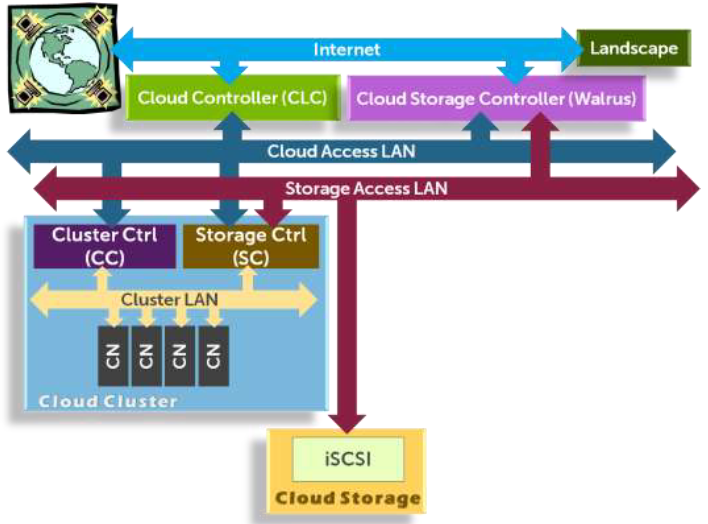
The architecture looks something like this:

The Dell UEC cloud solution architecture

The software components are:

  • Cloud Controller (CLC) – the cloud portal
  • Walrus Controller (W) – the cloud’s storage repository
  • Cluster Controller (CC) – the controller for a up to 1024 compute cores grouped together as a cluster
  • Storage Controller (SC) – the controller for cluster’s storage repository
  • Compute Node (CN) – cloud’s compute node

And on the support side…

If you’re looking for systems management and support services with your order, you are in luck.  Canonical, the company behind Ubuntu, has put together UEC Assist, a support service built specifically for Dell customers deploying SE Edition and which is delivered by Canonical’s Global Services and Support team.

Its all about efficiency

From a Dell DCS (the group at Dell behind this) point of view, this offering fits in well with our strategy of bringing total solutions to market that optimize efficiency at every layer, from code to servers to storage.  The open source Dell UEC solution is tailor made to deliver a ready to go IaaS solution.

Extra-credit reading:

Pau for now..


Mark Shuttleworth on UEC and OpenStack

January 11, 2011

Mark Shuttleworth, the ever gracious founder of Ubuntu, stopped by Dell this morning to talk to various folks about various subjects.   I was able to grab some time with him between meetings and get his thoughts on a few topics.

I was particularly interested in getting his thoughts on Ubuntu Enterprise Cloud (UEC) which will be available this week from Dell as the Dell | Canonical UEC Solution (along with the UEC software, the solution is based on our PowerEdge C2100 and C6100 and comes with a reference architecture and deployment guide).   The other topic I wanted to get his insight into was OpenStack.

Here’s what Mark had to say:

What Mark talked about

  • How Mark has settled into his role as non-CEO (he is still chairman).
  • What he is focusing on these days: the cloud and product design e.g. Unity.
  • [1:45] The thinking behind UEC and the combined Dell Canonical offering.
  • [3:45] OpenStack and Canonical’s participation
  • Working with both OpenStack and Eucalyptus and how both of these are central to the process of standardization that we are starting to see at the infrastructure layer of cloud computing.

Extra-credit reading:

Pau for now…


Chatting with Eucalyptus Co-founder about OpenStack

November 11, 2010

Continuing in my series of videos from the OpenStack design summit this week in San Antonio, here is an interview I did yesterday with Eucalyptus systems co-founder Graziano Obertelli.

Eucalyptus allows enterprises to set up open source infrastructure-as-a-service private clouds.  Eucalyptus is also one of the key ingredients in the Ubuntu Enterprise Cloud that is being certified to run on Dell’s PowerEdge C systems as part of our cloud ISV program.

Here is what Graziano had  to say:

Some of the ground Graziano covers:

  • What goals do the Eucalyptus team have for the summit
  • They’ve recently hired a community manager – Mark Atwood
  • What are their goals for their next release

Extra-credit reading:

Pau for now…


Dell’s hyper scale cloud efforts — Everything you wanted to know in 3 minutes

October 14, 2010

Last week a couple of us went down to San Antonio to help represent the OpenStack project at Rackspace’s partner summit.  While there I met up with the VAR Guy.   Mr. Guy got me chatting about Dell’s Data Center Solutions group, where we’ve been and where we’re going.  Below is the resulting video he put together featuring myself and San Antonio’s greenery. (See the original article this came from).

Some of topics I tackle:

  • How Dell’s Data Center Solutions Group is designing servers for high-end cloud computing
  • How Dell is integrating hardware with software in cloud servers
  • Coming soon: Dell Cloud Solution for Web Applications/Leveraging Joyent‘s software
  • Dell’s cloud partner program – where Ubuntu Enterprise Cloud, Aster Data and Greenplum fit in.
  • Dell’s commitment to OpenStack

Extra-credit reading:

Pau for now…


Ubuntu, the Cloud and the Future — Neil Levine

July 27, 2010

After the cloud summit last week at OSCON, I sat down with Neil Levine of Canonical to see what was in store for Ubuntu cloud-wise (Canonical is a partner of ours in our cloud ISV program).  Neil is the VP of Canonical’s corporate services division which handles their cloud and server products.

Here’s what Neil had to say:

Some of the topics Neil tackles:

  • The next Ubuntu release “Maverick Meerkat” and its geek-a-licious launch date: 10.10.10.
  • Look for Maverick to make Eucalyptus even easier to deploy and use.
  • Data processing and data analytics is one of the key use cases in the cloud and Canonical is looking to move up the stack and provide deep integration for other apps like Hadoop and NoSQL.
  • What are some of the areas of focus for next year’s two releases i.e. 11.04 and 11.10.
  • Project ensemble: what it is and what its goals are.

Extra-credit reading

Pau for now…


The OpenStack design summit in review

July 22, 2010

Tuesday after the OSCON cloud summit I sat down with Rick Clark over a well deserved beer.  Rick is the chief architect and project lead for the OpenStack compute project that was announced on Monday.

Last week I interviewed Rick on the first day of the inaugural OpenStack design summit and I wanted to catch up with him and get his thoughts on how it had gone.  This is what he had to say:

Some of the topics Rick tackles:

  • How it went engaging a very large technical group (100+) in an open design discussion patterned after an Ubuntu Developer Summit.
  • Some of the decisions he thought would be no brainers, turned out differently e.g. OVF (open virtualization format) and keeping the storage and compute groups separated.
  • Since the summit involved representatives from over 20 companies, some of them competitors, how good were people at putting away their business biases/agendas?
  • How far they got (hint they got requirements from everyone for the first release).
  • They’ve already gotten their first code contributions.
  • How they plan to build a community: actively looking to hire a community manager.   In the meantime its actively growing and in a week they’ve gone from 10 people in the IRC channel to 150 on Tuesday.

Extra-credit reading:

But wait there’s more…

I got back from OSCON last night with a fist full of videos.  In addition to the above, coming soon to a browser near you are the following interviews:

  • Brett Piatt with more OpenStack goodness
  • J.P. Rangaswami, Chief Scientist at BT — Nature doesn’t require SLAs
  • Simon Phipps about his new company ForgeRock
  • Neil Levine, VP at Canonical about what’s in store for Ubuntu.

Pau for now…