Dell Unveils Cloud Solutions (Yippee!)

March 24, 2010

Today is the big day.  The one we’ve been working towards for a long time.  As a part of Dell’s quarterly launch “Solutions for the Virtual Era,” we are announcing the introduction of:

  • Dell Cloud Solution for Web Applications, our first Revolutionary cloud solution.  Partnering with enterprise-class cloud pioneer Joyent, we are offering a turnkey private PaaS solution comprised of pre-tested, pre-assembled and fully-supported hardware, software and services — all sold and supported by Dell.  This integrated solution is targeted at enterprise app developers who are looking to develop “new world” applications in the cloud to be deployed in the cloud.
  • The Cloud Partner Program Working with cloud ISVs we will be offering easy-to-buy and deploy cloud solutions and blueprints optimized for and validated on Dell platforms.  The first three partners we are announcing are Aster Data (providing web analytics), Canonical (offering an open source Infrastructure-as-a-Service private cloud) and Greenplum (self-service data warehousing).   (On the Evolutionary cloud side we will continue to work with VMware and Microsoft  and stay tuned for news on what’s happening on the Windows Azure front :).
  • A new line of hyperscale-inspired PowerEdge C servers including the PowerEdge C1100, C2100 and C6100 targeting HPC, data analytics, gaming and cloud builders.  These are based on the designs we have created for the some of the worlds largest internet companies and cloud providers.
  • A suite of cloud professional services to help customers assess, deploy, design and manage dedicated solutions.

This is just a quick overview of what we are announcing today.  Stay tuned for more details and info in the coming days and weeks.

Extra credit reading: Our Cloud solutions press release

Pau for now…


Ubuntu founder stops by Round Rock

February 19, 2010

My favorite cosmonaut-coder Mark Shuttleworth stopped by our offices this morning for a visit.  Mark is the founder of both the Linux distribution Ubuntu and its commercial sponsor Canonical.   Mark and I sat down in the lobby and caught up.  Here is a short interview we recorded.

Some of the topics Mark tackles:

  • Where Canonical is currently working with Dell
  • Ubuntu Enterprise Cloud (to build your “own little EC2”)  and how its doing
  • Passing the CEO mantle to Jane Silber in March
  • The 10.4 Ubuntu release Lucid Lynx and what to expect: a strong cloud focus on the enterprise side and a lot of shiny new bling on the desktop as well as making the desktop “social” (e.g. Tweet straight from your desktop)
  • What Ubuntu is doing in the Netbook space
  • What excites Mark the most in technology today and why cloud is like HTTP in the early 90’s

Extra-credit reading

Pau for now…


Mark Shuttleworth on the Cloud, Ubuntu on Dell and more

September 24, 2009

Mark Shuttleworth, founder of Ubuntu and the head of Canonical, the commercial entity behind the popular linux distribution, is currently making his rounds in the States.  Yesterday he was quite busy,  taking the stage at both the Intel Developer Forum in San Francisco as well as at  LinuxCon up in Portland Oregon.

Today he popped by Dell here in Austin to chat.  I grabbed him for a few minutes right before lunch. Here is the result:

Some of the topics Mark tackles:

  • The release yesterday of Dell’s Mini netbook with Ubuntu Moblin Remix – Developer Edition. (More details on the release from the Dell blog.)
  • Mark’s keynote yesterday at Linuxcon and the themes of cadence, quality and design.
  • His kerfluffle with the Debian community around release schedules.
  • The cloud-related goals for next month’s Ubuntu 9.10 release, Karmic Koala:
    • To be able to deploy your own cloud across 5-10 servers in 15 mins to an hour
    • Be able to enable private clouds that are completely EC2 compatible
    • Ability to create a library of virtual appliances that will deploy on EC2 or private clouds
  • The announcement earlier this week of the 10.04 Long Term Support (LTS) release named “Lucid Lynx.”
  • Mark’s thoughts on Windows 7 or as he calls it, “the wonderful Service Pack for Vista.”
  • How long until profitability.

Pau for now…


RightScale part 1: Mickos joins and control moves up the stack

June 17, 2009

Yesterday I attended a webinar that RightScale put on entitled: How to Build Scalable Websites in the Cloud.  It was basically a welcome to RightScale, welcome to the cloud presentation but overall interesting and credible.

The presenters were their CEO, their head of marketing and a mini team of techies.  Below is part one of some of my thoughts and takeaways.  But first a slight digression…

Enter the Dolphin Master

One thing I noticed during the presentation and which warmed my heart was that MySQL played prominently in a bunch of the slides.  It was only today when I was poking around the RightScale site that I saw the press release from a few weeks ago announcing that Marten Mickos, former MySQL CEO and Sun employee joined the RightScale board of directors.  Its interesting but not surprising to note in the release that Marten calls out Sun and Canonical (the commercial sponsor behind Ubuntu) as two strategic partners helping to expand the RightScale ecosystem.

Where Right Scale fits within the tri-sected cloud.

Where Right Scale fits within the tri-sected cloud.

Where they play in the Cloud(s)

RightScale positions themselves as a cloud management platform or as I like to think of it “a cloud tamer.”  If you split the cloud in three — software as a service, platform as a service and infrastructure as a service — they play in the last space. Basically Right Scale sits on top of Infrastructure as a Service (IAAS) and can handle all the tricky bits so you don’t have to.

Choose or choose not to choose

For those who want more control over their infrastructure RightScale will allow you to “choose among a variety of development languages, software stacks, data stores and cloud providers.” For those less intrepid in the cloud they have server templates that you can start off with.

One of the key benefits they stressed was getting rid of vendor lock-in, “so that you never get locked in to a single provider.”  You’ll notice on the X axis above they show lock-in decreasing and portability increasing as you move to the right.  My question however is that with Right Scale aren’t you simply locked in to a different layer of the cloud?  Doesn’t the control point simply move up the stack?  Just wondering…

Tune in tomorrow for part deux!

Extra Credit Reading/Listening

  • What is MySQL founder Monty Widenius up to post MySQL/post Sun? The Open Database Alliance and his MariaDB – May ’09
  • An interview with Marten Mickos, the day the MySQL deal with Sun closed — Feb ’08.
  • An interview with Marten Mickos after he keynoted Canonical’s first (and last) Ubuntu Live — Aug ’07.

Pau for now…


Talking to Canonical’s KVM Kid — Dustin Kirkland

April 28, 2009

At Austin Cloud Camp on Saturday I ran into Ubuntu linux developer and Canonical employee, Dustin Kirkland.  Dustin is on the server developer team at Canonical and, as he explains it, focuses on various aspects of virtualization, the plumbing layer below cloud computing.  I grabbed Dustin for a few minutes and chatted with him about last week’s release and what he’s been working on.

Some of the topics Dustin Tackles:

  • KVM, Canonical’s hypervisor of choice
  • Ubuntu’s next release and its focus on Eucalyptus to enable companies to set-up their own EC2 compatible “private clouds” based on Ubuntu servers.
  • What Dustin likes most about cloud computing (hint: think green)
  • What he likes most about working at Canonical

Update: And on a related note — Eucalyptus goes commercial with $5.5M funding round

Pau for now…


Pics and Prose from Cloud Camp Austin ’09

April 27, 2009

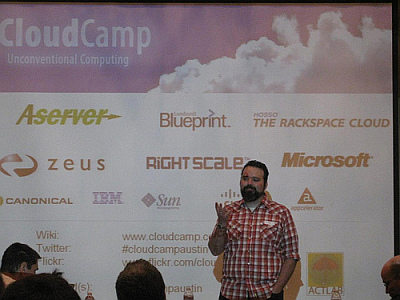
Michael Cote of Redmonk welcomes us all. (credit Dave Nielsen)

Michael Cote of Redmonk welcomes us all. (credit Dave Nielsen)

This past Saturday, Cloud Camp Austin was held down on the UT campus.  There was a very healthy turnout and a lot of great discussions were generated.

Sequence of Events

After opening salutations, camp got underway with a series of six five-minute lightening talks delivered by the camp’s gold sponsors.

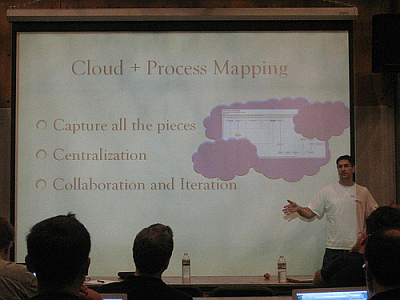
My lightening talk: Mapping Processes in the Cloud (credit: Dave Nielsen)

My lightening talk: Mapping Processes in the Cloud (credit: Dave Nielsen)

The Main Event

From there, Dave Nielsen, the man who originally developed the cloud camp format (and who took most of the pictures in this post — see them all), guided us through the process of coming up with topics for session discussions.  That process, appropriately enough given that this was an unconference, began with an “unpanel.”

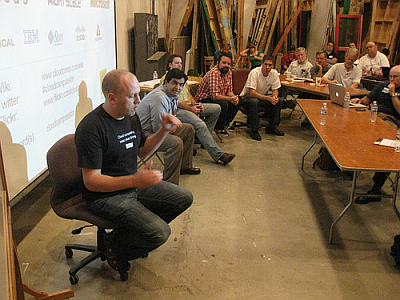
The Unpannel: Splunk representative, not sure, Cote, Dustin from Canonical, myself (credit Dave Nielsen)

The Unpannel: Michael Wilde of Splunk, (not sure), Dustin from Canonical, Cote, myself (credit Dave Nielsen)

All Together Now

The way it worked was the room first brainstormed a list of topics they were interested in discussing/learning more about.  Anyone who thought they were an expert on one or more of these topics got to get up from their seats and form a five person panel at the front of the room.   Each member of the panel then answered two questions from the board and as the question was answered the audience was asked if the topic had been covered by the answer or if it warranted further discussion in an afternoon session

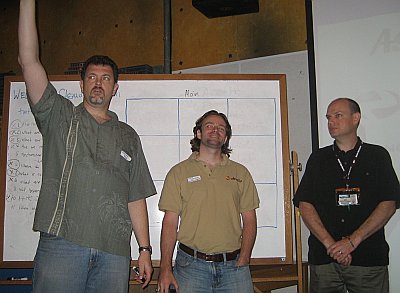
(L->R) Dave Nielsen leads us through our unconference set up.  Canonical's Dustin Kirkland and hero-for-hire John West lend a hand.

(L->R) Dave Nielsen leads us through our unconference set up. Canonical's Dustin Kirkland and hero-for-hire John West lend a hand.

A Schedule is Born

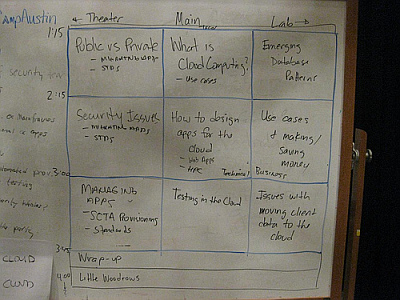
After the panel, as a group we all decided what the final sessions would be and who would lead them.  To lead a session you could either be knowledgeable in the area or completely clueless but wanted to learn about it.

The completed schedule:  three sessions ran at a time and there were three time slots (credit Dave Nielsen)

The completed schedule: three sessions ran at a time and there were three time slots (credit Dave Nielsen)

Coming Soon

While at camp I did a couple of video interviews, one with Dustin Kirkland of Canonical and one with Todd Morey of Mosso/Rackspace.  I should be posting those in the next few days.  I also found myself on the other end of the microphone being interviewed by Mr. Cote.  That should be appearing in the near distant future on his blog.

Update:

Pau for now…