Introducing Project Sputnik: Developer laptop

May 7, 2012

-> Update 2/18/2013: Sputnik 2 is here: Dell XPS 13 Developer Edition goes 1080p and lands in Europe

-> Update 11/29/2012: Sputnik has landed! Introducing the Dell XPS 13 Laptop, Developer Edition

Today I am very excited, I finally get to talk about project Sputnik!  In a nutshell, drumroll please, here it is:

Made possible by an internal innovation fund, project Sputnik is a 6 month effort to explore the possibility of creating an open source laptop targeted directly at developers.  It is based on Ubuntu 12.04 and Dell’s XPS13 laptop.

To put it in context, Sputnik is part of an effort by Dell to better understand and serve the needs of developers in Web companies.  We want to finds ways to make the developer experience as powerful and simple as possible.  And what better way to do that than beginning with a laptop that is both highly mobile and extremely stylish, running the 12.04 LTS release of Ubuntu Linux.

Why a developer laptop

When we first started setting up the web vertical to focus on companies who use the internet as their platform, we brought in Stephen O’Grady of Redmonk to learn as much as we could about the needs of developers.  One of the ideas that Stephen tossed out was a Dell laptop running Ubuntu, targeting developers.  We thought the idea was pretty cool and filed it away.

As we continued talking to customers and developers the topic of Ubuntu kept coming up and we came across a fair number of devs who were asking for a Dell laptop specifically based on it.  To my knowledge, no other OEM has yet made a system specifically targeted at devs and figured it was time to see what that might mean.  When the XPS13 launched we realized that we found the perfect platform to start with and when Dell’s incubation program was announced we knew I had the vehicle to get the effort kick started.

I should also add that Ubuntu was a natural choice not only because of its popularity in the Web world but Dell has quite a bit of experience with it.  In fact Dell has enabled and pre-installed out-of-the-factory Ubuntu on more computer models than any other OEM.

What’s Sputnik actually running?

The install image available for Sputnik contains

  1. drivers/patches for Hardware enablement
  2. a basic offering of key tools and utilities (see the complete list at the end of this entry)
  3. coming soon, a software management tool to go out to a github repository to pull down various developer profiles.

Hardware enablement

In putting together the project, the area that we focused on first was hardware enablement.  As Linux users are all too painfully aware, Linux drivers are not always available for various platforms.  We have been working hand in hand with Canonical, the commercial sponsor behind Ubuntu and identified three main areas on the XPS13:

  1. An issue with brightness
  2. The Wifi hotkey
  3. The touchpad and multi touch support

The first two have been resolved but the last one re the touchpad is still at large.  The issue is a bit of a pain particularly the lack of palm rejection support which can cause your cursor to jump by mistake.  We have contacted the vendor who makes the touchpad and they are sizing the effort to fix this and at the same time we are working with Canonical to find an interim solution.

Update June 21: the driver for the touchpad is now available!

Developer profile management

Hardware enablement is table stakes but where Sputnik starts to get interesting is when we talk about profiles.  No two developers are alike so instead of stuffing the system with every possible tool or app a developer could possibly want, we are trying a different approach.  As mentioned above, the actual “stuff” on the install image is pretty basic, instead we are working with a few developers to put together a tool that can go out to a github repository and pull down various developer profiles.  The first profiles we are targeting are Android, Ruby and JavaScript.

As a one of our alpha cosmonauts, Charles Lowell, explained (we have been working with three local developers in Austin, Charles, Mike Pav and Dustin Kirkland to put together our initial offering together.   And yes I know Sputnik was unmanned but its our project and we wanted to call the testers “cosmonauts.” )

What I’d like to see is not only a gold-standard configuration, but also a meta-system to manage your developer configuration… The devops revolution is about configuration as code. How cool would it be if my laptop configuration were code that I could store in a source repo somewhere?

After we build the management tool and some basic profiles to get the effort started, we are hoping that the community will take over and began creating profiles of their own.

Getting Feedback and UDS activities

The idea is to conduct project Sputnik out in the open.  There is a Storm Session that went live this morning on Dell Idea Storm for people to discuss the project and submit feedback, comments and ideas.  Later today here at the Ubuntu Developer Summit, Dustin, Mario Limonciello of Dell and I will be hosting a UDS session to discuss Sputnik.  Additionally at UDS there is a coding contest that has been kicked off.  The three people who write the best Juju charms will each get an XPS13.

The Vision: a Launchpad to the cloud

As mentioned at the start, Sputnik is currently a 6month project to investigate an Ubuntu laptop.  If successful, we have big plans for the effort. 🙂

When we initially pitched Sputnik to Ubuntu’s founder Mark Shuttleworth a couple months ago he really liked the idea.  In his eyes however, he saw something bigger.  Where it got really interesting for him was when this laptop was optimized for DevOps.  In this scenario we would have a common set of tools from client, to test, to production, thereby tying Sputnik via a common tool chain to a cloud backend powered by OpenStack.  Developers could create “micro clouds” locally and then push them to the cloud writ large.

We see a lot of potential in Sputnik to provide developers with a simple and powerful tool.  Only time will tell however so stay tuned to this blog, check out the Sputnik Storm session and weigh in on the project, what you’d like to see and how you think it can be made better.

Pau for now…

Extra-credit reading

Links and notes

Basic Install

== standard meta packages ==

ubuntu-desktop^

standard^

== scm ==

git

git-core

bzr

bzr-gtk

bzr-git

python-launchpadlib

== utilities ==

screen

byobu

tmux

meld

juju

charm-tools

charm-helper-sh

euca2ools

puppet

chef (available post install)

== editors ==

emacs

vim

vim-gnome

== browsers ==

chromium-browser

firefox

== common build tools/utilities & dependencies ==

fakeroot

build-essential

crash

kexec-tools

kvm

makedumpfile

kernel-wedge

fwts

devscripts

libncurses5

libncurses5-dev

libelf-dev

asciidoc

binutils-dev


Mark Shuttleworth part two: Developers, DevOps & the Cloud

January 13, 2012

As I mentioned in my last entry, Mark Shuttleworth of Ubuntu fame stopped by Dell this morning on his way back from CES.  Between meetings Mark and I did a couple of quick videos.  Here is the second of the two.  Whereas the first focused on the client, this one focuses on the Cloud and the back-end.

Some of the ground Mark covers

  • The cloud, Ubuntu and OpenStack involvement
  • The developer story: connecting the dots between app work on the client and testing and then deployment on the other end.
  • The world of DevOps and how JuJu fits in
  • Apple’s iOS as a developer platform and where Linux might have the edge going forward

Extra-credit reading


Hadoop World: Ubuntu, Hadoop and Juju

November 14, 2011

I’m always interested in what’s happening at Canonical and with Ubuntu.  Last week at Hadoop World I ran into a couple of folks from the company (coincidentally both named Mark but neither Mr. Shuttleworth).  Mark Mims from the server team was willing to chat so I grabbed some time with him to learn about what he was doing at Hadoop World and what in the heck is this “charming” Juju?

Some of the ground Mark covers

  • Making the next version of Ubuntu server better for Hadoop and big data
  • (0:34) What are “charms” and what do they have to do with service orchestration
  • (2:05) Charm school and learning to write Juju charms
  • (2:54)  Where does “Orchestra” fit in and how can it be used to spin up OpenStack
  • (3:40) What’s next for Juju

But wait, there’s more!

Stay tuned for more interviews from last week’s Hadoop world.  On tap are:

  • Todd Papaioannou from Battery Ventures
  • John Gray of Facebook
  • Erik Swan of Splunk
  • Nosh Petigara of 10gen/MongoDB.

Extra-credit reading

Pau for now..


DCS’s Chief Geek takes us on a tour of his mini Home Lab

February 4, 2011

Dell’s Data Center Solutions (DCS) group has some pretty colorful folks.  One of the more interesting members is Jimmy Pike, the man IDG New’s James Niccolai refered to as the “Willy Wonka of servers.”  Jimmy, the self-proclaimed “chief geek” of the DCS team is the consummate tinkerer whether that involves constructing a data center in a brief case or thinking of new ways of driving down data center power consumption by leveraging alternative forms energy.

Last Spring I visited Jimmy’s home to check out what he was working on in his “free time.”  Here’s what I saw (he keeps telling me he’s got much cooler stuff since I shot this so I may have to do a “geekquel”)

Some of the things Jimmy show us:

  • The low-power chips he’s playing with
  • His experimentation with user interfaces and superman glasses
  • His mini rack of servers
  • The various forms of desktop virtualization and OS’s he uses
  • Laying out and designing boards by mail
  • His micro recording studio

Extra-Credit reading

Pau for now…


RightScale Part 2: Why the cloud? Apple Fanboys and Server Suffrage

June 18, 2009

Tuesday I listened in on the RighScale webinar: How to Build Scalable Websites in the Cloud.  This is part two of my thoughts and notes from the event.  (Note: it doesn’t look like it’s been posted yet but it should be available here soon).
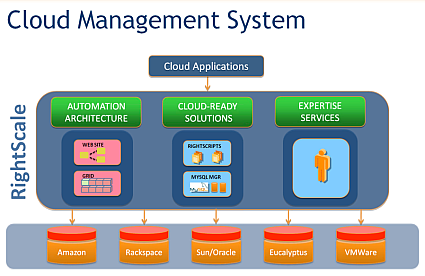
The clouds providers that Right Scale works with.

The clouds providers that Right Scale works with.

As I discussed last time, RightScale acts as a management platform between cloud providers and Apps.

Which Cloud Providers do they work with?

If you double click on the IAAS bit in the yesterday’s slide you get something like the above.  Right Scale works on top of Amazon, coming soon to Rackspace’s Slicehost, Sun/Oracle’s cloud), Eucalyptus theEC2-compatible open source alternative that allows you to set up “private clouds” (BTW as anyone who attended Austin Cloud camp knows I’m using “private cloud” under duress, Gordon Haff does a good job explaining my heartburn) and VMWare.

Linux more robust than Windows

When asked about OS’s supported the answer was Windows as well as Ubuntu and CentOS.  Their CEO did admit that currently Windows support is not as robust as Linux.  They actually began with CentOS and according to one of their team have recently begun supporting Ubuntu more fully.   When I asked about other Linux flavors, Debian, SuSE etc. they said that there were “licensing issues” standing in the way.  I should have asked about OpenSolaris 🙂

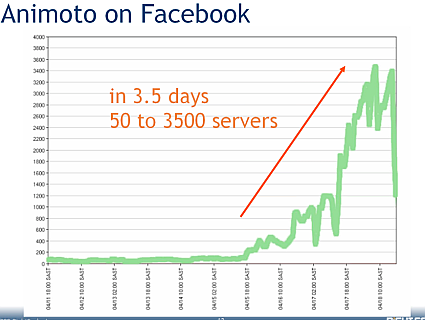
Animoto, the well used example of how server demand can explode.

Animoto, the well used example of how server demand can explode.

Why do you look to the clouds?

During the webinar they polled the 200 odd attendees: “what’s driving you to the cloud?”  The results (as you’ll notice, you were allowed to vote for more than one):

  • 80% Scalability
  • 73% Cost Savings
  • 59% On Demand access
  • 28% Back-up and recovery
  • 06% Other

Not surprisingly Scalability came in number 1.  As if to underscore the point they brought out everbody’s favorite case study of exploding demand, Animoto.  Thankfully they had another example of uneven demand, iFixit (see below).  As an aside, one example I’d like to see charted is the attendee who mentioned that their agency is responsible for posting election results and were “not prepared for the interest worldwide, for Proposition 8.”

It was interesting to see that cost savings came in a close second, its always hard to measure particularly over the long haul but the perceived cost benefit is definitely strong in most folks mind.

iFixit's traffic could be said to be a tad "spikey."

iFixit's traffic could be said to be a tad "spikey."

Right Scale fighting for Server voting rights

And in conclusion…I’m always intrigued with the way English language morphs and evolves so I thought it was really interesting how the word “vote” is being used in the cloud (or at least by RightScale).  Basically they use a “voting process” when scaling.  Here’s how one of their team explained it.

Once a machine hits the scale up threshold  it places a vote to scale up.  When enough machines vote to scale up i.e. 51% if that that is what the decision threshold is set at, then new servers are provisioned and configured.  The same goes for scaling down.

Don’t know if this usage is new or a throw back from mainframes or from some other industry but I like it.

Pau for now…


Talking to Canonical’s KVM Kid — Dustin Kirkland

April 28, 2009

At Austin Cloud Camp on Saturday I ran into Ubuntu linux developer and Canonical employee, Dustin Kirkland.  Dustin is on the server developer team at Canonical and, as he explains it, focuses on various aspects of virtualization, the plumbing layer below cloud computing.  I grabbed Dustin for a few minutes and chatted with him about last week’s release and what he’s been working on.

Some of the topics Dustin Tackles:

  • KVM, Canonical’s hypervisor of choice
  • Ubuntu’s next release and its focus on Eucalyptus to enable companies to set-up their own EC2 compatible “private clouds” based on Ubuntu servers.
  • What Dustin likes most about cloud computing (hint: think green)
  • What he likes most about working at Canonical

Update: And on a related note — Eucalyptus goes commercial with $5.5M funding round

Pau for now…


Mark Shuttleworth dicusses the Cloud and Ubuntu

March 30, 2009

Last month Mark Shuttleworth, founder of Ubuntu Linux, CEO of Cannonical Ltd and First African in Space, announced that Ubuntu was going to be making a big push into cloud computing with their release slated for October.  This will add to early cloud support that’s debuting in next month’s release, Ubuntu 9.04.  (BTW, For a good backgrounder on Mark and Ubuntu, check out Ashlee Vance’s story in the New York Times from January).

I  was interested to get some more details so I reached out to Mark to find out his master Cloud plan, his thoughts on Cloud Computing today and where he thought it was going.  This is what he had to say:

My interview with Mark (9:51)  Listen (Mp3) Listen (ogg)


Mark and myself at the Ubuntu Developer Summit in Boston at the end of ’07 (Mark’s the one without the “Barton” name tag.)

Some of the topics Mark Tackles:

  • Ubuntu has picked two anchor points for its cloud strategy: Amazon EC2 and UCSB‘s (go Gauchos!) Eucalyptus.  Eucalyptus is for those looking to create “private clouds” on their own and on the Amazon side they are making it easy for users to plug into EC2 as well as offering folks the ability to run Ubuntu-based machines on their cloud.
  • Why they went with EC2 and Eucalyptus.  On the Eucalyptus side it has to with it being Java-based, which meshes nicely with the work Ubuntu did with Sun to get the Java stack “straightened out” on Ubuntu for  app servers.
  • The constraints that EC2 imposes actually make it more interesting by providing discipline, much in the same way that http applied the discipline of being completely connectionless.
  • We haven’t yet seen the “definitive cloud” in  the way that Google came along and captured the spirit (and revenues) of the web.  It will still be 5 -10 years before the cloud computing is nailed.
  • Portability in the Cloud is key if we want to avoid gross lock-in issues.  People are trying to tackle this in a variety of ways but it makes sense to look at the way http came to dominance.
  • Any truth to the rumor that Google is planning on using Ubuntu as a Netbook OS? (listen how Mark deftly responds 🙂
  • Last time we spoke, back in August, Mark said he was looking at profitability in 18 months to two years, is he still on track?

Pau for now…

Update: Here is the Register article based on the above podcast.