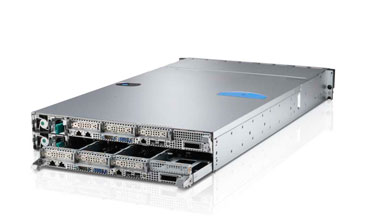
Savtira streams media and apps from the cloud with beefy PowerEdge C combo

April 18, 2011

Savtira Corporation, who provides outsourced Cloud Commerce solutions, has chosen Dell DCS’s PowerEdge C line of servers and solutions to deliver streamed media and apps from the cloud.  Dell’s gear will help power the Savtira Cloud Commerce platform and Entertainment Distribution Network (EDN).

With a little help from PowerEdge C, businesses will now be able to use EDN to stream all digital media (business apps, games, music, movies audio/ebooks) from the cloud to any device.  One of the particularly cool features is, since the state and configuration are cloud-based, consumers can switch between devices and pick up exactly where they pushed pause on the last device.

Talk about supercharging

To power Savtira’s EDN data center, the company picked PowerEdge C410xs packed with NVidia Tesla M2070 GPUs and driven by PowerEdge C6145s.  If you think GPUs are just for rendering first-person shooters, think again.  GPUs can also cost-effectively supercharge your compute-intensive solution by offloading a lot of the processing from the main CPUs.  According to NVidia, for 1/10 the cost and with only 1/20 of the power consumption, GPUs deliver the same performance as CPUs.

To  help you get an idea of the muscle behind this solution, the PowerEdge C410x PCIe expansion chassis holds up to 16 of the Tesla M2070s GPUs, each of which exceeds over 400 cores.  Two fully populated C410xs are in turn powered by one PowerEdge C6145 for a combined total of 33 Teraflops in just 7U.

Talk about a lot of power in a little space 🙂

Extra-credit reading

  • PowerEdge C6145 — Dell DCS unveils its 4th HPC offering in 12 months, and its a beefy one
  • PowerEdge C410x — Say hello to my little friend — packing up to 16 GPGPUs
  • NVIDIA: from gaming graphics to High Performance Computing

Pau for now…


Now Available, HPC monster machine

March 1, 2011

A couple of weeks ago, we announced the PowerEdge C6145 system made up of two servers crammed into a 2U enclosure with a total of 96 cores.  Today that system officially became available for purchase.

Rave reviews

This system got a great review in  CRN yesterday entitled “Performance Of Dell’s PowerEdge C6145 Rack Server Off The Charts.”  To give you a taste, here is how the article begins:

Dell (NSDQ:Dell) has really outdone itself. On Tuesday, the company begins shipping a machine that the CRN Test Center can only describe as 2010 Server of the Year squared.

Officially called the PowerEdge C6145, Dell’s latest monster server more than doubled the Geekbench score of the reigning champ, the Dell R815.

This is from the article that SearchDataCenter.com did:

Talk about dense. Dell’s new PowerEdge C6145 server stuffs eight AMD Opteron processors in a single 2U enclosure, making it a standout for high-performance computing (HPC) and, potentially, virtualization…By way of comparison, Dell called out Hewlett-Packard’s eight-way ProLiant DL 980 G7, which has 8U and takes up four times as much space as the Dell box. This is especially important in HPC environments, which, in their scope, tend to put a premium on footprint.

And the Register had this to say

This will be extremely useful for companies that want to attach lots of storage or networking to server nodes in dense configurations, or those who want to cram in a lot of cores into a box and lash them to lots of external GPU co-processors.

The C6145 is Dell Data Center Solutions group’s fourth HPC system in 12 months.  Looks like we’re picking up some momentum 🙂

Extra-credit reading

Pau for now…


Deep dive tour(s) of the PowerEdge C410x

August 5, 2010

In my last entry I talked about the wild and wacky world of GPGPUs and provided an overview of the PowerEdge C410x expansion chassis that we announced today. For those of you who want to go deeper and see how to set up and install this 3U wonder you’ll want to take a look at the three videos below.

  1. Card installation: How to install/replace a NVIDIA Tesla M1060 GPU card in the PowerEdge C410x taco.
  2. Setting up the system: How to set up the PowerEdge C410x PCIe expansion chassis in a rack, power it up and pull out cards.  Also addresses port numbering.
  3. BMC card mapping: How to map the PCIe cards in the PowerEdge C410x via the BMC web interface.  Also covered are how to monitor power usage, fans and more.

Happy viewing!  (BTW, the C410x’s code name was “titanium” so when you hear Chris refer to it as that don’t be thrown)

Extra-credit reading:

Pau for now…


Say hello to my little friend — packing up to 16 GPGPUs

August 5, 2010

While the name GPGPU, which stands for General-purpose computing on graphics processing units, doesn’t flow lyrically off the tongue, it’s an extremely powerful concept.

What’s the big idea?

The idea behind this sexy five letter acronym is to take a graphical process unit (GPU) and expand its use beyond graphics.  Through the “simple” addition of programmable stages and higher precision arithmetic to the rendering pipelines, the GPU is able to tackle general computing and off load it from the CPU.

So what does this mean and/or why should you care?  Well the connection of GPGPUs to servers bring about ginormous increases in performance helping to make HPC and scaled-out deployments wicked fast.  This works particularly well when you’re talking about modeling, simulation, imaging, signal processing, gaming etc.  Not only can the addition of GPGPUs boost these processes by one or two orders of magnitude but it does so much more cost effectively than by simply adding servers.

What is Dell’s DCS group offering up?

The Data Center Solutions (DCS) team have an Oil & Gas customer that is always looking to push the envelope when it comes to getting the most out of GPGPU’s in order to deliver seismic mapping results faster.  One of the best ways to do this is by increasing the GPU to server ratio.  In the market today, there are a variety of servers that have 1-2 internal GPUs and there is a PCIe expansion chassis that has 4 GPUs.

What we announced today is the PowerEdge C410x PCIe expansion chassis, the first PCIe expansion chassis to connect 1-8 servers to 1-16 GPUs.  This chassis enables massive parallel calculations separate from the server, adding up to 16.48 teraflops of computational power to a datacenter.

But enough of my typing, see for yourself in the overview/walk-thru below starring DCS’s very own Joe Sekel, the architect behind the C410x.

Extra-credit reading

Pau for now…