Here is the final post in the series of four concerning Dell’s IoT lab in California.
Product Technologist, Raja Tamilarasan gives an overview of the dedicated IoT data center for customers and explains how it can be used for local or remote access.
Dell’s Data Center Solutions (DCS) group has some pretty colorful folks. One of the more interesting members is Jimmy Pike, the man IDG New’s James Niccolai refered to as the “Willy Wonka of servers.” Jimmy, the self-proclaimed “chief geek” of the DCS team is the consummate tinkerer whether that involves constructing a data center in a brief case or thinking of new ways of driving down data center power consumption by leveraging alternative forms energy.
Last Spring I visited Jimmy’s home to check out what he was working on in his “free time.” Here’s what I saw (he keeps telling me he’s got much cooler stuff since I shot this so I may have to do a “geekquel”)
Some of the things Jimmy show us:
The low-power chips he’s playing with
His experimentation with user interfaces and superman glasses
His mini rack of servers
The various forms of desktop virtualization and OS’s he uses
In Data Center Knowledge last week there was a short article, accompanied by a set of photos, that gave view into Microsoft’s very cool new “Cloud Farm” data center. The design of the data center, which is located in Quincy Washington, was driven by Microsoft’s use of some ultra-cool modular data centers 🙂 . It was the modular nature of these units that helped Microsoft finish their initial deployment at their new facility in only eight months.
One of the modular data centers at Microsoft's Cloud Farm. Dang, those are good looking units. (Photo source: Data Center Knowledge)
Jimmy Pike is the director of systems architecture for the Data Center Solutions group here at Dell and self-proclaimed “head geek.” Using a tool case with its insides stripped out, part of an old inbox and a bunch of off the shelf components he has created the world’s first portable “data center.” (All for the princely sum of ~$2,000)
This former toolkit now holds:
Two dual-socket servers featuring 2.5GHz Intel processors
One server running Windows ’03 acting as the DHCP and domain server and the other running Red Hat linux.


 Posted by Barton George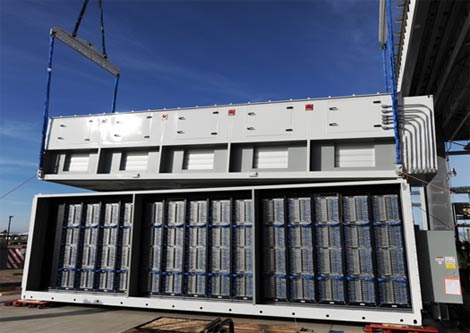
 Barton's Blog