
At DevOpsDays 2026 in Austin, I sat down with Suresh Paulchalmy, CEO and co-founder of ops0, to discuss a growing challenge with AI agents: On one hand they increase speed and agility by allowing individuals to make infrastructure changes directly— On the other, they introduce significant risk.
Suresh gave one cautionary example: someone working with an AI agent unintentionally deleted an entire production database. The problem, he argues, is the lack of a governance layer between AI and your cloud infrastructure. ops0, an early-stage startup out of Dallas, is building that layer.
CHAPTERS
- 00:00 Intro and the problem: governance for AI-driven infrastructure
- 00:47 Founder background and simplifying hard problems
- 01:10 Team and financing (bootstrapped plus angel)
- 01:50 Who it’s for, and finding the core problem: visibility
- 02:45 Oxid, the open source starting point
- 04:45 Moving from visibility to the governance layer
- 05:40 How ops0 governs an action before it happens
- 07:50 Codify and controlled infrastructure generation
- 09:15 Customers and traction
- 10:20 Audit firms and the discovery use case
- 10:40 Compliance frameworks (SOC 2, HIPAA, ISO)
- 12:00 Next six months: distribution
The Platform: Open Source Visibility + Governance
The platform has two layers. Its open source tool, Oxid, connects to your cloud environment to discover what is running and understand how resources depend on one another. On top of that sits ops0, the enterprise governance layer.
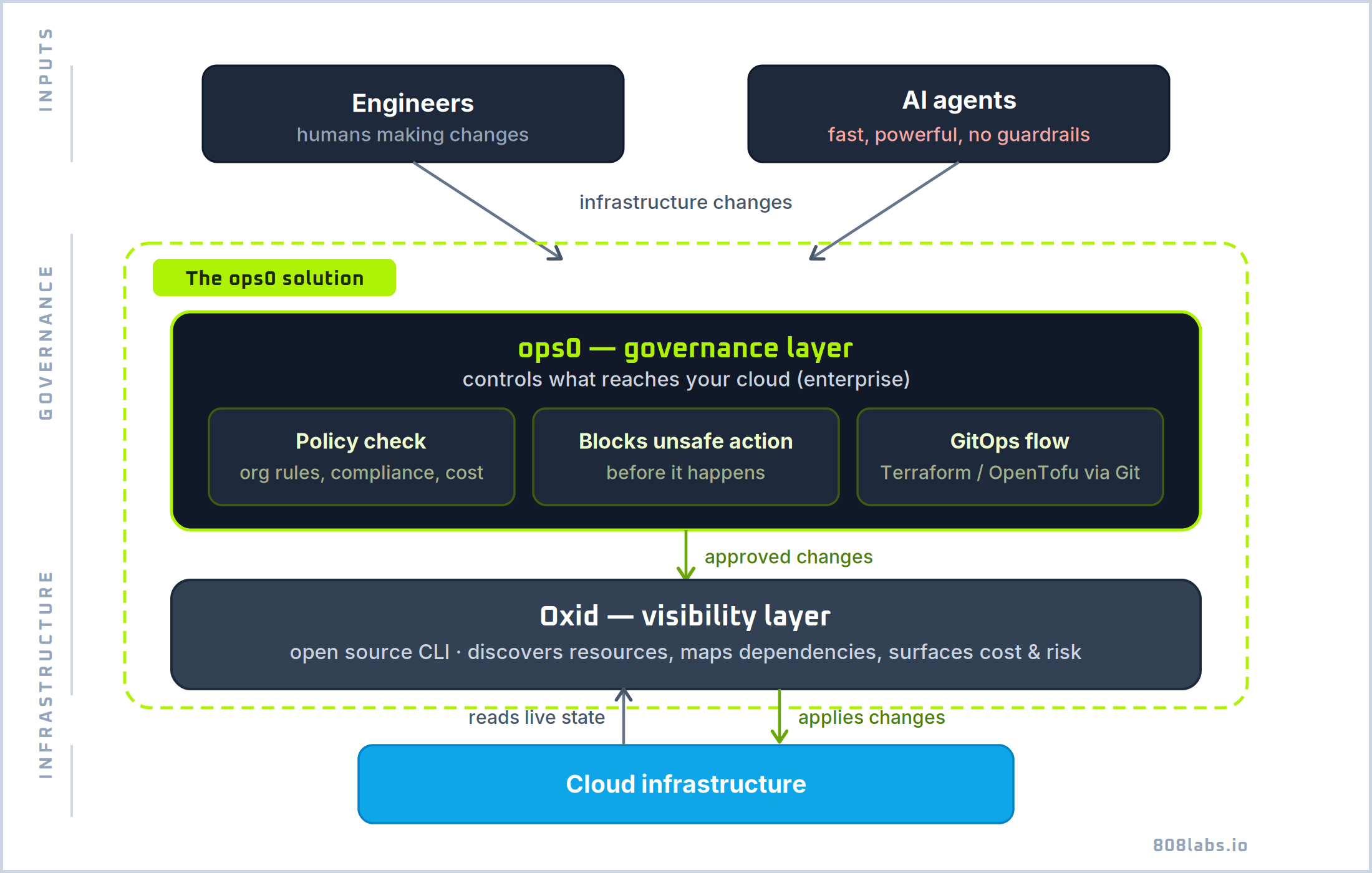
ops0 works with your existing GitOps workflow and evaluates proposed actions against the live state of your cloud, your organization’s policies, and applicable compliance frameworks. If an engineer—or an AI agent—tries to make a change that violates those rules, ops0 can stop it and explain why before anything changes. Cost can also be incorporated into those decisions.
A Walkthrough
In the following demo, co-founder Arjun walks through how this works in practice. He starts with Oxid, showing how it discovers existing cloud infrastructure and converts it into infrastructure as code using Terraform or OpenTofu.
He then moves to ops0 to show how proposed changes—including AI-driven actions—can be evaluated against policies and frameworks such as SOC 2, GDPR, ISO, and HIPAA before execution.
The demo also covers the agent briefing dashboard, cloud and VCS integrations, compliance reporting, pull-request review with sensitive-data redaction, and a query console for searching resources and understanding dependencies and blast radius across the environment.
CHAPTERS
- 00:00 Oxid open source CLI
- 00:30 Agent briefing dashboard
- 01:30 Cloud and VCS integrations
- 02:00 Infrastructure discovery and mapping
- 02:45 Converting resources to IaC
- 03:30 Cloud context and correlation engine
- 04:30 Projects, chat, resource graph and cost
- 05:50 Policies and governance
- 06:30 Compliance policies and enforcement
- 07:15 Compliance dashboard and audit readiness
- 07:50 Agent PR review and sensitive-data redaction
- 08:45 Query console and resource search
Shifting Focus From Cure to Prevention
As Arjun put it, many tools focus on the cure; ops0 wants to focus on prevention. As AI agents take on more infrastructure work, the need for visibility and governance before changes are made is only going to increase.
Pau for now…
Leave a Reply