
Based on an interview with Steve Semelsberger (CEO and co-founder) and Peco Karayanev (CTO and co-founder), recorded live at DevOpsDays Austin, May 6, 2026.
Last year at DevOpsDays Austin 2025, I sat down with Peco Karayanev. He’d just started building the Autoptic platform, and the company along with it. The DevOps change resilience platform was designed to pull telemetry from disparate sources and catch the lurking, latent problems that engineering teams usually find out about the hard way. At that point, Peco was a one-man band.
From Co-Founder to Co-Founders
Fast forward to DevOpsDays Austin 2026, and a lot has changed. The platform is publicly available, there are eight paying enterprise customers across five industries, and Peco has doubled the co-founder count. He’s now joined by CEO Steve Semelsberger, whose background is in quality engineering and production testing, and who has founded or been part of more startups than you can shake a stick at. Peco spent years as an observability vendor. Steve runs the business end; Peco, as CTO, owns product strategy and the platform itself. The company is up to nine employees. (Since our taping, they’ve also brought on DevOps OG Ernest Muller.)
I sat down with both of them to hear what they do, where they are, and where they’re going.
Where Autoptic is different
Most observability tools tell you when something has clearly broken. Autoptic goes after a blind spot Steve calls the messy middle: the unwatched gap after code has shipped and looks fine, but before it breaks and trips an alert. In that window, code is quietly degrading. The symptoms are already showing up in the data, but nothing has crossed a threshold, so no alarm fires and no one’s looking.
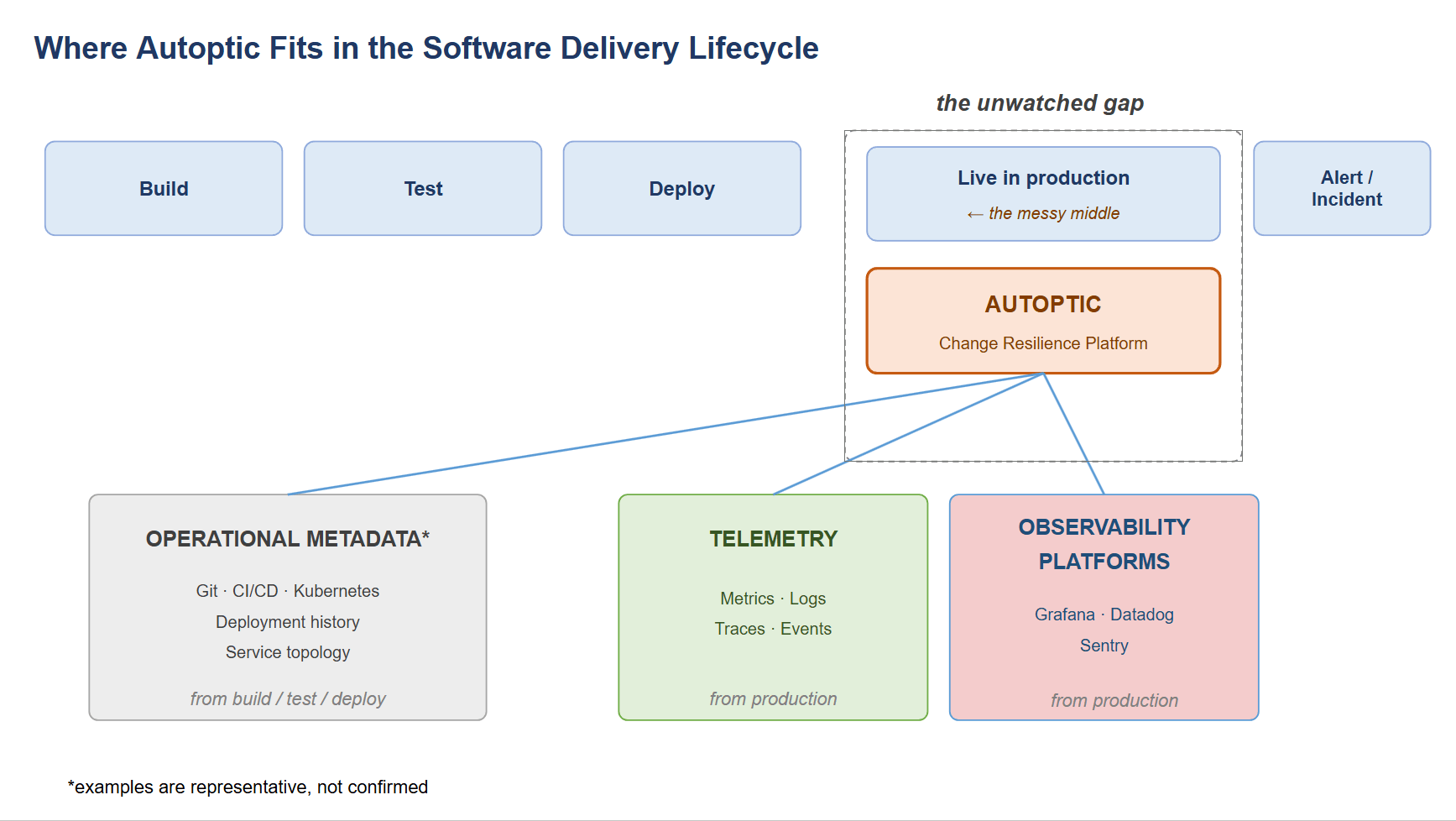
Rather than replace the observability and incident tools you already run, the company frames it as a complement that sits on top of your existing setup. Autoptic analyzes the telemetry those tools are already collecting, the same data a Datadog or a Grafana gathers but doesn’t flag.
The news: Autoptic goes agentic, adds a catalog and anomaly detection
At the event, Steve and Peco walked me through three intertwined capabilities aimed squarely at that no man’s land: open agent orchestration, a curated catalog of skills and agents, and dynamic anomaly change detection. Before, Autoptic pulled telemetry together and analyzed it. Now it can run agents that do that analysis automatically and unattended (orchestration), arrive pre-loaded so it works on day one (catalog), and pin down subtle problems more precisely (anomaly detection). Steve also previewed four forthcoming services offerings, from observability readiness through broader AI DevOps transformation.
See for yourself
Want to see how it works? Peco gave me a quick walkthrough of the platform, from the headlines view down through an individual brief and a live drill-down. Check it out.
Startup-building wisdom:
In the second half of our chat, Peco and Steve got into what they’ve learned building a company and setting its culture. On money, Steve’s advice was to be deliberate about capital structure and lean toward angels over institutional capital. Peco, a first-time founder, talked about staying laser-focused on the customer and hiring what he calls “missionary athletes.”
To see an overview of all we talked about, please see the timestamps below.
I’m very much looking forward to catching up with Autoptic at next DevOps Days Austin. Who knows, they may even have three co-founders!
PS. What’s in a name
If, like me, you assumed Autoptic was a made-up word, you’d be wrong. It’s in the dictionary. Autoptic shares a root with autopsy and means seeing with one’s own eyes. Fitting, for a platform whose whole job is making a flood of data visible.
Pau for now…
The Interview – timestamps
0:00 Intro — who’s who, and what Autoptic does
1:30 A year on: what’s changed, what hasn’t
3:30 The tyranny of the possibility
4:00 Eight customers, five industries
6:00 A year of growth: nine people, 30 angels
7:00 Federated search: pulling signal from telemetry
9:30 Observability vs. monitoring
11:45 The messy middle
13:30 Datadog: partner, not competitor
15:15 Are customers ahead or behind?
16:45 Hybrid companies and four new services
19:15 The announcement: three capabilities
21:30 Rethinking what an agent is
22:45 The catalog: content and tool primitives
23:45 Dynamic anomaly change detection
24:30 Open orchestration, BYOC, and briefs
27:15 Startup advice: capital structure
30:30 Where the name Autoptic comes from
31:15 Managing 30 angel investors
33:00 Missionary athletes and zero-to-0.01
36:15 Mercenary, missionary, artist
38:30 Close
Leave a Reply