Presented at Cloud Field Day in Santa Clara
Earlier this year, I had the opportunity to participate as a delegate at Cloud Field Day in Santa Clara. As delegates, we engaged directly with the presenting companies, offering feedback on what resonated, what needed clarification, and how their strategies could evolve.
The first presenter was Infoblox, a company that merges networking and security into a unified solution, more specifically they are focused on DDI — that’s DNS, DHCP, and IPAM. Other than an acronym of acronyms, what exactly is DDI? I soon found out as Chief Product Officer Mukesh Gupta explained how this combination of “boring” network services is critical in today’s messy, manual, and fragmented hybrid multi-cloud environments.
What Really Is DDI and Why Does It Matter?
DDI is about managing the “naming,” “numbering,” and “locating” of everything connected to a network — whether it’s a laptop, server, phone, or cloud service. Specifically it is made up of three foundational network services:
- DNS (Domain Name System): Translates human-readable domain names (like google.com) into IP addresses.
- DHCP (Dynamic Host Configuration Protocol): Automatically assigns IP addresses to devices on a network.
- IPAM (IP Address Management): Manages the allocation, tracking, and planning of IP addresses across an organization.
These services form the invisible infrastructure behind every enterprise network. Mukesh described DDI as the “electricity” of networking — when it goes down, everything stops.
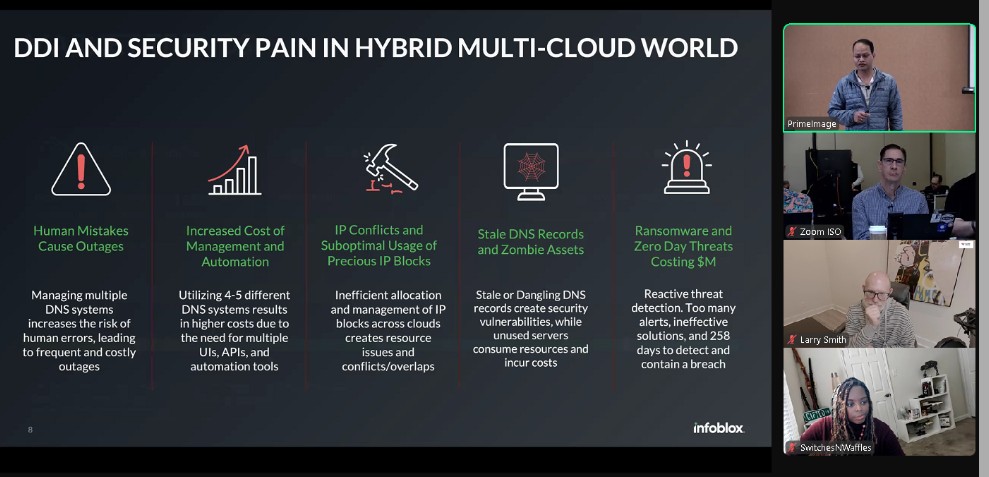
Multi-Cloud Challenges and DDI
Mukesh outlined three key trends currently reshaping enterprise infrastructure:
- Hybrid multi-cloud adoption
Most organizations now operate across a mix of public cloud providers and on-premises infrastructure. - SaaS-first, cloud-first strategies
Enterprises are rapidly moving off legacy systems (especially post-VMware acquisition) in favor of cloud-native approaches. - Increasing cybersecurity threats
Attackers are more frequent, more sophisticated, and more damaging than ever before.
These trends introduce real complexity for DDI. Key challenges include:
- Fragmented DNS systems across multiple clouds
- Inconsistent APIs that make automation difficult and expensive
- IP address conflicts due to disconnected systems
- Stale DNS records that introduce security vulnerabilities
Real-world example:
A major New York bank allowed cloud teams to use native DNS tools. One day, a simple typo in a DNS entry brought down the entire bank for four hours, costing them millions.
Infoblox’s Answer: An Integrated Platform
To address these pain points, Infoblox introduced the Infoblox Universal DDI™ Product Suite. This integrated platforms provides a centralized, automated, and cloud-managed way to run critical network services (DNS, DHCP, IPAM) across complex hybrid and multi-cloud environments.
Key Features:
- Unified management layer
Manage DNS across on-prem, branch, and cloud from a single interface. - Universal IPAM & asset visibility
Real-time insights into IP usage and resource status. - Conflict detection & stale record resolution
Automatically identify and resolve subnet overlaps and outdated DNS entries. - Built-in security
Use DNS as a security control point to detect and block threats.
The platform supports physical, virtual, and cloud-based DNS servers, and integrates with automation tools like Terraform and Ansible. It also maintains backward compatibility via API replication, ensuring existing workflows stay intact.
Security Through DNS
One of the most compelling elements of Infoblox’s platform is how it uses DNS as a security layer.
Since nearly every internet communication starts with a DNS query, Infoblox can analyze DNS traffic patterns to:
- Detect ransomware activity
- Prevent data exfiltration
- Block malicious domains in real time
By combining DNS logs with threat intelligence feeds, Infoblox transforms a foundational service into a proactive security shield.
The Future is Unified DDI
As enterprises deepen their multi-cloud investments, unified management and visibility across distributed infrastructure becomes invaluable. Infoblox’s Universal DDI™ Product Suite delivers this allowing organizations to manage DNS, DHCP, and IP address assignments consistently across data centers, cloud providers, and edge environments — all from a single interface.
While DNS, DHCP, and IPAM may seem behind-the-scenes, they are essential to:
- Prevent outages
- Accelerate cloud operations
- Strengthen enterprise security
In a world where spreadsheets and siloed tools can bring down billion-dollar operations, Infoblox’s Universal DDI is something definitely worth checking out.
Pau for now…


 Posted by Barton George
  Barton's Blog