At Cloud Field Day 22, cybersecurity leader Fortinet shared its vision for managing the growing complexity of cloud-native environments. Their focus: enabling security teams to move faster, reduce alert fatigue, and make smarter decisions using AI-driven threat detection and automation.
Navigating Modern Cloud Security Challenges
In traditional data centers, firewalls protected predictable network chokepoints. But in the cloud, the security landscape is fluid—defined by ephemeral workloads, dynamic ingress/egress, and fragmented microservices. These cloud-native architectures make visibility and threat correlation far more difficult.

Fortinet’s response is to empower security operators with a cloud-native security platform designed to turn noisy telemetry into meaningful, actionable insight.
Inside Fortinet’s CNAPP: Composite Threat Detection at Scale
Fortinet’s Cloud-Native Application Protection Platform (CNAPP) is a unified, vendor-agnostic solution that protects across the entire cloud application lifecycle—from source code and CI/CD pipelines to infrastructure and production workloads.
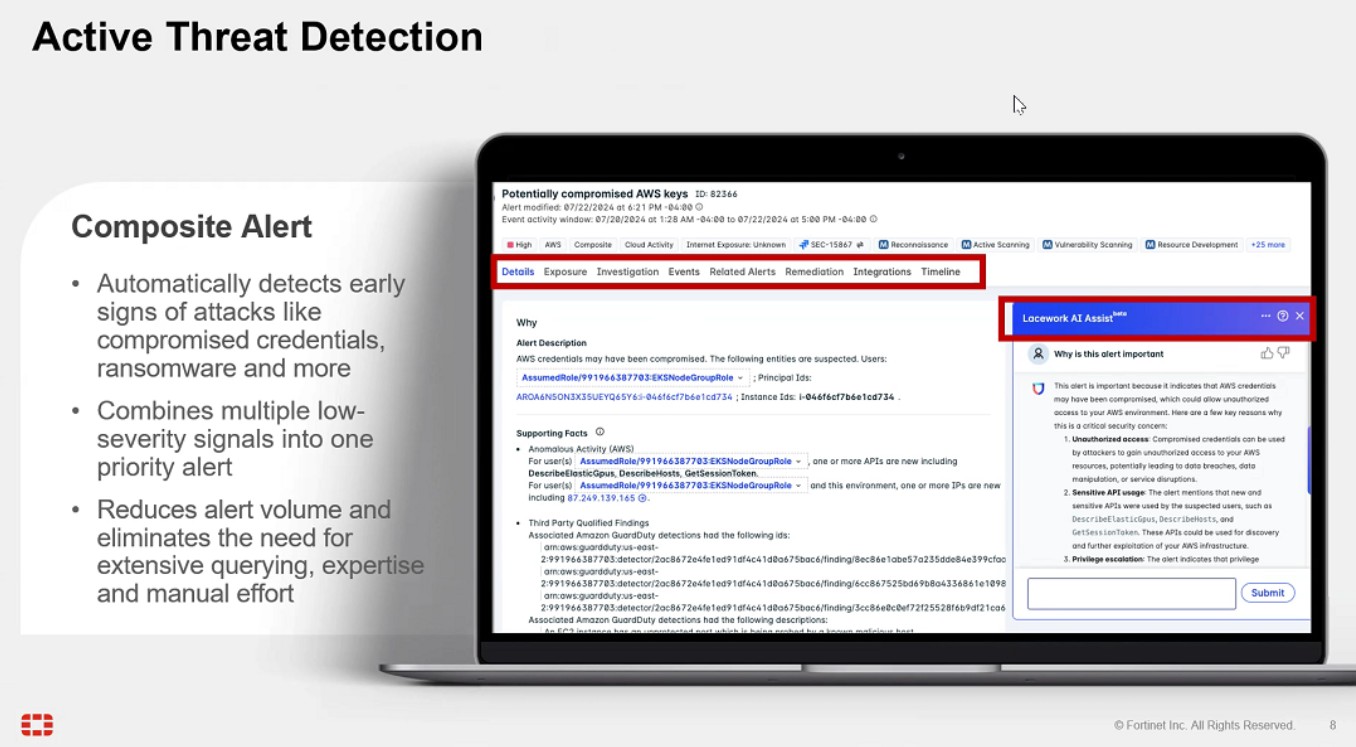
Rather than simply aggregating security data, CNAPP uses machine learning to correlate low-level signals into composite risk insights—multi-source, high-confidence threat narratives. This AI-powered threat detection helps teams separate real attacks from benign anomalies and respond faster, with fewer false positives.
Built for Security Operators: AI + Context
A standout feature is the integration of large language model (LLM) assistants into the analyst workflow. These LLMs provide pre-investigation context, explain attack chains, and suggest tailored remediation actions. It’s like having a virtual teammate triaging alerts in real-time.
CNAPP also supports:
- Software Composition Analysis (SCA) for code-level vulnerabilities
- Infrastructure monitoring for cloud misconfigurations
- Pipeline inspection for DevSecOps visibility
- Runtime protection across containers, VMs, and serverless apps
Whether identifying CVEs in Kubernetes clusters or flagging anomalies in your VPC, Fortinet delivers a holistic view of cloud risk.
Final Thoughts
As organizations scale across multi-cloud and hybrid environments, cloud-native threat detection and security automation become critical. Fortinet’s CNAPP shows what’s possible when AI meets cloud security—turning volumes of raw data into clarity, action, and real-time resilience.
Pau for now…


 Posted by Barton George
  Barton's Blog